
Review · spring · summer · fall
Outdoor Research Helium Bivy 2024 Review: Ultralight Single-Wall Shelter for Fast-and-Light Trips
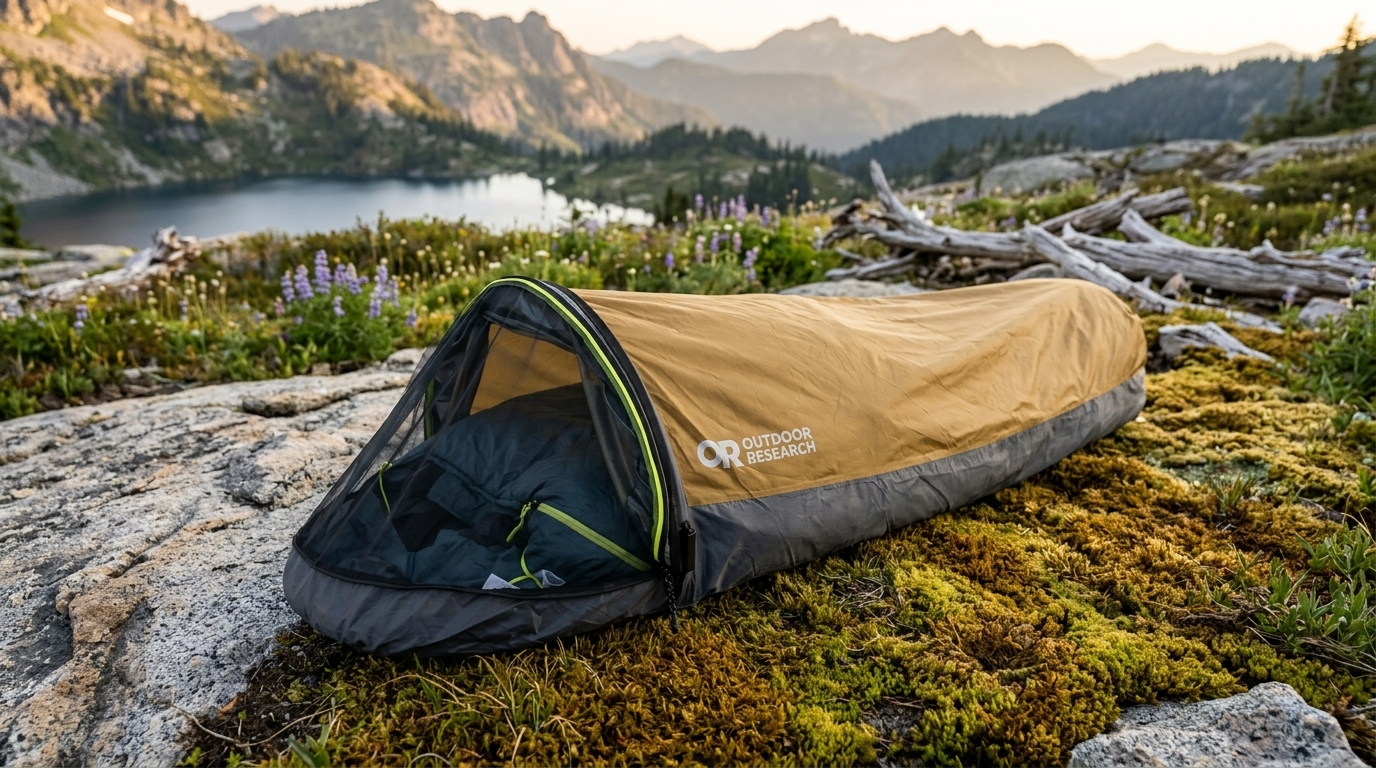
The Outdoor Research Helium Bivy 2024 is a minimalist single-wall shelter for experienced backpackers who prioritize weight savings over interior space and condensation management. At approximately 510 g (18 oz) with a clamshell mesh upper and seam-taped waterproof floor, it delivers backcountry mobility for summer alpine starts, bikepack overnights, and ultralight thru-hikes where you're willing to trade the livability of a tent for pack weight measured in grams. This is a bivy for sleepers who understand condensation physics and accept the tradeoffs of single-wall construction.
Disclosure: Four Seasons Gear is reader-supported. When you buy through links on our site, we may earn an affiliate commission at no extra cost to you. Prices and availability are accurate as of the time we last checked.
Construction and Materials
The 2024 Helium Bivy uses a seam-taped waterproof floor (likely 70D nylon with polyurethane or silicone coating, manufacturer doesn't publish exact denier) paired with a mesh upper that provides insect protection and breathability. The clamshell opening runs the length of the bivy, secured with internal fly fasteners that allow you to adjust ventilation without exiting the bag. A single hoop pole at the head end creates approximately 15–20 cm of clearance above your face, preventing direct contact with condensation on the mesh. The construction prioritizes packability: the bivy stuffs to roughly the size of a 1-liter water bottle, making it viable for bikepacking frame bags or ultralight pack side pockets.
Specs
Intended Use and Category Context
Bivies occupy a niche between tarp-and-groundsheet setups and full tents. The Helium Bivy targets solo backpackers who need insect protection and a waterproof floor but don't want the weight or bulk of a tent like the Big Agnes Copper Spur HV UL Ultralight Bikepacking Tent (which offers 1.13 kg of freestanding double-wall comfort). OutdoorGearLab's bivy sack roundups consistently note that single-wall bivies like the Helium excel in dry, cool conditions where condensation is manageable, but struggle in humid or rainy environments where moisture accumulates on the interior mesh. /r/Ultralight threads comparing the Helium to the Borah Gear side-zip bivy and the SOL Escape Bivvy highlight the Helium's balance: lighter than most hooped bivies, more breathable than emergency bags, but less condensation-resistant than tarps with separate bug netting.
This is a shelter for nights when you expect to be asleep more than awake. The internal volume is roughly 60 cm at the widest point, tapering to 45 cm at the feet—enough room for a sleeping bag and pad, but not for sitting upright, cooking, or storing gear inside. If you need to change clothes or organize your pack, you'll do it outside the bivy or in the vestibule of a tarp. The clamshell opening mitigates claustrophobia compared to side-entry bivies, but this is still a coffin-shaped shelter.
Ventilation and Condensation Management
The mesh upper provides passive airflow, and the internal fly fasteners let you partially open the clamshell to increase ventilation when rain isn't forecast. In practice, single-wall bivies accumulate condensation from body moisture: your breath and perspiration hit the cooler mesh, condense, and drip back onto your sleeping bag. Trail reports note that the Helium performs well in arid climates (Sierra Nevada, Rockies above treeline) and during cool, dry fall nights, but struggles in humid coastal ranges or during warm, muggy summer conditions. Expect to wake with damp mesh and potentially a wet footbox if you're a warm sleeper in a high-humidity environment.
Durability Considerations
The seam-taped floor construction suggests polyurethane or silicone waterproofing, both of which degrade with UV exposure and abrasion over 100+ nights. The mesh upper is no-see-um grade (approximately 500–600 holes per square inch), which resists mosquitoes and midges but can snag on sharp tent stakes or rough granite if you're careless during setup. The single hoop pole is a potential failure point: if it bends or breaks in the field, the bivy loses its head clearance and becomes a flat sack. Outdoor Research doesn't publish pole material specs (likely DAC Featherlite or similar aluminum alloy), but field repairs with a splint sleeve are straightforward. The clamshell zipper is a critical component—YKK coil zippers in this application typically last 200+ open/close cycles before teeth misalignment, but sand and grit accelerate wear. Rinse the zipper after desert trips.
Expected lifespan for a bivy in this weight class is 50–100 nights of active use before the floor coating delaminates or the mesh develops holes. This is a consumable shelter for thru-hikers, not a decade-long investment like a double-wall tent.
Value and Competitive Positioning
At $224.95, the Helium Bivy sits in the mid-range for hooped bivies. The Borah Gear Bug Bivy (approximately 170 g, $95) is lighter and cheaper but requires a separate tarp for rain protection. The Black Diamond Spotlight Bivy (approximately 595 g, $279) adds a larger vestibule and better condensation management at the cost of 85 g and $54. The Helium's value proposition is simplicity: one piece of gear that handles insects and ground moisture for roughly 500 g, with no stakes or guylines required if you're cowboy camping on stable ground.
For backpackers who already carry a tarp (and accept the setup complexity of separate bug netting), a flat bivy like the Borah Gear Side-Zip (approximately 142 g, $75) saves 368 g and $150. For those who want more interior space and better weather protection, the Big Agnes Copper Spur HV UL Ultralight Bikepacking Tent adds 620 g but provides double-wall condensation control and room to sit up. The Helium occupies the middle: lighter than a tent, more integrated than a tarp system, but with the condensation compromises of single-wall construction.
What we like
Trade-offs
Best For
- Solo ultralight backpackers targeting sub-4.5 kg base weights for summer thru-hikes
- Bikepackers needing compact shelter for dry-climate overnights (Great Divide, Arizona Trail)
- Alpine climbers on multi-day approaches where every 100 g matters and weather windows are predictable
- Minimalist campers comfortable with condensation management and cowboy camping in fair weather
- Fast-and-light backpackers who sleep efficiently and don't need interior space for gear organization
Not For
- Backpackers who need to cook, change clothes, or organize gear inside shelter during rain
- Warm sleepers or those camping in humid coastal or southeastern U.S. environments where condensation is severe
- First-time bivy users unfamiliar with single-wall shelter tradeoffs and condensation physics
- Campers who prioritize durability and expect 200+ nights from a shelter investment
- Anyone who values sitting headroom or interior storage space over weight savings
Frequently Asked Questions
+How does the Helium Bivy handle rain?
The seam-taped floor is waterproof, but the mesh upper is not. In rain, you'll need to pitch a tarp overhead or accept that the mesh will get wet (though it dries quickly). The clamshell can be partially closed to reduce rain entry, but you'll sacrifice ventilation. This is a fair-weather bivy or a bivy-plus-tarp system, not a standalone rain shelter.
+Can I fit a 25-inch-wide sleeping pad inside?
Yes. The Helium Bivy's approximately 76 cm (30 in) shoulder width accommodates standard 20-inch (51 cm) and 25-inch (64 cm) wide pads with a few centimeters of clearance. A 30-inch wide pad will be tight and may push against the mesh walls, increasing condensation contact.
+Is the single hoop pole durable enough for windy conditions?
The hoop pole is designed for face clearance, not structural wind resistance. In sustained winds above 25 mph, the pole may flex and the bivy may flatten against your face. Stake out the head and foot ends to reduce flapping. For exposed alpine ridges or desert playas with high winds, a freestanding tent or a staked tarp provides better wind performance.
+How do I minimize condensation?
Pitch with the head end elevated 10–15 cm to encourage airflow, keep the clamshell partially open when rain isn't forecast, and wipe down the interior mesh with a bandana in the morning before packing. Pair with a synthetic sleeping bag or a water-resistant quilt rather than down if you're expecting consecutive humid nights. Site selection matters: camp in breezy locations rather than sheltered valleys where cold air pools.

Read next
More from this category
REVIEW
MSR Hubba Hubba LT 2-Person Lightweight Backpacking Tent Review
REVIEW
NEMO Equipment Hornet OSMO Ultralight Backpacking Tent Review
REVIEW
Big Agnes Tiger Wall UL Ultralight Bikepacking Tent with UV-Resistant Solution Dyed Fabric Review
REVIEW
MSR Freelite 2-Person Ultralight Backpacking Tent Review
REVIEW
Coleman Sundome Camping Tent Review: Affordable 3-Season Shelter for Casual Campers
REVIEW