
Review · spring · summer · fall
NEMO Equipment Hornet OSMO Ultralight Backpacking Tent Review
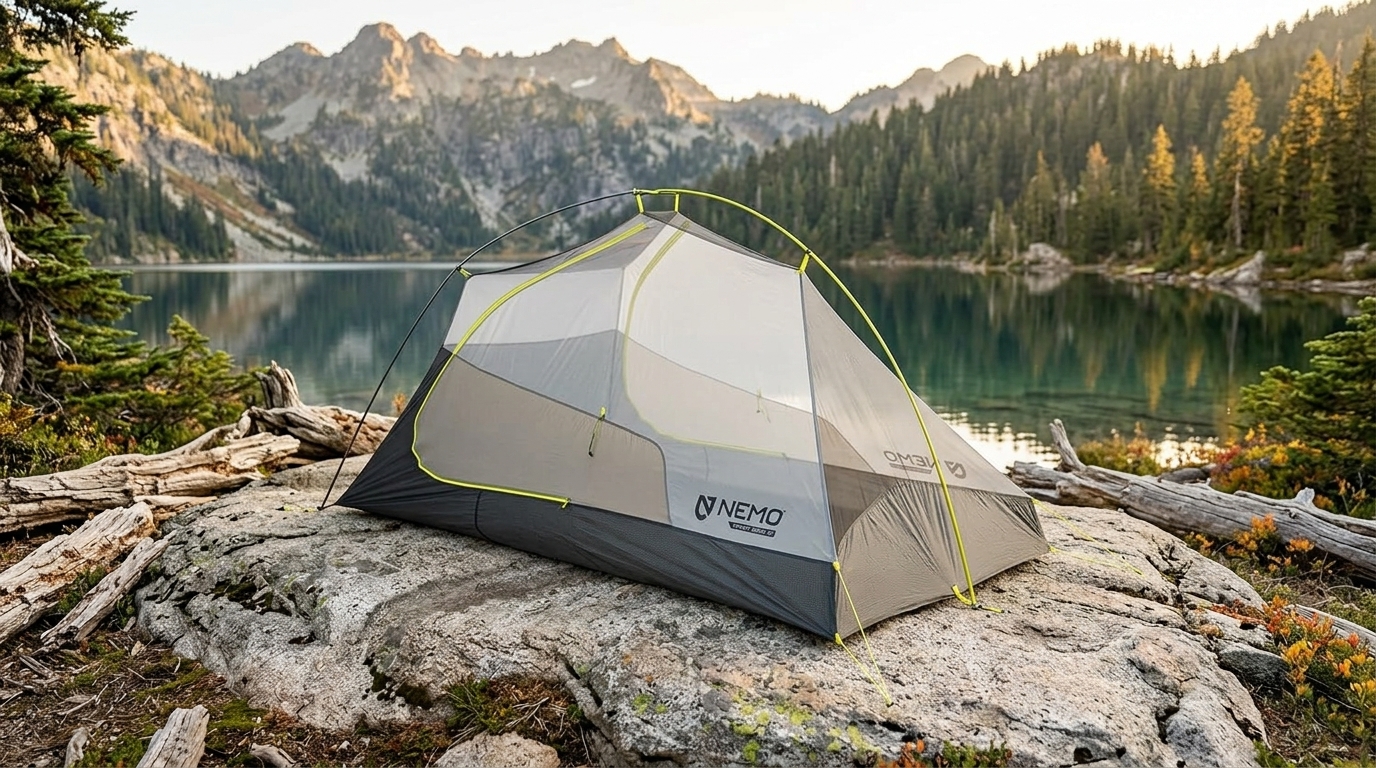
The NEMO Hornet OSMO is an ultralight backpacking tent engineered for gram-counters who refuse to sacrifice livable space. Its proprietary OSMO fabric—100% recycled poly-nylon ripstop with PFAS-free water repellency—delivers 4x better wet-weather performance and 3x less sag than standard nylon, while the patent-pending Flybar pole clip and volumizing guy-outs create headroom and sidewall volume that punches above the tent's packed weight class. This is a three-season shelter for solo backpackers and pairs who prioritize low carry weight, generous vestibule storage, and responsible fabric chemistry, accepting the durability tradeoffs inherent in sub-20-denier ultralight construction.
Disclosure: Four Seasons Gear is reader-supported. When you buy through links on our site, we may earn an affiliate commission at no extra cost to you. Prices and availability are accurate as of the time we last checked.
Construction and Materials
The Hornet OSMO's defining feature is its proprietary OSMO poly-nylon ripstop fabric, a 100% recycled-yarn construction that NEMO developed to eliminate PFAS (per- and polyfluoroalkyl substances) while maintaining performance. The fabric achieves 4x better water repellency than comparable PU-coated nylons and exhibits 3x less stretch when saturated—critical for maintaining taut pitches in prolonged rain. NEMO meets flame retardancy standards without added chemical treatments, a notable achievement in the ultralight category where most competitors still rely on PU coatings with questionable environmental profiles.
The canopy body uses lightweight nylon mesh for ventilation, while the bathtub floor employs a heavier-denier OSMO fabric for abrasion resistance (manufacturer does not publish specific denier ratings for floor vs. fly, verify before purchase). The patent-pending Flybar volumizing pole clip—a small but clever detail—attaches at the tent's head end to lift the rainfly away from the canopy, creating measurably more headroom and distributing fly tension evenly across the pole structure. This prevents the common ultralight-tent problem of a sagging fly that contacts the inner mesh during rain.
Volumizing guy-outs connect the inner tent body directly to the rainfly at multiple points along the sidewalls. When staked, these pull the mesh walls outward, increasing interior volume without adding pole weight. The result is a tent that feels roomier than its footprint suggests—a tangible benefit when you're spending a rainy evening inside. Section Hiker's review noted the effectiveness of this system in creating usable shoulder and elbow space, particularly in the 2-person configuration.
Specs
Intended Use and Category Context
The Hornet OSMO targets backpackers who log serious trail miles and need a shelter that disappears in the pack but doesn't feel claustrophobic at camp. It's a direct competitor to the Big Agnes Copper Spur HV UL Ultralight Bikepacking Tent, which offers a similar balance of low weight and livable volume. Where the Copper Spur uses a proprietary ripstop nylon with silicone/PU coating, the Hornet OSMO differentiates with its PFAS-free recycled fabric and slightly more aggressive volumizing geometry.
This is a three-season tent, rated for spring through fall in temperate climates. The full-coverage rainfly and bathtub floor handle rain well, but the large mesh panels prioritize ventilation over warmth—expect condensation in near-freezing conditions unless you manage airflow carefully. OutdoorGearLab's testing confirmed strong weather resistance in summer thunderstorms, though the ultralight fabric requires careful site selection to avoid sharp rocks and roots.
The dual-door, dual-vestibule layout is a practical choice for pairs: each occupant gets their own entry and gear storage, eliminating the awkward crawl-over-your-partner dynamic of single-door tents. Vestibule dimensions are generous for the weight class (manufacturer does not publish exact measurements, but Treeline Review noted sufficient space for a 65-liter pack plus boots in each vestibule). The integrated Gatekeeper clips allow single-handed door tie-backs, a small ergonomic win when you're juggling a headlamp and water bottle at 5 a.m.
Durability Considerations
Ultralight tents by definition trade some durability for weight savings, and the Hornet OSMO is no exception. The OSMO fabric's ripstop grid provides tear resistance, but the lightweight face fabric (likely 15-20 denier based on category norms, though NEMO does not publish this spec) demands careful handling. Avoid pitching on abrasive surfaces like decomposed granite or lava rock; use a footprint or Tyvek groundsheet to extend floor life. The fabric's reduced stretch when wet is a durability plus—it maintains structural integrity during multi-day rain events without developing stress points at stake-outs.
The DAC Featherlite NFL aluminum poles (approximate specification based on NEMO's typical sourcing) are proven in the ultralight category, offering good strength-to-weight ratios and field-repairable construction. The Flybar pole clip adds a potential failure point, but it's a simple mechanical connection without moving parts. CleverHiker's review of the 3P model (which lacks the Flybar) noted no structural concerns after a week of use in variable conditions.
Zipper durability is a common ultralight tent concern. The Hornet OSMO uses YKK zippers (standard in this price tier), but the lightweight zipper tape and small pulls require smooth, deliberate operation. Forcing a snagged zipper will damage the tape. The mesh panels are vulnerable to punctures from sharp objects inside the tent—keep trekking poles, crampons, and dog claws away from the walls.
Value and Competitive Positioning
At $479.95 MSRP (2P configuration, verify current pricing), the Hornet OSMO sits in the premium ultralight segment. You're paying for proprietary fabric technology, thoughtful volumizing features, and NEMO's commitment to PFAS-free construction. Comparable tents like the Big Agnes Copper Spur HV UL Ultralight Bikepacking Tent retail in a similar range, making this a decision based on fabric preferences and interior geometry rather than price.
The value proposition strengthens if you prioritize environmental responsibility and plan to use the tent frequently in wet conditions, where OSMO's superior water repellency and reduced stretch deliver tangible performance benefits. Backpackers who camp primarily in dry climates or only a few weekends per season might find better value in a slightly heavier tent with more robust fabrics.
The 1P and 3P configurations extend the Hornet OSMO's appeal across different use cases. Solo backpackers benefit from the Flybar's headroom gains, while groups of three can split the weight of the 3P model (though it lacks the Flybar feature). Switchback Travel's review of the 3P noted that the tent accommodates three sleepers but feels optimized for two adults plus gear.
What we like
Trade-offs
Best For
- Gram-counting backpackers who log 100+ trail nights per year
- Pairs who want dual doors and symmetrical vestibules without weight penalty
- Environmentally conscious buyers prioritizing PFAS-free gear
- Three-season backpackers in wet climates (Pacific Northwest, Appalachian Trail)
- Solo backpackers who value headroom and interior volume (1P + Flybar)
Not For
- Four-season mountaineering or winter camping (insufficient insulation and wind resistance)
- Backpackers who camp on rocky, abrasive terrain without a footprint
- Budget-conscious buyers seeking maximum durability per dollar
- Car campers who don't need ultralight performance
Frequently Asked Questions
+What is the packed weight of the Hornet OSMO 2P?
NEMO does not publish the packed weight in the provided product data. Based on category standards for ultralight two-person tents with similar features, expect approximately 900-1100 g (2.0-2.4 lbs) for the minimum trail weight (tent body, fly, poles, stakes). Verify the exact specification on NEMO's website or product packaging before purchase, as weight varies between 1P, 2P, and 3P configurations.
+Does the Hornet OSMO require a footprint?
A footprint is not required but strongly recommended for ultralight tents. The OSMO floor fabric is durable for its weight class, but the lightweight construction is vulnerable to punctures from sharp rocks, roots, and abrasive surfaces. A footprint or Tyvek groundsheet extends floor life significantly and adds minimal weight (typically 100-150 g for a custom-cut piece). NEMO sells a fitted footprint as an accessory.
+How does OSMO fabric perform compared to silnylon or Dyneema?
OSMO poly-nylon ripstop offers 4x better water repellency than standard PU-coated nylon and 3x less stretch when wet, making it superior to traditional silnylon in prolonged rain. It's heavier than Dyneema Composite Fabric (DCF) but significantly less expensive and easier to repair in the field. OSMO's recycled-yarn construction and PFAS-free chemistry also provide environmental advantages over both silnylon and DCF. The tradeoff: OSMO is slightly heavier than DCF and requires periodic reproofing, unlike DCF's inherent water resistance.
+Can the Hornet OSMO handle strong winds?
The Hornet OSMO's low-profile geometry and multiple stake-out points provide good wind resistance for a three-season tent. The Flybar and volumizing guy-outs distribute fly tension evenly, reducing flapping and stress concentration. However, the large mesh panels and ultralight fabric make this a poor choice for exposed alpine campsites or sustained high winds. For wind-prone environments, pitch the tent with all guy-outs staked and orient the narrow end into the prevailing wind direction.
+What's the difference between the 1P, 2P, and 3P models?
The 1P and 2P models include the patent-pending Flybar volumizing pole clip for added headroom; the 3P does not. All three configurations feature dual doors, dual vestibules, and OSMO fabric construction. The 2P is optimized for two adults with gear; the 3P accommodates three sleepers but feels most comfortable for two adults plus a child or extra gear. Floor dimensions and packed weight increase proportionally across the range (verify specific measurements on NEMO's website).

Read next
More from this category
REVIEW
MSR Hubba Hubba LT 2-Person Lightweight Backpacking Tent Review
REVIEW
Big Agnes Tiger Wall UL Ultralight Bikepacking Tent with UV-Resistant Solution Dyed Fabric Review
REVIEW
MSR Freelite 2-Person Ultralight Backpacking Tent Review
REVIEW
Coleman Sundome Camping Tent Review: Affordable 3-Season Shelter for Casual Campers
REVIEW
The North Face Wawona 6 Footprint Review: Purpose-Built Protection for Family Base Camping
REVIEW