
Review · spring · summer · fall
MSR Hubba Hubba LT 2-Person Lightweight Backpacking Tent Review
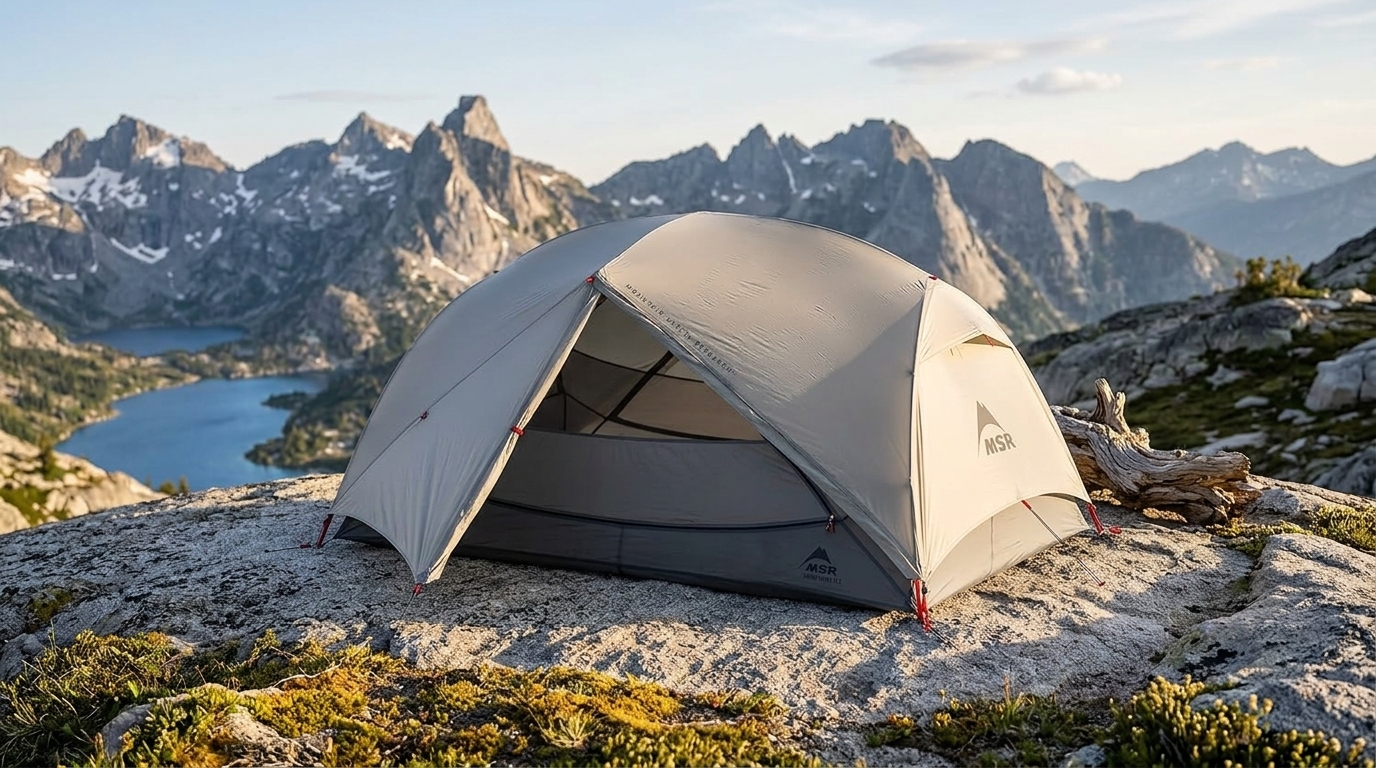
The MSR Hubba Hubba LT targets backpackers seeking a balance between livability and packability in the 3-pound class. Its rectangular floor plan accommodates modern thick sleeping pads, the mostly-mesh body maximizes ventilation, and the unified hub system simplifies setup. At 3 lbs minimum trail weight (1.36 kg), it sits between ultralight shelters and heavier expedition tents, trading some weight savings for interior volume and creature comforts like gear lofts and dual vestibules. Section Hiker's review and Treeline Review both highlight the tent's exceptional headroom and pad compatibility, while Clever Hiker notes the solution-dyed fabrics reduce environmental impact without compromising performance.
Disclosure: Four Seasons Gear is reader-supported. When you buy through links on our site, we may earn an affiliate commission at no extra cost to you. Prices and availability are accurate as of the time we last checked.
Construction and Materials
The Hubba Hubba LT uses 100% solution-dyed ripstop nylon for the rainfly, floor, and mesh panels. Solution dyeing integrates pigment during fiber extrusion rather than applying dye afterward, reducing water consumption by approximately 90% and energy use by roughly 60% compared to conventional piece-dyeing. The process also improves colorfastness—solution-dyed fabrics resist UV fading more effectively than traditionally dyed materials.
MSR specifies DAC NFL (Next Generation Featherlight) aluminum poles, which use 7001-T6 aluminum alloy with thinner wall thickness than standard tent poles. The unified hub architecture consolidates pole junctions into a single central hub, reducing setup complexity and eliminating the need to thread multiple pole segments through sleeves. The pole system is symmetrical, meaning either end can be inserted first without affecting pitch geometry.
Specs
The rainfly incorporates StayDry doors—vestibule entries with integrated rain gutters that channel water away from the zipper track. Two kickstand vents at opposite ends of the fly create cross-ventilation pathways, helping mitigate condensation during humid nights. The mostly-mesh body maximizes breathability; mesh coverage extends from the floor to near the peak on all walls, with solid fabric panels only at critical stress points and the bathtub floor.
Intended Use and Livability
MSR designed the Hubba Hubba LT for backpackers who prioritize interior volume and pad compatibility over absolute minimum weight. The true rectangular floor plan measures 52 inches wide—sufficient for two 25-inch-wide sleeping pads with a few inches of clearance. Section Hiker's review specifically praises the tent's ability to accommodate pads over 4 inches thick, a consideration for side sleepers using insulated air mattresses like the Therm-a-Rest NeoAir XTherm or Sea to Summit Ether Light XT.
The 40-inch peak height and nearly vertical sidewalls create usable volume throughout the tent rather than concentrating headroom at the center. Treeline Review notes that the vertical architecture allows occupants to sit upright without pressing against the mesh walls, a practical advantage during extended rain events when you're confined to the tent for hours. Internal organization includes a gear loft (suspended mesh shelf for small items), end pockets with cable ports for routing headlamp cords or charging cables, and a clothesline for drying damp gear.
At 3 lbs minimum trail weight, the Hubba Hubba LT falls into the lightweight category rather than ultralight. For context, the Big Agnes Copper Spur HV UL Ultralight Bikepacking Tent achieves a similar floor area at approximately 2 lbs 8 oz, sacrificing some vestibule space and interior height. The Hubba Hubba LT's extra 8 ounces buys more livable volume and larger vestibules—each vestibule provides enough space for a 50-liter backpack plus boots.
Setup and Packability
The unified hub system reduces setup time to approximately 3-4 minutes for experienced users. The symmetrical pole configuration eliminates the need to identify specific pole ends or orientations—you simply clip the pole feet into grommets at opposite corners, insert the hub into the tent body's central attachment point, and stake out the corners. Clever Hiker's review emphasizes that the symmetrical design prevents the common frustration of discovering you've oriented the tent backward after staking three corners.
Packed dimensions of 20 × 5.5 inches allow the tent to fit horizontally in most backpack bottom compartments or lash externally to the pack body. The 51 cm length exceeds the internal height of some ultralight packs (which may have 45-48 cm torso lengths), so vertical packing inside the main compartment may require a pack with at least 60 liters of volume. Splitting components between partners—one carries the tent body and poles (approximately 2 lbs), the other carries the rainfly and stakes (approximately 1 lb)—is a common strategy for duo backpackers.
Durability Considerations
Solution-dyed ripstop nylon provides inherent UV resistance, but the manufacturer doesn't publish denier specifications for the floor or canopy fabrics. Typical 3-season backpacking tents in this weight class use 15-20 denier floor fabric and 10-15 denier canopy fabric. Without published specs, buyers should assume the floor requires a footprint or groundsheet when camping on abrasive surfaces like decomposed granite or volcanic rock. The bathtub floor design extends waterproof fabric 4-6 inches up the sidewalls (exact height not specified), creating a barrier against ground moisture and splash.
DAC NFL poles use thinner walls than standard 8.5mm poles, trading some impact resistance for weight savings. The aluminum alloy resists permanent deformation under normal loading, but sharp impacts (dropping a rock on a pole segment, stepping on a pole while packing) can dent or crease the tubing. MSR doesn't publish a pole diameter specification, but DAC NFL poles typically measure 8.7-9.0mm in diameter. Carry a pole repair sleeve—a 4-inch aluminum tube that slides over a cracked pole segment—as standard practice on multi-day trips.
The mostly-mesh body maximizes ventilation but provides minimal wind protection when used without the rainfly. On exposed ridgelines or alpine campsites above treeline, wind can buffet the mesh walls and create a noisy, drafty interior. The tent is rated for 3-season use (spring, summer, fall), meaning it's designed for temperatures above freezing with minimal snow loading. For shoulder-season trips where overnight temperatures drop below 25°F, consider a 4-season tent with more solid fabric panels and stronger pole architecture.
Value and Category Context
At $549.95 MSRP, the Hubba Hubba LT sits in the premium segment of the 2-person backpacking tent market. The price reflects DAC pole technology, solution-dyed fabrics, and MSR's warranty support. Section Hiker's review notes that the tent competes directly with the Big Agnes Copper Spur HV UL series (typically $499-$579 depending on model year) and the Nemo Dagger ($479-$529), both of which offer similar floor areas and 3-season ratings.
The value proposition centers on livability—the rectangular floor, vertical walls, and 40-inch peak height create more usable interior volume than dome-style tents with similar footprints. For backpackers who spend extended periods inside the tent due to weather or early darkness at high latitudes, the extra headroom and elbow space justify the cost. Budget-conscious buyers seeking similar floor area at lower weight can consider the Big Agnes Copper Spur HV UL Ultralight Bikepacking Tent, which typically retails $50-$100 less and weighs 8 ounces lighter, though with slightly smaller vestibules.
MSR's warranty covers manufacturing defects for the tent's lifetime (defined as the original owner's period of use), and the company maintains a repair service for damaged poles, torn fabric, and broken zippers. Replacement pole segments, stakes, and guylines are available through MSR's website and authorized dealers, a practical consideration for long-term ownership.
What we like
Trade-offs
Best For and Not For
The Hubba Hubba LT serves backpackers who value interior comfort and don't require ultralight minimalism. It's particularly well-suited for taller users (over 6 feet), side sleepers using thick insulated pads, and partners who appreciate elbow room during multi-day trips.
- Backpackers prioritizing livability over absolute minimum weight
- Tall users (6'+ height) needing full-length sleeping space without diagonal positioning
- Side sleepers using thick (4+ inch) insulated air mattresses
- Partners sharing a tent who want separate vestibule access and storage
- 3-season backpackers in humid climates where condensation management is critical
- Environmentally-conscious buyers valuing solution-dyed fabrics
The tent is less suitable for gram-counting ultralight backpackers, solo users who don't need 2-person capacity, or mountaineers requiring 4-season snow protection.
- Ultralight backpackers targeting sub-2.5 lb shelter weights
- Solo backpackers (the 1-person Hubba NX would be more appropriate)
- Mountaineers needing 4-season snow-loading capacity
- Budget buyers with hard limits under $400
- Minimalists who pack inside small-volume ultralight packs (under 50 liters)
Frequently Asked Questions
+Does the Hubba Hubba LT require a footprint?
MSR doesn't publish floor denier specifications, so a footprint is recommended when camping on abrasive surfaces like decomposed granite, volcanic rock, or areas with sharp sticks. The bathtub floor design provides some protection by extending waterproof fabric up the sidewalls, but a footprint extends the floor's lifespan and simplifies cleanup. MSR sells a fitted footprint (approximately 6-8 oz), or you can cut a Tyvek sheet to match the tent's floor dimensions.
+How does the Hubba Hubba LT compare to the Big Agnes Copper Spur HV UL for weight and livability?
The Hubba Hubba LT weighs 3 lbs minimum trail weight versus the Big Agnes Copper Spur HV UL Ultralight Bikepacking Tent at approximately 2 lbs 8 oz—an 8-ounce difference. The Hubba Hubba LT provides larger vestibules (enough space for 50-liter packs) and slightly more headroom due to its 40-inch peak height and vertical walls. The Copper Spur uses a more tapered floor and lower peak height to save weight, which may feel more cramped for taller users or those with thick sleeping pads. Both tents use premium pole systems (DAC NFL vs. DAC Featherlite) and offer similar durability.
+Can the Hubba Hubba LT handle condensation in humid environments?
The mostly-mesh body maximizes airflow, and the two kickstand vents on the rainfly create cross-ventilation pathways. Section Hiker's review and Clever Hiker both note that the tent manages condensation well compared to tents with more solid fabric panels. However, no tent eliminates condensation entirely in humid conditions—opening both vestibule doors partially (if rain permits) and wiping down the fly interior in the morning are standard practices. The solution-dyed mesh resists moisture absorption better than traditionally dyed fabrics, reducing the clammy feel when condensation does occur.
+What's the minimum trail weight versus packed weight?
MSR specifies 3 lbs (1.36 kg) minimum trail weight, which typically includes the tent body, rainfly, and poles—the essential components for a functional shelter. Packed weight (not published) adds stakes, guylines, stuff sacks, and repair materials, usually totaling 3.5-4 lbs. Minimum trail weight reflects the lightest configuration for experienced backpackers who may substitute lighter stakes or leave non-essential guylines at home. First-time users should plan for packed weight when calculating base weight.
+Is the tent freestanding?
Yes, the unified hub and pole system creates a freestanding structure—the tent stands upright without stakes, allowing you to pick it up and reposition it after initial setup. However, staking the corners and guylines is essential for wind stability and proper rainfly tensioning. The freestanding design is advantageous on hard surfaces (rock slabs, wooden platforms) where staking is difficult, though you'll need to weight the tent with rocks or gear in windy conditions.
Final Thoughts
The MSR Hubba Hubba LT delivers on its promise of essential features in a lightweight package, though 'lightweight' here means 3 lbs rather than sub-2-lb ultralight territory. The rectangular floor, 40-inch peak height, and mostly-mesh construction create a livable interior that justifies the weight for backpackers who spend significant time inside the tent. Solution-dyed fabrics and DAC NFL poles reflect MSR's focus on environmental responsibility and premium materials. At $549.95, the tent competes with the Big Agnes Copper Spur HV UL Ultralight Bikepacking Tent and Nemo Dagger, offering more vestibule space and headroom in exchange for a few extra ounces. For backpackers prioritizing comfort over gram-counting, the Hubba Hubba LT represents a well-engineered balance of livability, packability, and 3-season versatility.

Read next
More from this category
REVIEW
NEMO Equipment Hornet OSMO Ultralight Backpacking Tent Review
REVIEW
Big Agnes Tiger Wall UL Ultralight Bikepacking Tent with UV-Resistant Solution Dyed Fabric Review
REVIEW
MSR Freelite 2-Person Ultralight Backpacking Tent Review
REVIEW
Coleman Sundome Camping Tent Review: Affordable 3-Season Shelter for Casual Campers
REVIEW
The North Face Wawona 6 Footprint Review: Purpose-Built Protection for Family Base Camping
REVIEW