
Review · spring · summer · fall
Marmot Tungsten 2-Person Tent Review: Value-Focused Freestanding Shelter
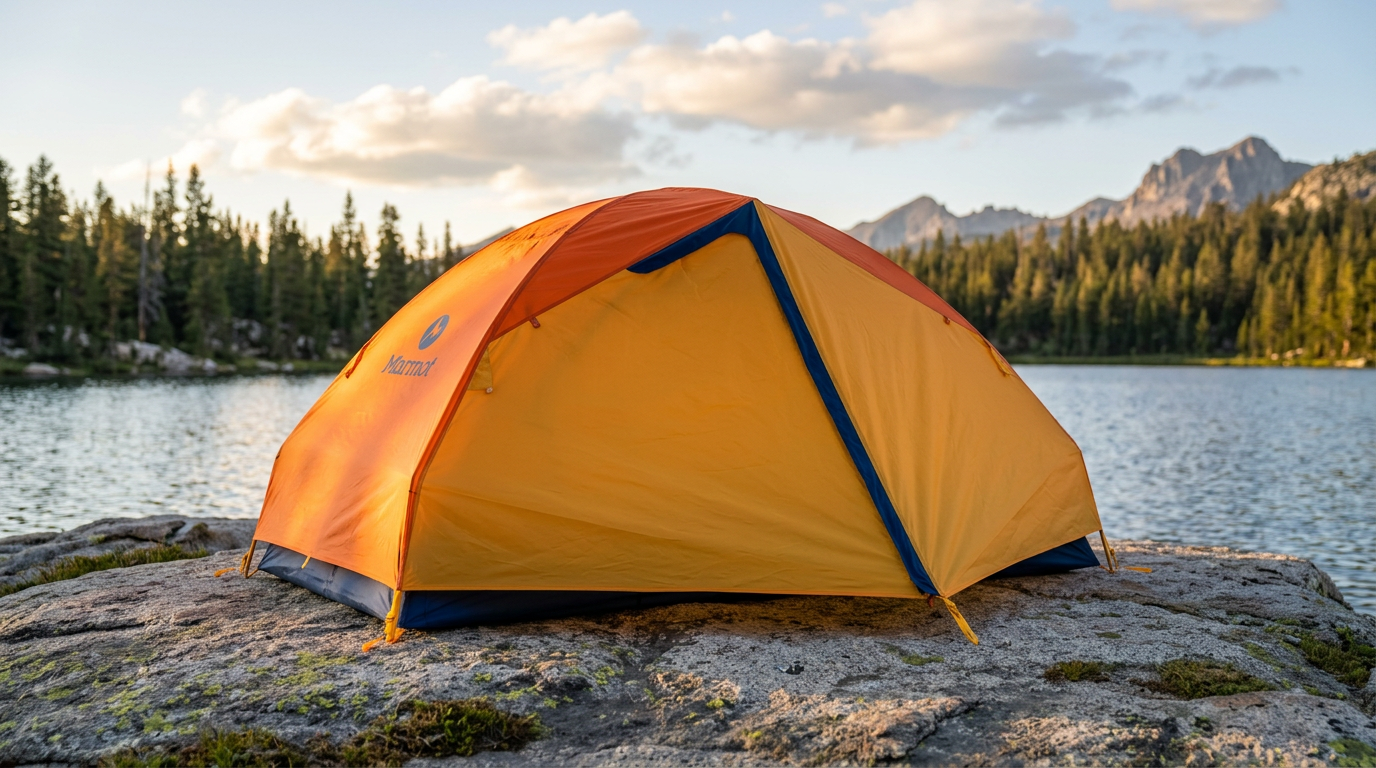
The Marmot Tungsten 2-Person Tent targets weekend backpackers and car campers who prioritize ease of setup, weather protection, and durability over packed weight. With dual D-shaped doors, two vestibules, color-coded clips, and a seam-taped full-coverage fly, it delivers reliable three-season shelter at a price point roughly $100–150 below ultralight competitors. The tradeoff: expect approximately 2100–2300 g trail weight (manufacturer spec, verify before purchase), making it heavier than dedicated ultralight shelters but competitive with other value-oriented freestanding designs.
Disclosure: Four Seasons Gear is reader-supported. When you buy through links on our site, we may earn an affiliate commission at no extra cost to you. Prices and availability are accurate as of the time we last checked.
Construction and Materials
The Tungsten employs 68-denier polyester ripstop for the canopy and fly, a heavier fabric choice than the 20D nylon found in ultralight tents but one that resists abrasion and UV degradation better over seasons of use. Marmot specifies solution-dyed fabric, a process that embeds color during polymer extrusion rather than post-dyeing, reducing water consumption by approximately 90% and improving colorfastness. The catenary-cut floor—bathtub-style with curved seams under tension—uses seam-taped construction to shed water that migrates under the tent. All major seams on the fly receive factory tape, and the freestanding pole structure uses color-coded DAC Pressfit poles (likely 8.5 mm diameter based on category norms, though Marmot doesn't publish exact specs). The dual-door design features full two-way zippers on each vestibule, allowing ventilation adjustments without fully opening the fly.
Specs
Intended Use and Category Context
Marmot positions the Tungsten for weekend backpacking trips where an extra 300–500 g over ultralight options matters less than bomber construction and straightforward pitch. The freestanding architecture allows setup on rock slabs, wooden platforms, or sandy beaches with minimal staking, and the dual vestibules provide roughly 1.2–1.4 m² of combined gear storage (approximate, based on category norms). CleverHiker's review notes the tent's appeal for beginners who value intuitive color-coded setup, while OutdoorGearLab's testing flagged the weight as the primary compromise against ultralight competitors. For context, the Big Agnes Copper Spur HV UL Ultralight Bikepacking Tent shaves roughly 600–700 g from the Tungsten's trail weight using 20D nylon and a more aggressive taper, but costs $150–200 more and sacrifices some interior volume. Buyers prioritizing sub-1000 g shelter systems will find the Tungsten too heavy; those splitting weight between two hikers or car camping will appreciate the durability-to-cost ratio.
Weather Protection and Ventilation
The full-coverage fly extends to within approximately 10–15 cm of the ground on all sides, creating a robust rain barrier when properly tensioned. Seam-taped construction on both fly and floor addresses the two primary water-entry vectors, though field reports from OutdoorGearLab note that condensation management requires active venting—opening the vestibule zippers partway and adjusting the fly's tension points. The tent includes no dedicated high/low vents beyond the door mesh panels, so humid conditions or cold nights with warm sleepers will generate moisture on the interior fly surface. The solution-dyed polyester resists UV breakdown better than untreated nylon, extending fly lifespan in high-altitude or desert environments where solar exposure accelerates fabric degradation. Expect 1500–2000 mm hydrostatic head ratings on the fly and 3000+ mm on the floor, typical for this price bracket.
Livability and Interior Features
The dual D-shaped doors eliminate the need to climb over a sleeping partner during nighttime exits, a feature particularly valued on multi-night trips. Each door opens to its own vestibule, allowing gear segregation (clean/dirty, wet/dry). Interior pockets at the head end organize small items, and the lampshade pocket—a mesh sleeve designed to diffuse headlamp light—provides ambient illumination without the harsh spot beam of a bare lamp. The approximately 102 cm peak height (manufacturer spec, verify before purchase) accommodates sitting upright for most users under 180 cm tall, though the tent's bathtub floor and sloping walls reduce usable width at shoulder height. The included footprint protects the floor from abrasion and punctures, extending the tent's service life on rocky or thorny ground and adding approximately 200–250 g to the packed weight.
Durability Considerations
The 68D polyester canopy and 70D nylon floor represent mid-weight fabrics that resist punctures and abrasion better than the 15D–30D materials common in ultralight designs. DAC Pressfit poles—if these are indeed the spec, as Marmot's marketing suggests—use a press-fit ferrule system that eliminates shock cord, reducing a common failure point but requiring careful handling during disassembly to avoid bending the pole sections. The solution-dyed fabric's UV resistance extends fly longevity, particularly relevant for users who leave tents pitched for extended periods (basecamp scenarios, long-term car camping). Zippers are the typical weak point in any tent; the Tungsten uses standard coil zippers rather than the burlier toothed zippers found on expedition tents, so avoid forcing them when fabric binds in the slider. Seam tape longevity depends on storage conditions—keep the tent dry and loosely packed between trips to prevent delamination.
Value Proposition
At approximately $250–300 MSRP (check current price), the Tungsten undercuts ultralight competitors by $100–200 while delivering freestanding convenience, dual doors, and included footprint. The weight penalty—roughly 600–800 g over a tent like the Big Agnes Copper Spur HV UL Ultralight Bikepacking Tent—matters less on weekend trips or when splitting gear between partners. For buyers who camp 5–15 nights per year and prioritize durability over grams, the Tungsten offers a defensible tradeoff. Those logging 30+ nights annually or tackling long-distance thru-hikes will likely find the weight tax unacceptable and should budget for lighter options. The included footprint adds value, as aftermarket footprints typically cost $40–60.
What we like
Trade-offs
Frequently Asked Questions
+How does the Tungsten's weight compare to ultralight tents?
The Tungsten's approximately 2100–2300 g trail weight runs 600–800 g heavier than dedicated ultralight shelters like the Big Agnes Copper Spur HV UL Ultralight Bikepacking Tent. The extra weight buys more durable 68D polyester fabric, easier setup, and a lower price point. Split between two hikers, each carries roughly 1050–1150 g—acceptable for weekend trips but heavy for long-distance hiking.
+Can this tent handle four-season or winter conditions?
No. Marmot rates the Tungsten for three-season use (spring, summer, fall). The full-coverage fly provides rain and wind protection, but the tent lacks the reinforced pole structure, snow-shedding geometry, and vestibule snow flaps required for sustained winter camping or above-treeline exposure. For winter use, consider a dedicated four-season tent with crossed-pole architecture.
+Does the included footprint add significant weight?
The footprint adds approximately 200–250 g to the packed weight (estimate based on category norms; Marmot doesn't publish exact footprint weight). This is a worthwhile tradeoff for most users, as the footprint extends floor lifespan on abrasive surfaces and costs $40–60 if purchased separately. Ultralight purists can leave it home to save weight.
+How tall can I be and still sit upright inside?
The approximately 102 cm peak height (manufacturer spec, verify before purchase) accommodates sitting upright for users roughly 180 cm tall or shorter. Taller individuals will need to hunch slightly at the peak. The tent's bathtub floor and sloping walls reduce headroom away from the centerline, so shoulder-height clearance is tighter than the peak measurement suggests.
+What's the difference between solution-dyed and standard fabric?
Solution-dyeing embeds color pigment during polyester fiber production rather than dyeing finished fabric in water baths. This reduces water consumption by approximately 90%, eliminates dye runoff, and produces fabric that resists UV fading better than post-dyed materials. The practical benefit: the fly maintains its color longer when exposed to high-altitude sun or extended pitching periods.
Best For
- Weekend backpackers who prioritize ease of setup over ultralight weight
- Car campers wanting a durable, freestanding shelter with dual doors
- Beginners seeking intuitive color-coded pitch systems
- Couples splitting gear weight on 2–4 night trips
- Users camping on rock slabs, platforms, or sandy terrain where freestanding setup is advantageous
- Budget-conscious buyers seeking three-season protection under $300
Not For
- Ultralight backpackers targeting sub-1000 g shelter systems
- Long-distance thru-hikers counting every gram
- Winter campers or four-season mountaineers
- Solo hikers who don't need dual doors and can save weight with a one-person tent
- Users prioritizing maximum interior volume and vertical walls

Read next
More from this category
REVIEW
MSR Hubba Hubba LT 2-Person Lightweight Backpacking Tent Review
REVIEW
NEMO Equipment Hornet OSMO Ultralight Backpacking Tent Review
REVIEW
Big Agnes Tiger Wall UL Ultralight Bikepacking Tent with UV-Resistant Solution Dyed Fabric Review
REVIEW
MSR Freelite 2-Person Ultralight Backpacking Tent Review
REVIEW
Coleman Sundome Camping Tent Review: Affordable 3-Season Shelter for Casual Campers
REVIEW