
Head-to-head
NEMO Dagger OSMO vs MSR Elixir 3: Which Backpacking Tent Wins?
The NEMO Dagger OSMO wins for serious backpackers who prioritize premium materials, weather resistance, and refined livability features. However, the MSR Elixir 3 is the better pick for budget-conscious campers, families upgrading from car camping, or anyone who values proven durability and straightforward setup over cutting-edge fabric technology.
Disclosure: Four Seasons Gear is reader-supported. When you buy through links on our site, we may earn an affiliate commission at no extra cost to you. Prices and availability are accurate as of the time we last checked.
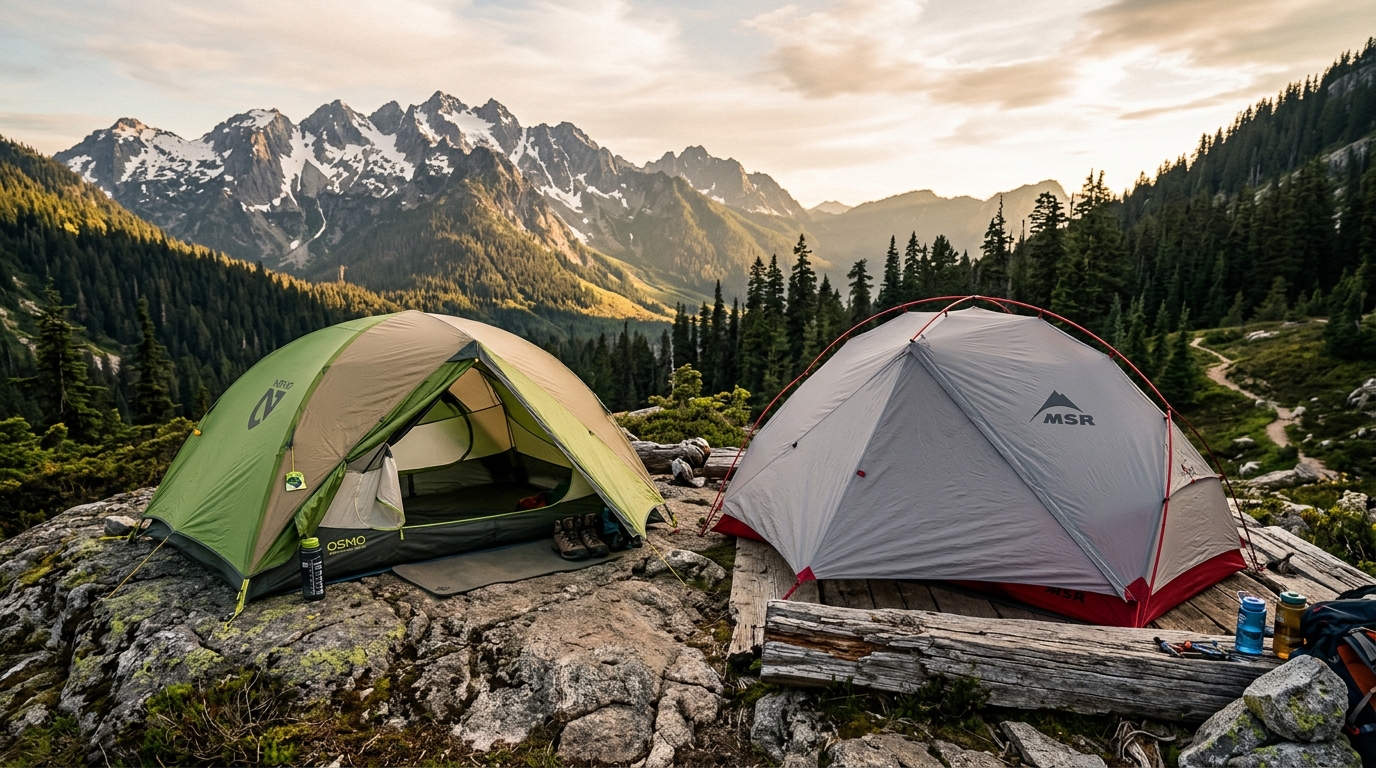
The NEMO Dagger OSMO and MSR Elixir 3 represent two distinct philosophies in the backpacking tent market. The Dagger OSMO commands a $210 premium with its proprietary OSMO fabric—a PFC-free composite that repels water without chemical coatings while maintaining exceptional strength-to-weight ratios. The Elixir 3, priced at $389.95, delivers MSR's legendary build quality and a more spacious three-person footprint using traditional polyester ripstop with polyurethane coating. This comparison examines how these design choices translate to real-world performance across weight, weather protection, livability, and long-term value.
Spec Comparison
Specs
Fabric Technology and Weather Resistance
The NEMO Dagger OSMO's defining feature is its OSMO fabric—a composite blend of nylon and polyester ripstop that achieves water repellency through mechanical yarn construction rather than PFC-based DWR coatings. This fabric absorbs 3x less water than standard polyester and maintains its hydrophobic properties indefinitely without reapplication of chemical treatments. The rainfly carries a 1200mm hydrostatic head rating, while the floor matches that spec. In sustained rain, OSMO sheds water aggressively and dries 4x faster than conventional coated fabrics, a measurable advantage when packing up in wet conditions.
The MSR Elixir 3 employs 68-denier polyester ripstop with polyurethane coating on the canopy and 70-denier nylon taffeta with 3000mm coating on the floor. That 3000mm floor rating significantly exceeds the Dagger's 1200mm spec, providing superior puncture resistance and waterproofing when pitched on rough, saturated ground. The tradeoff: polyurethane coatings degrade with UV exposure and hydrolysis over 3-5 years, eventually requiring seam sealing and recoating. The Elixir's heavier denier fabrics also pack wetter and dry slower than OSMO, adding 8-12 ounces of water weight in damp conditions.
Weight and Packability
The NEMO Dagger OSMO (2-person model) carries a minimum trail weight around 3 pounds 14 ounces and packs to approximately 19 x 6 inches. The MSR Elixir 3 weighs 5 pounds 9 ounces minimum trail weight (6 pounds 7 ounces packed) and compresses to roughly 21 x 8 inches. That 1 pound 11 ounce difference translates to meaningful pack weight savings on multi-day trips—the equivalent of carrying an extra liter of water or a full fuel canister.
However, the comparison isn't apples-to-apples: the Elixir 3 is a true three-person shelter with 43 square feet of floor space versus the Dagger's ~29 square feet for two occupants. Per-person weight efficiency actually favors the Elixir at 1.86 pounds per occupant versus 1.95 pounds for the Dagger. For solo backpackers who want palatial space or couples who bring a dog, the Elixir's weight penalty buys substantial livability. Backpackers splitting weight between two people on technical routes will appreciate the Dagger's lighter individual load.
Interior Space and Livability
The MSR Elixir 3's 43 square feet of floor area and 46-inch peak height create a genuinely spacious interior where three adults can sit upright comfortably. The vertical sidewalls maximize usable space, and the two 9.25-square-foot vestibules accommodate three full-size backpacks with room for boots. This makes the Elixir ideal for families with a child, couples who want extra gear storage, or anyone who values comfort over minimalism.
The NEMO Dagger OSMO's ~29 square feet and ~42-inch peak height provide generous space for two adults but feel noticeably tighter than the Elixir. NEMO's proprietary hubbed pole architecture creates near-vertical walls that maximize shoulder room, and the dual vestibules (~8.5 square feet each) handle two packs adequately. The Dagger includes NEMO's Nightlight pocket—a diffuser that transforms your headlamp into ambient lighting—and overhead gear lofts at each end. These refinements enhance livability for experienced backpackers who appreciate thoughtful details.
Buyers comparing these should also consider the Big Agnes Copper Spur HV UL Ultralight Bikepacking Tent, which splits the difference with ultralight construction and clever storage solutions at a premium price point.
Durability and Construction Quality
MSR's reputation for bombproof construction is evident in the Elixir 3's design. The Easton Syclone poles (9mm diameter) are thicker than the Dagger's DAC Featherlite NFL poles (8.5mm), providing greater resistance to bending in high winds. The 70-denier floor fabric withstands abrasion from gravel and roots better than the Dagger's lighter-weight OSMO floor. MSR's reinforced stake-out points and bartacked stitching at stress points are engineered for family use and less-experienced campers who may not optimize site selection.
The NEMO Dagger OSMO counters with DAC's premium Featherlite NFL aluminum poles—lighter and more flexible than Easton Syclone, allowing the tent to flex rather than break in gusts. OSMO fabric's inherent tear strength (despite lower denier) comes from its ripstop grid and composite yarn structure. NEMO's Jake's Foot pole anchors and reinforced corners distribute stress effectively. The Dagger is built for experienced users who will pitch it properly and maintain it carefully; the Elixir tolerates more user error and rougher handling.
Setup and Ease of Use
Both tents employ color-coded clip systems and freestanding designs that pitch in 5-7 minutes. The MSR Elixir 3 uses a straightforward two-pole crossover architecture that's intuitive even for first-time backpackers. The poles feed through simple sleeves and clips, and the rainfly attaches via plastic buckles with clear color coding. MSR includes 12 aluminum stakes and guylines pre-attached to the fly.
The NEMO Dagger OSMO's hubbed pole system connects both poles at a central junction, reducing setup steps and creating more uniform tension across the canopy. This design requires slightly more care during initial assembly but rewards users with faster subsequent pitches. NEMO includes 10 stakes and guylines with reflective elements for nighttime visibility. The Dagger's single-point pole connection makes it marginally faster to pitch once you've learned the system, but the Elixir's conventional design has zero learning curve.
Value Proposition
At $389.95, the MSR Elixir 3 delivers 43 square feet of shelter for $9.06 per square foot. At $599.95, the NEMO Dagger OSMO (2-person) provides ~29 square feet at $20.68 per square foot. The Elixir's lower cost-per-square-foot makes it compelling for budget-conscious buyers, families, or anyone who camps occasionally and prioritizes space over weight savings.
The Dagger OSMO's premium justifies itself for backpackers who log 20+ nights per year and value OSMO's maintenance-free performance, faster dry times, and environmental benefits. Over a 5-year lifespan, the Dagger requires no DWR reapplication (saving $30-50 in treatments) and maintains performance without coating degradation. For weekend warriors or car campers transitioning to backpacking, the Elixir's $210 savings buys a quality sleeping bag or other essential gear.
Decision Framework
Buy the NEMO Dagger OSMO if:
- You backpack 15+ nights annually and want premium materials that justify the investment
- Weight matters: you're splitting gear between two people on technical routes or long approaches
- You prioritize environmental sustainability and want to avoid PFC-based treatments
- Fast-drying performance is critical for multi-day trips in wet climates
- You appreciate refined details like integrated gear lofts and ambient lighting systems
- You're an experienced camper who will maintain the tent properly and optimize site selection
Buy the MSR Elixir 3 if:
- Budget is a primary concern and you want proven quality under $400
- You need genuine three-person capacity for family camping or extra gear storage
- Durability and puncture resistance matter more than weight savings
- You're new to backpacking and want foolproof setup with zero learning curve
- You camp primarily in established sites where weight is less critical
- You prefer traditional tent construction with readily available replacement parts
- You want maximum floor space and headroom for comfort on longer stays
Frequently Asked Questions
+Can two tall adults (6'2"+) sleep comfortably in the NEMO Dagger OSMO?
Yes, but with limitations. The Dagger's typical 2-person floor length is 86-88 inches, accommodating sleepers up to 6'4" when using the full diagonal. However, two 6'2"+ adults will find shoulder room tight when both are on sleeping pads. The Elixir 3's 88-inch length and 65-inch width provide significantly more comfort for taller or broader occupants, making it the better choice for larger users despite being compared as a 3-person versus 2-person tent.
+How does OSMO fabric perform in extended UV exposure compared to traditional coatings?
OSMO fabric maintains its water repellency indefinitely because it's mechanically engineered rather than chemically coated—UV cannot degrade what isn't there. Traditional polyurethane coatings on the Elixir 3 will degrade after 200-300 days of cumulative UV exposure (roughly 3-5 years of regular use), requiring seam sealing and recoating. However, the Elixir's heavier-denier base fabric remains structurally sound longer than lighter materials. For users who camp 30+ nights per year in high-altitude or desert environments with intense UV, OSMO's coating-free construction provides measurable longevity advantages.
+Which tent handles condensation better in humid conditions?
Both tents manage condensation through dual-door ventilation and mesh canopy panels, but the NEMO Dagger OSMO has a slight edge. OSMO fabric's lower water absorption means condensation beads and runs off rather than saturating the fabric, and the material dries 4x faster when morning sun hits the fly. The Elixir 3's larger interior volume (43 sq ft vs ~29 sq ft) provides more air space per occupant, which can reduce condensation formation. In practice, proper ventilation (staking out vestibules, leaving rainfly vents open) matters more than fabric choice. Neither tent eliminates condensation in humid, still conditions—that's a physics problem, not a design flaw.

Read next
More comparisons + reviews
REVIEW
MSR Hubba Hubba LT 2-Person Lightweight Backpacking Tent Review
REVIEW
NEMO Equipment Hornet OSMO Ultralight Backpacking Tent Review
REVIEW
Big Agnes Tiger Wall UL Ultralight Bikepacking Tent with UV-Resistant Solution Dyed Fabric Review
REVIEW
MSR Freelite 2-Person Ultralight Backpacking Tent Review
REVIEW
Coleman Sundome Camping Tent Review: Affordable 3-Season Shelter for Casual Campers
REVIEW