
Review · spring · summer · fall
AquaQuest Defender Tarp – Heavy-Duty Waterproof (20,000 mm) Seam-Taped Rain Fly for Camping, Bushcraft & Survival
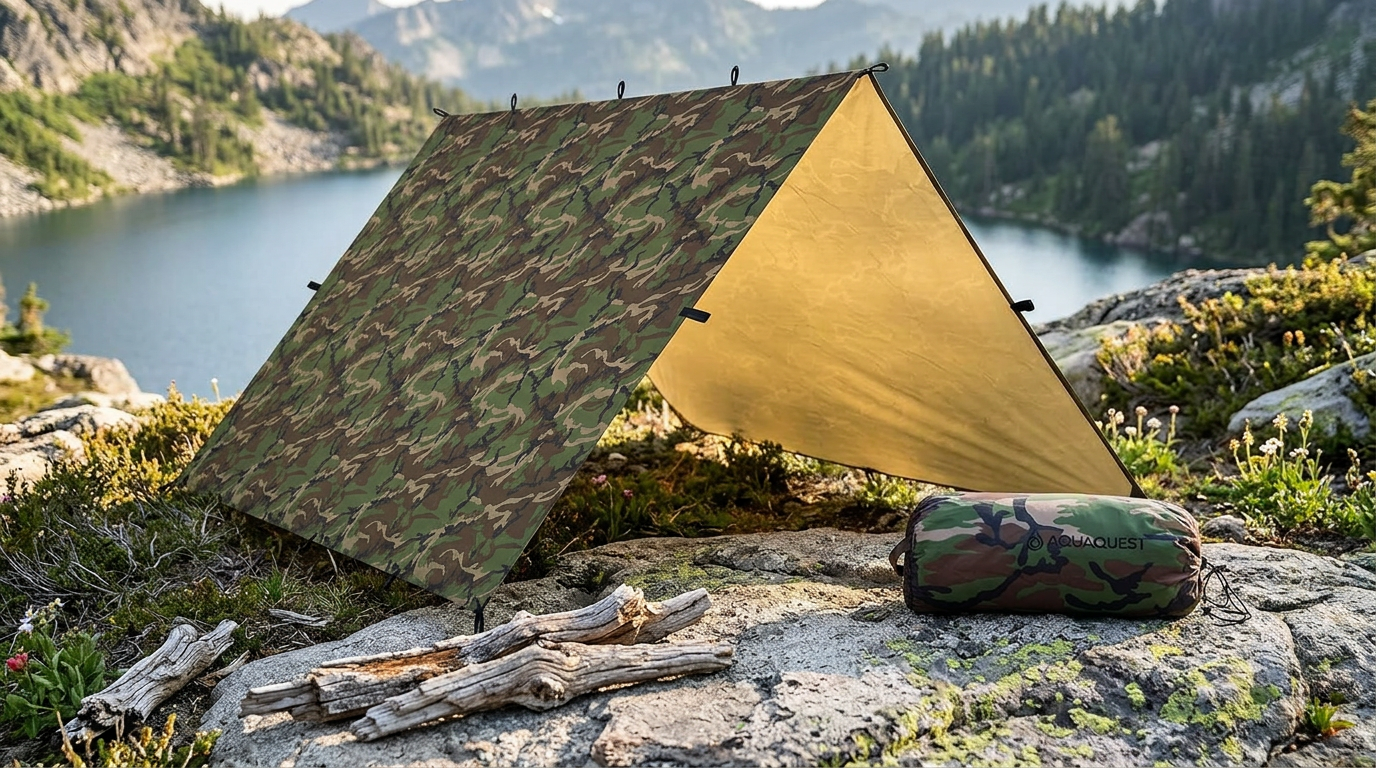
The AquaQuest Defender is a bombproof 15×15 ft tarp built for guides, rescue teams, and anyone who needs guaranteed weather protection in exposed terrain. Its 20,000 mm hydrostatic head, heat-taped seams, and 70D dual-coated nylon make it heavier (7.2 lbs) and bulkier than ultralight silnylon shelters, but that extra mass buys you multi-season durability, storm-stable pitching with 37 tie-outs, and a lifetime warranty. If your priority is a tarp that won't fail in sustained rain and wind—and you're willing to carry the weight—this is a proven workhorse.
Disclosure: Four Seasons Gear is reader-supported. When you buy through links on our site, we may earn an affiliate commission at no extra cost to you. Prices and availability are accurate as of the time we last checked.
Construction & Materials
The Defender uses 70-denier ripstop nylon with a dual-layer coating—a polyurethane base plus a second weatherproofing layer—rated to 20,000 mm hydrostatic head. That's roughly four times the waterproofness of a typical backpacking tent rainfly (3,000–5,000 mm) and puts it in the same league as mountaineering hard-shells. All seams are heat-taped from the factory, eliminating the need for field seam-sealing. Tie-out points use reinforced webbing loops bar-tacked at stress junctions, a detail borrowed from industrial and rescue rigging. The finished tarp measures 14'7" × 14'7" (215 ft² of coverage) and packs into an included stuff sack.
Specs
Intended Use & Pitch Versatility
AquaQuest markets the Defender to guides, search-and-rescue teams, and military users—contexts where gear failure isn't an option. The 37 tie-out grid (perimeter loops plus interior anchor points) supports a wide range of configurations: A-frame, lean-to, plow-point, flying diamond, or low storm pitch. The dense tie-out spacing lets you tension the fabric evenly in shifting wind, and the braced corners resist flutter. At 15×15 ft, the tarp shelters 3–4 people with gear in an A-frame or provides a large communal cooking/staging area in base-camp setups. The woodland camo pattern offers visual concealment for hunters and military users but may be less appealing for recreational campers who prefer high-visibility colors.
Unlike ultralight silnylon tarps (which often weigh 10–16 oz for a solo shelter), the Defender's 7.2 lbs makes it a poor choice for solo gram-counting backpackers. It's better suited to group trips where weight is divided, car camping, canoe/raft expeditions, or fixed camps where durability trumps packability. The stuff sack is generously sized, but the tarp's bulk still exceeds what fits comfortably in a typical 50–65 L backpack's main compartment—expect to lash it externally or dedicate a large side pocket.
Comparison Context
In the tarp market, the Defender occupies the heavy-duty end of the spectrum. A Sea to Summit Escapist 15×10 tarp (silnylon, 1 lb 6 oz) offers similar coverage at one-fifth the weight but sacrifices abrasion resistance and long-term durability. The Defender's 70D fabric and dual coating are closer to expedition-grade truck tarps than backpacking shelters. For context, the Big Agnes Copper Spur HV UL Ultralight Bikepacking Tent—a full double-wall tent—weighs 3 lbs 3 oz and includes a bathtub floor and bug netting, highlighting the Defender's weight penalty for open-tarp simplicity.
Where the Defender excels is multi-season, multi-year abuse. The dual coating resists UV degradation better than single-layer silnylon, and the 70D face fabric shrugs off branch scrapes and boot scuffs that would snag lighter fabrics. The lifetime warranty—backed by AquaQuest since 1994—signals the manufacturer's confidence in long-term performance, though users should verify warranty terms cover field wear versus manufacturing defects.
Durability Considerations
The 70D ripstop nylon face fabric is roughly twice as thick as the 30–40D fabrics common in backpacking tarps, offering better puncture and tear resistance. The dual polyurethane coating adds a second line of defense against hydrolysis (the breakdown of PU coatings in humid storage), though all PU-coated fabrics eventually degrade—store the tarp dry and loosely packed to maximize lifespan. Bar-tacked tie-outs distribute load across reinforced webbing rather than concentrating stress on a single stitch line, reducing the risk of blow-outs in high wind. Heat-taped seams eliminate the most common failure point in budget tarps (untaped or poorly sealed seams that wick water). The woodland camo dye may fade with sustained UV exposure, but this is cosmetic and doesn't affect performance.
Value & Positioning
At $269.99 (MSRP, verify current price), the Defender costs 2–3× more than entry-level poly tarps and sits in the mid-to-upper range for premium nylon tarps. The price reflects the dual-coated fabric, heat-taped seams, dense tie-out grid, and lifetime warranty. For professional users (guides, SAR teams) who expense gear and need guaranteed reliability, the cost-per-use over a decade of hard service is competitive. Recreational users should weigh whether they need the Defender's overkill waterproofing and abrasion resistance or would be better served by a lighter, cheaper tarp for occasional 3-season trips.
The 15×15 size offers excellent coverage-per-dollar compared to smaller specialty tarps, and the 37 tie-outs provide more pitch flexibility than minimalist designs. However, the weight penalty means this isn't a tarp you'll grab for a weekend solo hike—it's a basecamp/group/expedition tool.
What we like
Trade-offs
Best For
- Guides and outfitters who need bombproof group shelters for multi-day trips
- Search-and-rescue teams requiring reliable field staging areas
- Car campers and canoe/raft expeditions where weight is less critical
- Hunters and military users wanting camouflage and storm-proof coverage
- Basecamp setups where one tarp serves as communal kitchen/gear area
- Users in wet climates (Pacific Northwest, tropics) who prioritize waterproofness over weight
Not For
- Solo ultralight backpackers counting every ounce
- Thru-hikers needing sub-2-lb shelter systems
- Recreational campers who prefer high-visibility colors over camo
- Minimalist fast-packers with small pack volumes
- Budget-conscious occasional users who don't need expedition-grade durability
- Alpine/winter campers needing four-season enclosed shelters (this is a tarp, not a tent)
Frequently Asked Questions
+Does the Defender come with guylines and stakes?
No. The tarp includes a stuff sack but no cordage or stakes. You'll need to purchase approximately 150–200 feet of guyline (2–3 mm cord) and 10–15 stakes separately. Many users prefer to customize line length and stake type for their typical terrain (sand stakes for beaches, snow stakes for winter, etc.).
+How does the 20,000 mm rating compare to a typical tent rainfly?
Most 3-season backpacking tents use rainflies rated 1,500–5,000 mm, which is adequate for normal rain. The Defender's 20,000 mm rating is overkill for recreational camping but provides a large safety margin for sustained storms, driving rain, and abrasion from repeated pitching/packing. It's closer to the waterproofness of a hard-shell mountaineering jacket.
+Can I pitch the Defender as a winter shelter?
Yes, with caveats. The tarp itself handles snow load well (the 70D fabric is strong, and you can pitch it steeply to shed accumulation), but you'll need a separate ground cloth or bivy for floor protection and insulation from snow. The open design (no bug netting or enclosed walls) means you'll lose heat rapidly—pair it with a four-season sleeping bag and consider a mid-layer tarp or inner tent for warmth. The Defender is better suited to spring/summer/fall or mild-winter conditions unless you're experienced with open-tarp winter camping.
+How do I store the tarp to maximize the coating's lifespan?
Always store the Defender completely dry in a cool, dark place. Hang it loosely or roll it without compression—long-term storage in a tight stuff sack accelerates PU coating hydrolysis. Avoid prolonged exposure to direct sunlight when not in use (UV degrades coatings over years). If you notice the coating becoming sticky or flaking, it's nearing end-of-life; contact AquaQuest about warranty coverage.
+Is the woodland camo effective, or just cosmetic?
The pattern provides genuine visual concealment in forested environments—useful for hunters, wildlife photographers, and military training. However, camo is less visible to rescuers in an emergency. If you prioritize safety visibility over concealment, consider a bright-colored tarp or carry a separate signal panel.
+Can I use trekking poles to pitch the Defender, or do I need dedicated poles?
Trekking poles work for many pitches (A-frame, lean-to), but the Defender's 15×15 size and weight mean you'll want sturdy poles—adjustable aluminum or carbon poles that lock securely at 4–5 feet. Lightweight carbon poles designed for ultralight tarps may flex under the Defender's tension. For permanent or basecamp setups, dedicated adjustable tarp poles or natural anchors (trees, large rocks) are more stable.

Read next
More from this category
REVIEW
MSR Hubba Hubba LT 2-Person Lightweight Backpacking Tent Review
REVIEW
NEMO Equipment Hornet OSMO Ultralight Backpacking Tent Review
REVIEW
Big Agnes Tiger Wall UL Ultralight Bikepacking Tent with UV-Resistant Solution Dyed Fabric Review
REVIEW
MSR Freelite 2-Person Ultralight Backpacking Tent Review
REVIEW
Coleman Sundome Camping Tent Review: Affordable 3-Season Shelter for Casual Campers
REVIEW