
Review · spring · summer · fall
Osprey Stratos 36L Men's Hiking Backpack Review: Ventilated Carry for Day Hikes and Overnighters
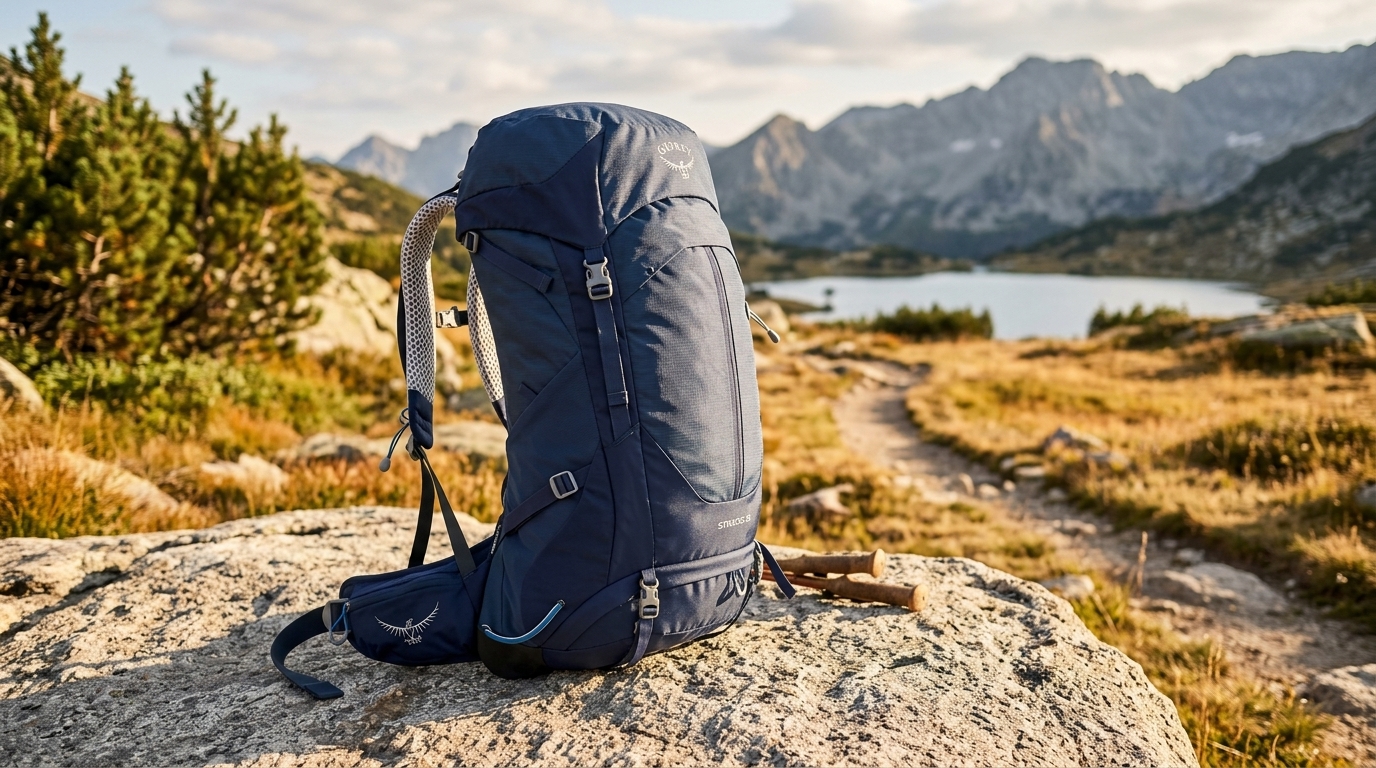
The Osprey Stratos 36L targets day hikers and weekend backpackers who prioritize ventilation and adjustable fit over ultralight minimalism. Its Airspeed suspension system uses injection-molded frames and 3D-tensioned mesh to create standoff ventilation between your back and the pack body, reducing sweat accumulation on warm-weather hikes. At 36 liters, it sits in the overlap zone: large enough for overnight gear with careful packing, roomy enough for day hikes with layers, food, and a hydration reservoir. The tradeoff is weight—Osprey's ventilated packs typically run 1,400–1,600 g in this size class, heavier than frameless ultralight alternatives but justified if you value airflow and load distribution on longer approaches.
Disclosure: Four Seasons Gear is reader-supported. When you buy through links on our site, we may earn an affiliate commission at no extra cost to you. Prices and availability are accurate as of the time we last checked.
Construction and Suspension System
The Stratos 36L employs Osprey's Airspeed suspension architecture: an injection-molded plastic framesheet tensioned with mesh that creates a 2–3 cm air gap between the pack body and your back. This design prioritizes ventilation over direct contact, allowing convective cooling on ascents. The frame geometry extends taller and wider than previous Stratos generations, accommodating a broader range of torso lengths through Osprey's molded ladder adjustment system—you slide the harness up or down seven indexed positions without tools.
The pack body uses Osprey's standard nylon blend (likely 210D or 420D high-wear zones, though the manufacturer doesn't publish exact deniers for this model). The included raincover stows in a bottom zippered pocket, a practical feature for sudden weather changes. The top-loading design uses a floating lid with a drawcord closure under the lid, a time-tested configuration that accommodates variable loads but sacrifices the quick access of panel-loaders.
Specs
Intended Use and Capacity Context
Thirty-six liters occupies the versatile middle ground: too large for minimalist daypacks, slightly small for multi-night trips unless you pack efficiently. This volume suits overnight trips in three-season conditions when you're carrying a compact sleeping bag, lightweight shelter (like the Big Agnes Copper Spur HV UL Ultralight Bikepacking Tent), and a stove such as the MSR PocketRocket 2 Stove. For day hikes, 36L provides ample room for layers, lunch, a Sawyer Squeeze Water Filter System or hydration reservoir, and safety gear like the Garmin inReach Mini 2 Satellite Communicator without feeling cavernous.
The internal hydration sleeve accommodates 2–3 liter reservoirs with a hose port routed through the backpanel, keeping the hose accessible and protected. Side stretch pockets hold water bottles (Nalgene 32 oz Wide Mouth Water Bottle or Hydro Flask Water Bottle — 32 oz Wide Mouth Flex Lid fit easily), and the lid pocket organizes small items—headlamp, snacks, sunscreen.
Ventilation Performance and Fit Adjustability
The Airspeed system's standoff mesh delivers measurably better airflow than body-contact designs, particularly noticeable on climbs above 15°C. The tradeoff: the pack rides slightly farther from your center of gravity, which can feel less stable on technical terrain compared to frameless or body-hugging designs. Osprey compensates with a wide hipbelt and load-lifter geometry that pulls the load forward, but this pack is optimized for trail hiking rather than scrambling.
The molded ladder torso adjustment spans approximately 10 cm of range, fitting most male torsos from 43–53 cm (measure C7 vertebra to iliac crest). This adjustability is a key differentiator—many fixed-torso packs in this price range force you to choose S/M/L sizing upfront. The wider frame geometry accommodates broader shoulders without pressure points.
Durability Considerations
Osprey's nylon fabrics typically balance abrasion resistance with weight, though without published denier specs we estimate 210D body fabric with 420D reinforcements at wear points (bottom panel, shoulder strap attachment zones). The injection-molded plastic frame components are robust but not field-repairable if cracked—a consideration for remote trips. The zippers appear to be YKK or equivalent coil construction; the raincover's storage pocket zipper sees frequent use and represents a potential long-term wear point.
The 3D-tensioned mesh is durable under normal use but can snag on sharp branches or rock edges. Osprey's All Mighty Guarantee covers manufacturing defects and offers repair services, which extends practical lifespan. Expected service life for moderate use (30–50 days/year) is 5–8 years before mesh or fabric shows significant wear.
Value Positioning
At approximately $193 USD, the Stratos 36L competes with Gregory Zulu, Deuter Futura, and REI Flash models in the ventilated day-and-overnight category. It's positioned as a premium option—frameless ultralight packs cost less and weigh 600–800 g lighter, but lack the suspension system and ventilation. The included raincover, tool-free torso adjustment, and Osprey's warranty justify the price for hikers who value fit customization and brand support.
The weight penalty (approximately 1,450 g) matters less on day hikes where you're not counting every gram, but becomes noticeable on multi-day trips where ultralight competitors save 0.5–0.7 kg. This pack makes sense if you prioritize comfort and ventilation over pack weight, or if you're building a quiver and want one pack for both long day hikes and occasional overnights.
What we like
Trade-offs
Frequently Asked Questions
+Can the Stratos 36L handle a 3-day backpacking trip?
Possible with careful packing and ultralight gear, but tight. You'll need a compact sleeping system (sub-3L packed volume), lightweight shelter, and minimal clothing changes. The 36L volume works better for 1–2 nights in three-season conditions. For comfortable 3-day trips, consider Osprey's 50–65L models.
+How does the ventilation compare to body-contact packs?
The Airspeed mesh creates 2–3 cm standoff, allowing convective airflow that reduces back sweat compared to direct-contact designs. You'll notice the difference on climbs above 15°C or in humid conditions. The tradeoff is slightly less load stability—the pack rides farther from your body's center of gravity.
+Is this pack suitable for winter hiking?
The ventilation system is less advantageous in cold weather when you're not generating excess heat. Winter loads (heavier sleeping bags, insulated jackets, extra layers) push the 36L capacity. The pack functions in winter but isn't optimized for it—consider it a three-season design (spring, summer, fall) per the manufacturer's positioning.
+What's the difference between the men's Stratos and women's Sirrus?
The Sirrus uses narrower shoulder strap spacing, shorter torso range, and conical-shaped hipbelt padding to match typical female anatomy. Both share the same Airspeed suspension and feature set. If you're between sizes or prefer different geometry, try both—gender-specific fit matters more for comfort than arbitrary labeling.
+Can I fit a 15-inch laptop in this pack?
The Stratos 36L lacks a dedicated laptop sleeve, and the internal hydration sleeve isn't padded for electronics. You could use a padded case inside the main compartment, but this pack is designed for trail use rather than commuting. For laptop carry, look at Osprey's travel or commuter lines.

Read next
More from this category
REVIEW
Osprey Atmos AG 65L Men's Backpacking Backpack Review
REVIEW
Gregory Baltoro 75L Backpacking Pack Review: Load-Hauling Comfort for Extended Trips
BEST OF
Best Rechargeable Headlamps for Backpacking
BEST OF
Best Beginner Binoculars for Hiking and Bird Watching
GUIDE
How to Choose a Backpacking Tent: The 5 Specs That Matter
GUIDE