
Review · spring · summer · fall
Osprey Atmos AG 65L Men's Backpacking Backpack Review
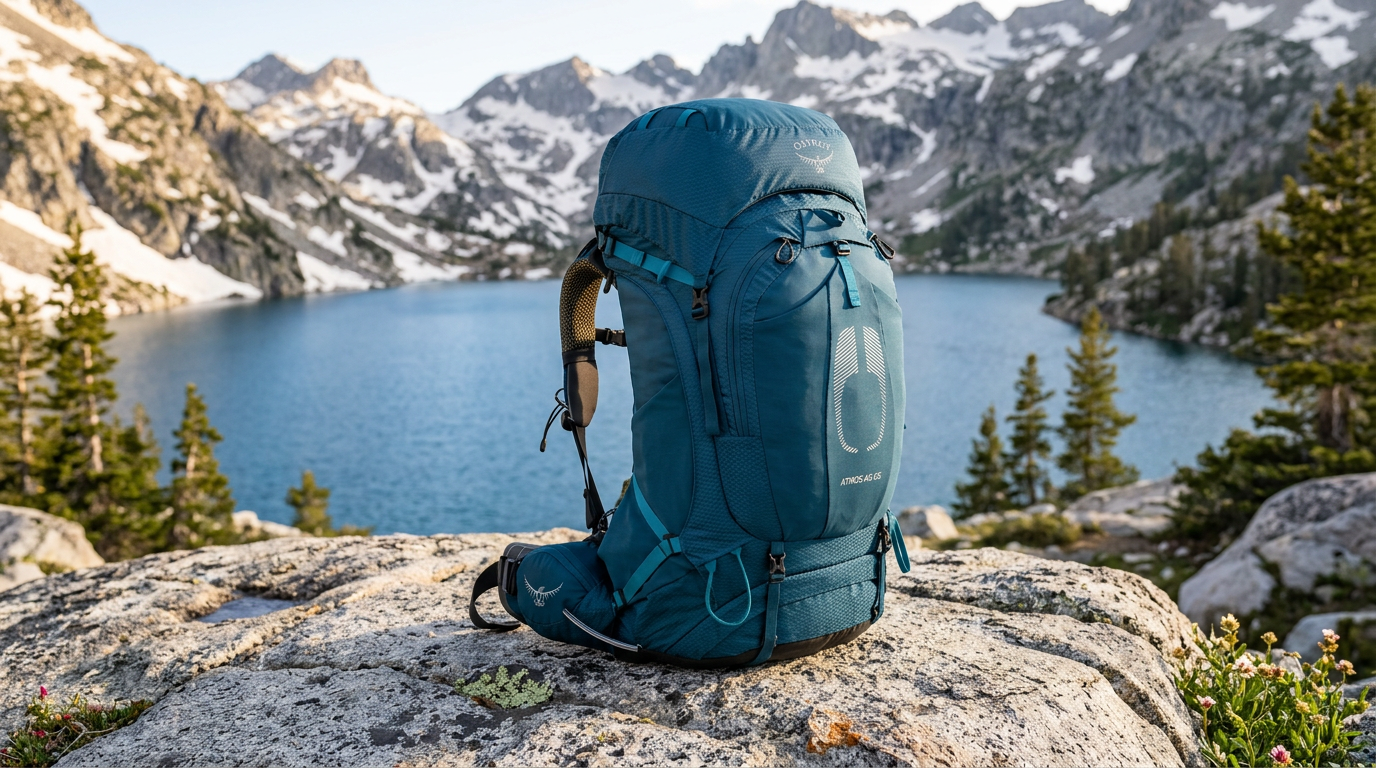
The Osprey Atmos AG 65L is a comfort-first multi-day backpack built for hikers who prioritize ventilated carry and adjustable fit over raw weight savings. Its Anti-Gravity suspended mesh backpanel trades approximately 300-500 g compared to frameless or minimalist packs for exceptional load distribution across 3-5 day trips in spring through fall conditions, making it a strong choice for traditional backpackers willing to accept the weight penalty for all-day comfort under 15-20 kg loads.
Disclosure: Four Seasons Gear is reader-supported. When you buy through links on our site, we may earn an affiliate commission at no extra cost to you. Prices and availability are accurate as of the time we last checked.
Construction and Materials
The Atmos AG 65L employs Osprey's Anti-Gravity (AG) suspension system, which uses a continuous tensioned mesh panel spanning from shoulder straps through the hipbelt. This construction creates a suspended trampoline-like surface that maintains 2-4 cm of air gap between your back and the pack body during loaded carry. The frame consists of a lightweight peripheral wire frame integrated with dual vertical aluminum stays, allowing the pack to transfer weight primarily to the hipbelt rather than shoulders.
The pack body fabric is a nylon blend with a PFAS-free DWR finish, though Osprey doesn't publish specific denier ratings for the Atmos AG 65L on their current spec sheets. The included raincover uses bluesign-approved materials, indicating third-party verification of the textile supply chain for environmental and safety standards. Construction details visible in product imagery show reinforced stitching at high-stress attachment points and bar-tacked webbing anchors at the hipbelt and shoulder harness junctions.
Specs
Intended Use and Performance Context
This pack targets traditional backpackers carrying 12-20 kg total pack weight on 3-7 day trips where resupply isn't available. The 65 L capacity accommodates a typical 3-season sleep system (sleeping bag, pad, tent or tarp), 4-6 days of food, 2-3 L water capacity, and clothing layers without requiring external lashing for most users. The curved side-zip panel access allows mid-trip gear retrieval without unpacking from the top, a feature particularly useful when you need your rain shell or first aid kit buried mid-pack.
Switchback Travel's review notes the AG suspension excels on long mileage days where sustained comfort matters more than shaving grams, while OutdoorGearLab's testing flagged the pack's ventilation as notably superior to solid-back designs in warm conditions. The floating top lid with lash points provides 8-12 L of additional overflow capacity for bulky items like rope, camp shoes, or a bear canister that won't fit internally.
The S/M torso sizing fits users with 41-51 cm torso lengths, measured from the C7 vertebra (base of neck) to the iliac crest (top of hipbones). Osprey's torso adjustment system allows fine-tuning within this range, but users outside these measurements should consider the M/L size variant. The hipbelt range of 66-114 cm accommodates most male users, though those at the extremes should verify fit before committing.
Comparison Context
Within the 60-70 L traditional backpacking category, the Atmos AG 65L sits in the comfort-prioritized segment alongside packs like the Gregory Baltoro and Deuter Aircontact. It trades 300-500 g compared to stripped-down alternatives for the AG suspension system and included raincover. Ultralight-oriented backpackers who've transitioned to frameless or minimalist packs (sub-1000 g base weights) will find this pack overbuilt for their needs, but those carrying traditional gear loads will appreciate the load-bearing capacity.
The curved side-zip access is less comprehensive than full-panel-loading designs but more convenient than pure top-loaders. Users who frequently need mid-pack access will value this compromise, while those who pack methodically and rarely dig mid-trip may not utilize the feature. The pack's ventilated design pairs well with navigation tools like the Garmin inReach Mini 2 Satellite Communicator or Garmin GPSMAP 67 Handheld GPS stored in the top lid pocket for quick access during trail navigation.
Durability Considerations
The tensioned mesh backpanel represents the primary durability consideration. The mesh material is inherently more vulnerable to puncture or abrasion than solid foam-backed designs, particularly when the pack is dropped onto sharp rocks or dragged across rough surfaces. The peripheral wire frame distributes load effectively but introduces additional failure points compared to internal framesheet designs if the pack experiences impact loads (falls, drops from vehicle tailgates).
Bar-tacked webbing attachment points and reinforced stitching at stress zones suggest Osprey has engineered for typical backpacking loads, but users who routinely exceed 20 kg pack weight or engage in off-trail scrambling should expect accelerated wear on the mesh panel and frame attachment points. The included raincover extends pack longevity by protecting the main fabric from sustained UV exposure and precipitation, though the PFAS-free DWR coating will require periodic reapplication (typically every 30-50 use days depending on conditions).
The floating top lid attachment uses a combination of compression straps and buckles that allow removal for day-hike configurations, but this modularity introduces additional potential failure points compared to fixed-lid designs. Users should inspect buckle integrity and webbing condition every 20-30 use days, particularly after trips involving heavy loads or rough handling.
Value Assessment
At approximately $332 USD MSRP (verify current pricing), the Atmos AG 65L sits in the mid-to-upper price tier for 60-70 L backpacking packs. This positions it above budget-oriented options ($150-200 range) but below premium technical packs with exotic materials or specialized features ($400-600 range). The included raincover (typically a $30-50 separate purchase) and Osprey's All Mighty Guarantee (lifetime repair or replacement for manufacturing defects) add value beyond the base purchase price.
For backpackers planning 10+ trips per year over 3-5 years, the comfort investment pays dividends through reduced fatigue and improved trail experience. Weekend warriors with 3-5 annual trips may find better value in simpler designs unless they specifically prioritize ventilated carry. The pack's 3-season designation limits year-round utility—winter users needing to carry mountaineering gear, avalanche equipment, or bulky insulated layers may find 65 L insufficient and should consider 70-80 L alternatives.
Pros and Cons
What we like
Trade-offs
Best For and Not For
This pack serves specific backpacking profiles while being poorly suited for others:
- Best for: Traditional backpackers carrying 12-20 kg on 3-7 day trips who prioritize comfort over weight savings
- Best for: Warm-weather hikers in spring through fall who value ventilated carry and reduced back sweat
- Best for: Users with 41-51 cm torso lengths seeking adjustable fit within that range
- Best for: Backpackers who frequently access mid-pack gear and value side-zip convenience
- Best for: Multi-day trips where resupply isn't available and 65 L capacity is appropriate for food/gear volume
- Not for: Ultralight backpackers with sub-1000 g base weights who prioritize minimal pack weight
- Not for: Winter mountaineering or trips requiring bulky insulated gear exceeding 65 L capacity
- Not for: Users with torso lengths outside 41-51 cm range (consider M/L sizing instead)
- Not for: Off-trail scrambling or technical terrain where mesh backpanel puncture risk is elevated
- Not for: Budget-conscious buyers seeking sub-$200 options for occasional use
Frequently Asked Questions
+How do I measure my torso length for S/M versus M/L sizing?
Measure from your C7 vertebra (the prominent bone at the base of your neck when you tilt your head forward) to your iliac crest (the top of your hipbones, roughly where your hands rest on your hips). S/M fits 41-51 cm (16-20 in), while M/L typically fits 48-58 cm (19-23 in). If you're at the boundary, size up for more adjustment range. Incorrect torso sizing eliminates the AG suspension's benefits and causes discomfort.
+Can I use this pack for winter backpacking or mountaineering?
The 65 L capacity and 3-season designation limit winter utility. Bulky insulated sleeping bags, winter clothing layers, and mountaineering equipment (crampons, ice axe, rope) often require 70-80 L capacity. The mesh backpanel also provides less insulation than solid-back designs in cold conditions. Consider this pack for spring through fall trips, but evaluate larger-capacity winter-specific packs for cold-weather expeditions.
+How much weight can the Atmos AG 65L comfortably carry?
The AG suspension and frame design target 12-20 kg total pack weight (including water, food, and gear). The pack can physically carry more, but comfort degrades and frame stress increases above 20 kg. Users routinely carrying heavier loads should consider expedition-grade packs with more robust frames. For reference, a typical 3-season setup with 4-5 days of food usually lands in the 14-18 kg range.
+Is the mesh backpanel durable enough for off-trail use?
The tensioned mesh is more puncture-vulnerable than solid foam-backed designs. On-trail backpacking with normal pack handling presents minimal risk, but off-trail scrambling, bushwhacking, or situations where the pack is frequently dropped onto rocks increase puncture probability. If your trips involve significant off-trail travel or rough handling, consider solid-back alternatives or take extra care when setting the pack down on uneven surfaces.
+Does the included raincover fit when the pack is fully loaded?
Osprey designs the included raincover to fit the pack at stated capacity plus moderate top-lid overflow. When the pack is loaded to 65 L with the floating top lid compressed normally, the raincover should fit. Extreme overpacking or large items lashed externally may prevent full raincover deployment. The PFAS-free DWR coating on both the pack body and raincover provides water resistance, but the raincover offers superior protection during sustained rain.
The Osprey Atmos AG 65L delivers on its comfort-first design mandate for traditional backpackers willing to accept 2100-2300 g of pack weight in exchange for ventilated carry and adjustable fit. Its Anti-Gravity suspension, curved side-zip access, and included raincover address the core needs of 3-7 day spring-through-fall trips, while the mesh backpanel and 3-season designation define clear use-case boundaries. Backpackers who've measured their torso length at 41-51 cm and routinely carry 12-20 kg loads will find this pack's comfort investment worthwhile across multiple seasons of use.

Read next
More from this category
REVIEW
Osprey Stratos 36L Men's Hiking Backpack Review: Ventilated Carry for Day Hikes and Overnighters
REVIEW
Gregory Baltoro 75L Backpacking Pack Review: Load-Hauling Comfort for Extended Trips
BEST OF
Best Rechargeable Headlamps for Backpacking
BEST OF
Best Beginner Binoculars for Hiking and Bird Watching
GUIDE
How to Choose a Backpacking Tent: The 5 Specs That Matter
GUIDE