Buying guide
Satellite Communicators Explained: inReach vs Spot vs Zoleo
Disclosure: Four Seasons Gear is reader-supported. When you buy through links on our site, we may earn an affiliate commission at no extra cost to you. Prices and availability are accurate as of the time we last checked.
What You're Really Deciding
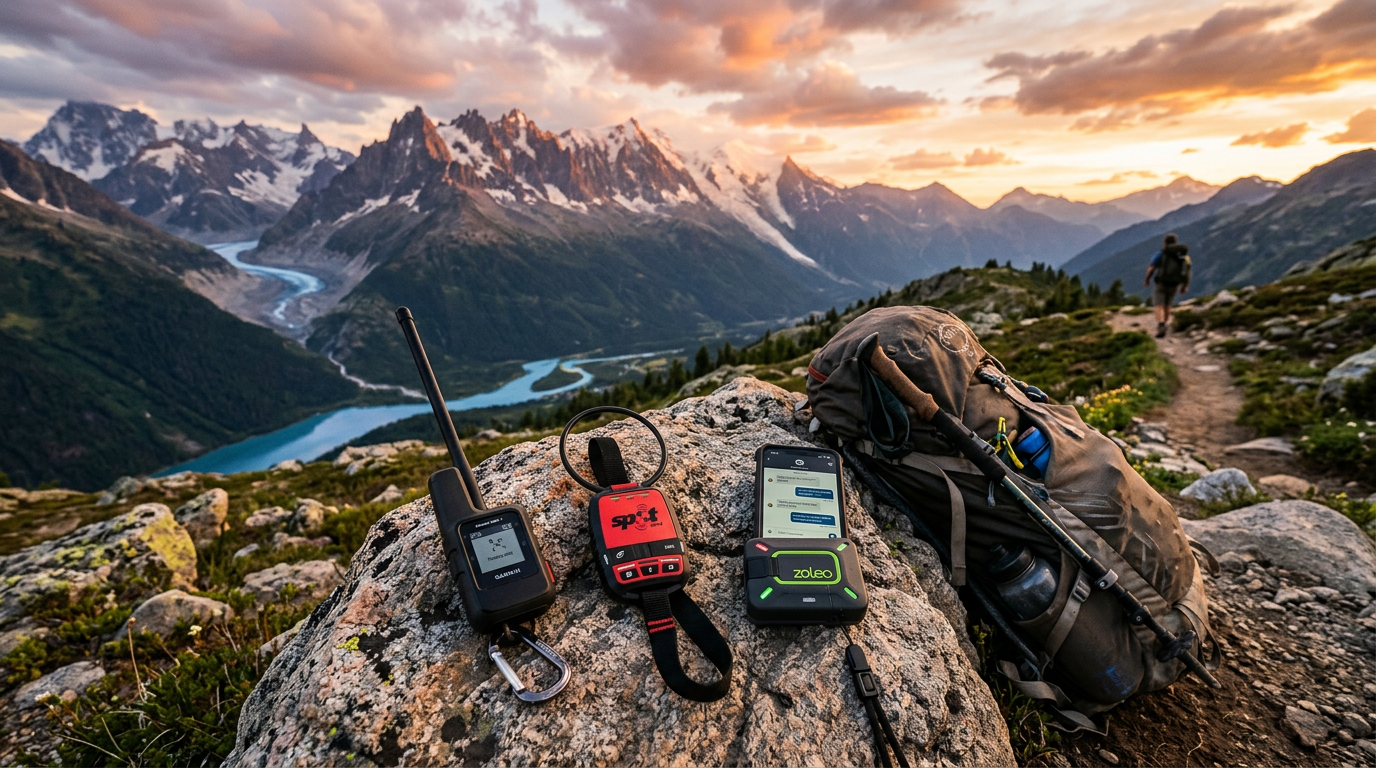
Satellite communicators split into three tiers. One-way SOS beacons (classic SPOT devices) send distress alerts but can't receive replies. Two-way texters (inReach, Zoleo, SPOT X) let you exchange messages with anyone via email or SMS. Navigation-capable units (inReach models, some SPOT variants) add GPS tracking, waypoint marking, and topographic map display. Your choice hinges on whether you need conversation in the field, whether you already carry a dedicated GPS like the Garmin GPSMAP 67 Handheld GPS, and how much you'll use the device annually—subscription plans range from $12/month for basic SOS to $80/month for unlimited messaging.
Core Specifications to Understand
Satellite Network
All consumer satellite communicators use either the Iridium or Globalstar network. Iridium operates 66 low-earth-orbit satellites providing true pole-to-pole coverage—messages route from any latitude including the Arctic and Antarctic. Globalstar uses 24 satellites with gaps above 70° latitude and below 70° south. Garmin inReach and Zoleo devices run on Iridium; SPOT uses Globalstar. For most North American and European backcountry use, both networks perform reliably. Polar expeditions, high-latitude Alaska, or Patagonian treks require Iridium. Message latency averages 30 seconds to 3 minutes on either network depending on satellite position.
Messaging Capability
Devices fall into three categories. SOS-only units send a preset distress signal to a 24/7 rescue coordination center but cannot receive confirmation or instructions—you press the button and wait. Limited preset messaging devices (SPOT Gen4) can send 3-4 canned messages like 'I'm OK' or 'Send help (non-emergency)' to predefined contacts. Full two-way texting units (inReach Mini 2, Zoleo, SPOT X) let you compose freeform messages up to 160 characters and receive replies from any email address or phone number. Two-way capability matters when coordinating pickup times, reporting weather delays, or conversing with rescue services during an evolving situation. The Garmin inReach Mini 2 Satellite Communicator exemplifies the compact two-way category—3.5 oz with full QWERTY keyboard pairing via smartphone.
Battery Life
Rated endurance spans 10 days to 30 days depending on tracking interval and message frequency. Manufacturers specify battery life at a default 10-minute tracking ping and minimal messaging—real-world duration shortens to 4-7 days with active daily texting. Devices with e-ink displays (some inReach models) draw less power than backlit LCDs. Units without screens (Zoleo) maximize battery by offloading display to your smartphone. Expect 200-1,000 hours in standby mode versus 20-50 hours of continuous tracking. Cold weather below 0°F reduces lithium battery capacity by 30-40%; carry the device inside your jacket and swap to a fresh battery if your model allows. The Garmin Instinct 2 Solar GPS Watch integrates inReach compatibility and solar charging for extended expeditions, though it requires pairing with a separate inReach device for satellite messaging.
Weight and Size
Satellite communicators range from 3.5 oz (100 g) for screenless or minimal-display models to 8 oz (227 g) for units with full color maps and touchscreens. Dimensions span 2 x 4 inches for ultralight texters to 3 x 6 inches for navigation-capable handhelds. Thru-hikers and fastpackers prioritize sub-4-oz devices; weekend backpackers tolerate 6-8 oz if bundled navigation replaces a separate GPS. Mounting options include carabiner clips, MOLLE webbing attachment, and backpack strap sleeves. A 4-oz communicator adds less bulk than the Therm-a-Rest NeoAir XLite NXT Sleeping Pad but delivers disproportionate safety value.
Built-in Navigation
Some satellite communicators incorporate GPS receivers, digital compasses, barometric altimeters, and preloaded topographic maps. These features let you mark waypoints, track your route, and navigate without a separate handheld GPS. inReach models with screens (Mini 2, Messenger, Explorer+) display basic breadcrumb trails and coordinates. Full-featured units show USGS quad maps, elevation profiles, and turn-by-turn routing. If you already carry a dedicated GPS or rely on smartphone apps with offline maps, a navigation-capable communicator duplicates functionality. If the communicator is your only navigation tool, ensure it has a screen large enough to read contour lines—at minimum 2 inches diagonal.
Durability and Weather Resistance
Satellite communicators meet IPX7 (submersion to 1 meter for 30 minutes) or IP67 (dust-tight plus submersion) ratings. All major models survive rain, snow, and accidental creek dunking. Shock resistance varies—military-spec units withstand 6-foot drops onto concrete; consumer models tolerate 3-4-foot tumbles onto rock. Operating temperature ranges typically span -4°F to 140°F (-20°C to 60°C), adequate for most alpine and desert conditions. Extreme cold below -20°F may require keeping the device in a jacket pocket between uses. Antenna design matters: external stub antennas (SPOT) require clear sky view; internal patch antennas (inReach Mini 2) work inside mesh backpack pockets but perform better when clipped externally.
Subscription Plans: The Hidden Cost
Satellite communicators require monthly or annual service subscriptions separate from the hardware purchase. Plans tier by message volume, tracking frequency, and SOS coverage. Basic SOS-only plans start at $12-15/month with no messaging. Entry-level texting plans ($25-35/month) include 10-40 messages and hourly tracking. Unlimited messaging plans reach $65-80/month. Most providers offer annual prepay discounts (15-20% savings) and seasonal suspension options ($5-8/month to pause service). Over a device's typical 5-year lifespan, subscription costs total $720 to $4,800—often exceeding the hardware price. Calculate your expected monthly usage: if you take 2-3 trips per year, an annual plan with seasonal suspension costs less than activating month-to-month. If you're weekend-warrior frequency, compare the 3-year total cost across brands rather than just upfront device price.
inReach vs SPOT vs Zoleo: Key Differences
Garmin inReach Ecosystem
inReach devices (Mini 2, Messenger, Explorer+) use the Iridium network and integrate with Garmin's broader GPS ecosystem. The Garmin inReach Mini 2 Satellite Communicator weighs 3.5 oz and pairs with smartphones for message composition via the Garmin Explore app. All inReach models support two-way texting, location sharing via MapShare web portal, and weather forecast downloads. Subscription plans range from $15/month (10 messages, SOS) to $65/month (unlimited texting). Unique features include ActiveAssist SOS escalation, which automatically notifies emergency contacts if you fail to check in, and compatibility with Garmin wearables like the Garmin Fenix 7X Sapphire Solar Smartwatch for message notifications on your wrist. The ecosystem shines if you already own Garmin GPS devices—waypoints and routes sync across hardware.
SPOT Devices
SPOT (Gen4, X) runs on Globalstar satellites with coverage gaps at extreme latitudes. The Gen4 model offers SOS plus three preset messages ('OK', 'Help', 'Custom') but no two-way texting—$12/month for basic service. SPOT X adds a full QWERTY keyboard and two-way messaging for $20-50/month depending on message volume. SPOT devices cost $50-100 less upfront than comparable inReach models, but Globalstar's network shows higher message failure rates in mountainous terrain and northern latitudes above 65°. SPOT's main advantage is price for users who need only basic check-in capability and operate in the Lower 48 or Europe. If your trips include Alaska, northern Canada, or southern Patagonia, the network limitation becomes a dealbreaker.
Zoleo
Zoleo is a screenless two-way messenger using Iridium satellites. It weighs 5.3 oz and relies entirely on smartphone pairing—no standalone operation. The device automatically routes messages via satellite when cellular coverage drops and switches back to cell/Wi-Fi when available, reducing satellite message charges. Plans start at $20/month for 25 messages. Zoleo's check-in feature sends automated 'I'm safe' messages at scheduled intervals. The lack of a screen and buttons means you cannot send messages if your phone dies, unlike the inReach Mini 2 which has an SOS button and basic texting via Bluetooth even with a dead phone. Zoleo suits users who always carry a smartphone and want the simplest possible interface.
Match the Gear to Your Trip
Use this decision tree to narrow your choice:
- Day hikes and trail running within cell range, occasional backcountry overnights: SOS-only device (SPOT Gen4) with $12/month plan. You're buying peace of mind for the 1-2 trips per year beyond cell towers.
- Weekend backpacking trips, 2-4 nights, established trails: Two-way messenger without navigation (Zoleo, inReach Mini 2). You already navigate with phone apps and offline maps; the communicator is for check-ins and emergency texting. Pair with a power bank to keep your phone alive.
- Week-long expeditions, off-trail travel, international trips: Two-way messenger with basic navigation (inReach Mini 2) or full-featured GPS communicator (inReach Explorer+). You need reliable texting, route tracking, and the ability to download weather forecasts. Iridium network is non-negotiable for global coverage.
- Thru-hiking or ultralight fastpacking: Lightest two-way device (inReach Mini 2 at 3.5 oz) with annual unlimited plan. You'll send daily updates to a blog or worried family; per-message plans become expensive fast. The weight savings versus a 6-oz SPOT X compounds over 2,000 miles.
- Mountaineering, alpine climbing, or polar expeditions: inReach device with ActiveAssist and weather forecasting. You need Iridium's high-latitude coverage, the ability to coordinate with base camp, and automated check-in escalation if you miss a scheduled contact window.
What About Smartphone Satellite Features?
Apple's iPhone 14 and 15 models include Emergency SOS via satellite for North America, and Google is adding similar features to Pixel phones. These services provide free SOS messaging to emergency services but lack two-way texting with personal contacts, location tracking, or weather downloads. Smartphone satellite features work as a backup SOS layer but don't replace a dedicated communicator for anyone spending multiple days beyond cell range. Battery life is the critical limitation—your phone dies in 8-20 hours of active use; a dedicated communicator runs 5-10 days. If your phone is your primary navigation tool (common with apps like Gaia GPS), it won't have battery left for satellite SOS on day three of a trip. Dedicated communicators also survive harsher conditions than smartphones.
Practical Usage Tips
Satellite communicators perform best when you understand their quirks. Always send a test message from your trailhead before hiking out of cell range—this confirms your subscription is active and the device has acquired satellites. In dense forest, pause in clearings every 30-60 minutes to let the device sync; don't wait until you need to send an urgent message. Compose messages before hitting send to minimize transmit time and battery drain. Use preset messages ('I'm OK', 'Camped at waypoint') rather than freeform texts when possible—they send faster and count as fractional messages on tiered plans. Enable tracking intervals of 30-60 minutes rather than 10 minutes unless you're in high-risk terrain; this triples battery life. Download weather forecasts in the evening for next-day planning rather than mid-hike. Pair your communicator with a small external battery pack (3 oz) for trips longer than 5 days.
Common Mistakes to Avoid
First-time buyers often underestimate subscription costs. A $300 device with a $35/month plan costs $2,400 over five years—the subscription is the real expense. Calculate your annual trip frequency and compare seasonal suspension plans versus year-round service. Second, many users bury the communicator inside their pack where the antenna can't see sky. Clip it to your shoulder strap or pack top; the 30-second inconvenience of external mounting prevents 10-minute message delays. Third, don't assume SOS triggers instant helicopter rescue. In remote areas, response times range from 4 hours to 24 hours depending on weather, terrain, and available resources. Satellite communicators summon help but don't replace first-aid skills, shelter, and the ability to self-rescue for minor injuries.
Integration with Other Gear
Satellite communicators pair well with other navigation and safety tools. If you carry a dedicated GPS like the Garmin GPSMAP 67 Handheld GPS, a lightweight two-way messenger (inReach Mini 2, Zoleo) adds communication without duplicating navigation features. For ultralight setups, an inReach Mini 2 plus smartphone offline maps (Gaia GPS, CalTopo) replaces a heavier standalone GPS. Mountaineers often pair an inReach with an avalanche beacon and GPS watch—the Garmin Instinct 2 Solar GPS Watch displays inReach message notifications and shares GPS coordinates with the communicator for faster location fixes. On extended expeditions, carry a small solar panel (6-10 watts) to recharge both your communicator and phone; the combined system weighs less than extra battery packs for week-long trips.
When to Upgrade or Replace
Satellite communicator technology evolves slowly—a 5-year-old device still functions fine if the battery holds charge and the manufacturer supports firmware updates. Consider upgrading when: (1) Your device uses an older satellite network (original SPOT models on Globalstar Gen 2 satellites have worse coverage than current Gen 3 network); (2) Battery life degrades below 3 days of normal use and replacement batteries aren't available; (3) Your usage pattern changes—moving from weekend trips to thru-hiking justifies upgrading to an unlimited messaging plan and lighter hardware; (4) New features become essential—ActiveAssist automated check-ins or weather forecasting weren't available on early inReach models. Otherwise, keep using your existing device and put the $300-400 upgrade cost toward better shelter or sleep system.
Specs
Frequently Asked Questions
+Can I share one satellite communicator subscription across multiple devices?
No. Each device requires its own active subscription tied to its unique identifier (ESN or IMEI). You cannot swap a SIM card or transfer service between devices like cell phones. If you own two communicators—say, an inReach Mini 2 for backpacking and an inReach Explorer+ for mountaineering—each needs a separate plan. Some providers offer multi-device discounts (10-15% off the second device), but you're still paying two subscriptions. For families or groups, one person carries the communicator and shares access; buying multiple devices only makes sense if you're splitting up in the backcountry.
+How quickly does rescue arrive after I trigger an SOS?
Response time depends on your location, weather, available resources, and injury severity. In popular national parks near helicopter bases, expect 2-6 hours. In remote wilderness 100+ miles from the nearest road, 12-24 hours is common—rescuers must mobilize ground teams or wait for flyable weather. International locations vary widely; some countries lack organized search-and-rescue infrastructure. The GEOS or IERCC coordination center (depending on your device) will acknowledge your SOS within 5-10 minutes via text and ask for details about your situation. Provide injury type, number of people, and whether you can self-evacuate to a clearing for helicopter pickup. Satellite communicators summon help but don't guarantee instant extraction—carry first-aid supplies and shelter to sustain yourself during the wait.
+Do I need to pay for rescue services if I trigger an SOS?
In the United States, search-and-rescue services are typically free—national parks, county sheriffs, and volunteer teams don't bill for rescues. Helicopter transport to a hospital may incur charges ($10,000-30,000) depending on whether the aircraft is military, park service, or private contractor. Some satellite communicator subscriptions include optional rescue insurance ($30-50/year) that covers helicopter and evacuation costs. Outside the U.S., policies vary: Canada generally doesn't charge for SAR; many European countries bill for helicopter rescue ($5,000-15,000); New Zealand charges for careless behavior that requires rescue. Check your health insurance policy—some cover emergency medical evacuation, others exclude adventure sports. Rescue insurance through your communicator subscription is cheap relative to potential helicopter bills.
+Can I use a satellite communicator for routine texting to save on cell phone roaming charges while traveling internationally?
Technically yes, but it's impractical and expensive. Satellite message plans charge $0.50-2.00 per text on pay-per-use tiers, versus $0.10-0.50 for international SMS roaming. Satellite messages take 30 seconds to 3 minutes to send versus instant cell texts. You can't send photos, videos, or messages longer than 160 characters. Satellite communicators are designed for safety and coordination in areas without cell coverage, not as a replacement for international cell service. If you're traveling to places with intermittent cell coverage (rural Iceland, Patagonian towns), a communicator makes sense as a backup. If you're mostly in cities and villages with cell towers, buy a local SIM card or international roaming plan—it's faster and cheaper.
+What happens if my satellite communicator gets wet or damaged during a trip?
All major communicators meet IPX7 waterproof ratings—they survive 30 minutes submerged to 1 meter. If you drop your device in a creek, retrieve it, shake out water, and let it dry for 30 minutes before powering on. The device will likely work fine. If the screen cracks or the case splits from a fall onto rock, SOS functionality usually persists even if the display is unreadable—the SOS button is a separate circuit with redundant design. If your device stops working entirely, you're reliant on your backup plans: paper maps, compass, signaling mirror, and the skills to self-rescue or navigate to a trailhead. This is why experienced backcountry travelers carry redundant navigation (GPS plus paper maps) and never rely solely on electronics. If you're on a multi-week expedition, consider carrying a backup lightweight communicator (SPOT Gen4 as SOS-only backup costs $100 and weighs 4 oz).
+Can I test my satellite communicator without triggering a real emergency response?
Yes. All devices have a test mode or check-in message that sends a signal to the coordination center without dispatching rescuers. For inReach devices, send a preset 'I'm OK' message or a custom text to a friend—this confirms satellite connectivity without alerting emergency services. For SPOT, the 'OK' button sends a check-in to your contacts; only the SOS button triggers rescue. Test your device before every trip: send a message from your trailhead, confirm it arrives at the recipient, and verify your subscription is active. Some coordination centers (GEOS for inReach) also offer annual test SOS triggers—you press the SOS button, they acknowledge receipt, and you cancel within 60 seconds. This confirms the full emergency chain works without mobilizing helicopters. Never test the SOS button without prior arrangement; false alarms waste rescue resources and may incur fines.