
Head-to-head
Marmot Women's Echo Featherless Jacket vs Outdoor Research Women's Helium Insulated Hoodie: Which Lightweight Insulation Layer Wins?
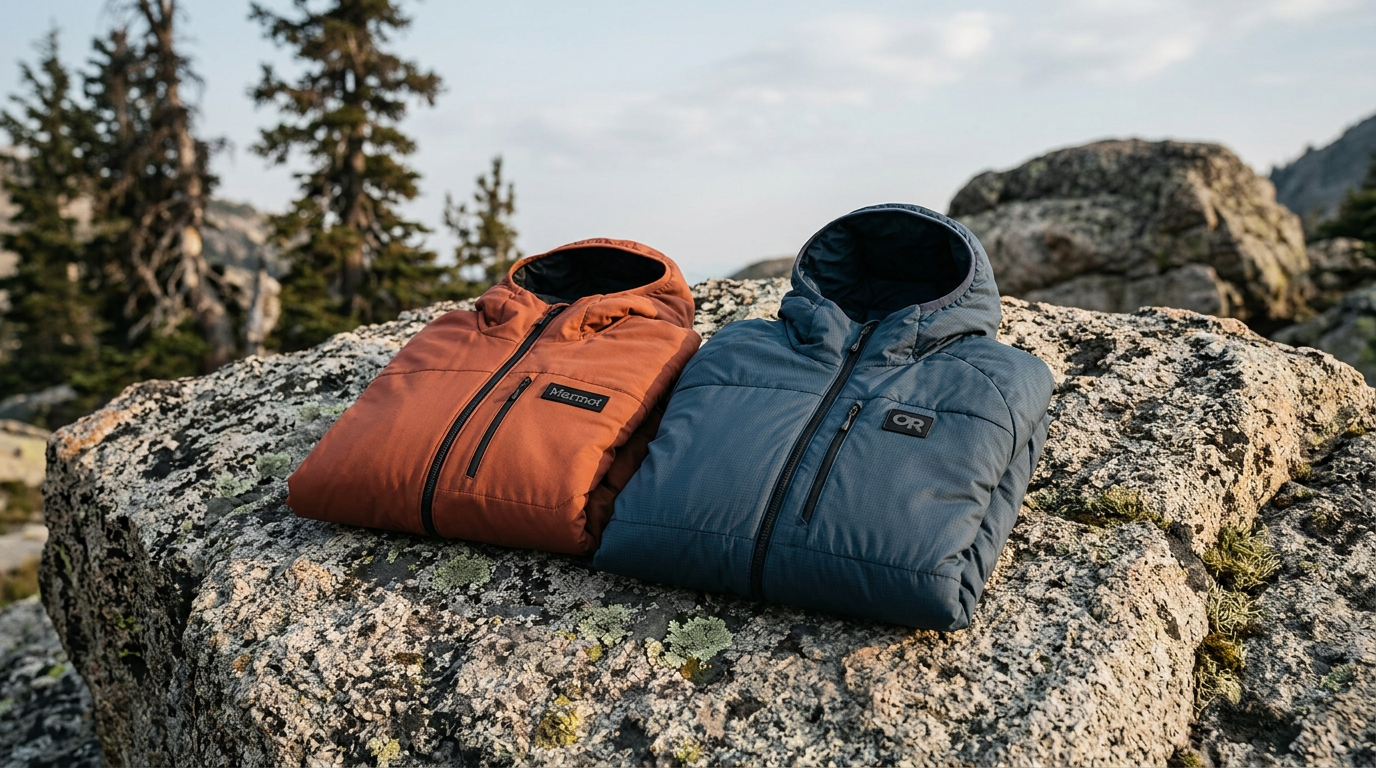
The Outdoor Research Helium Insulated Hoodie is the superior choice for serious backcountry users who prioritize packability, weather resistance, and hood protection despite the $126 premium. However, the Marmot Echo Featherless delivers exceptional value at $82.88 for casual hikers and everyday users who want reliable synthetic warmth without breaking the bank and don't require a hood.
Disclosure: Four Seasons Gear is reader-supported. When you buy through links on our site, we may earn an affiliate commission at no extra cost to you. Prices and availability are accurate as of the time we last checked.
Choosing between synthetic insulation jackets often comes down to balancing performance against price. The Marmot Echo Featherless and Outdoor Research Helium Insulated Hoodie represent two distinct philosophies in the lightweight insulation category: budget-conscious versatility versus premium technical performance. Both use synthetic insulation to maintain warmth when wet, but they diverge significantly in construction, features, and intended use cases.
Spec Comparison
Specs
Price and Value: $126 Separates These Jackets
The $126.12 price gap is the most obvious differentiator. At $82.88, the Marmot Echo Featherless costs 60% less than the OR Helium's $209.00 price tag. This isn't a minor difference—it's the cost of adding a quality base layer or upgrading your water filtration system. The Marmot delivers synthetic insulation warmth at a price point that makes it accessible for casual weekend warriors or those building their first layering system. The OR commands premium pricing for its technical fabric package and integrated features, which only pay dividends if you're regularly pushing into challenging conditions where packability and weather resistance justify the investment.
Insulation Technology: 3M Thinsulate vs VerticalX Eco
The Marmot uses 3M Thinsulate Featherless insulation, a synthetic fill designed to mimic down's loft and warmth-to-weight ratio while maintaining performance when damp. This insulation uses fine microfibers that trap air efficiently. The OR Helium employs VerticalX Eco SR insulation, which uses a continuous filament structure that resists compression and maintains loft even after repeated packing cycles. In practical terms, both provide similar warmth for their weight class, but the VerticalX construction in the OR recovers faster from compression and maintains consistent loft in a pack's stuff sack over multiple seasons. If you're constantly packing and unpacking your insulation layer on multi-day trips, the OR's insulation architecture provides measurable durability advantages.
Shell Fabric and Weather Protection: Pertex vs Standard Ripstop
The Outdoor Research Helium uses Pertex Quantum shell fabric, a tightly-woven 20-denier nylon that provides exceptional wind resistance and light weather protection while remaining breathable. This fabric is specifically engineered for alpine environments where wind chill and light precipitation are constant factors. The Marmot Echo Featherless uses a 100% nylon ripstop with DWR coating—a perfectly adequate construction for trail use and moderate conditions, but without the wind-blocking density of Pertex. In 15+ mph winds, you'll feel the difference: the OR maintains a warmer microclimate against your body, while the Marmot allows more air penetration. For shoulder-season hiking where you're moving in and out of wind exposure, the OR's shell fabric provides tangible comfort benefits that justify its weight in technical applications.
Hood Design: A Critical Feature Difference
The OR Helium includes a helmet-compatible insulated hood with a single-pull adjustment system, while the Marmot Echo Featherless has no hood. This isn't a minor feature gap—it's a fundamental design choice that defines each jacket's use case. An insulated hood adds approximately 15-20% more warmth retention by protecting your head and neck, the body's primary heat-loss zones. For alpine climbing, ski touring, or any activity where you're wearing a helmet or need maximum warmth, the OR's hood is non-negotiable. The Marmot's hoodless design keeps weight down and provides a cleaner profile for layering under a shell, making it ideal for trail hiking where you're wearing a beanie and don't need integrated head protection.
Packability and Travel: Integrated Stuff Sack Matters
The OR Helium features an integrated stuff pocket that allows the jacket to pack into its own chest pocket, creating a self-contained bundle roughly the size of a Nalgene bottle. This eliminates the need for a separate stuff sack and ensures you'll never lose your storage solution. The Marmot Echo Featherless compresses well but requires a separate stuff sack (not included), adding a small organizational burden. For fast-and-light missions where every cubic inch of pack space matters and you're frequently transitioning between wearing and storing your insulation, the OR's integrated system provides measurable convenience. Day hikers who leave their jacket in the pack until lunch breaks won't notice the difference.
Fit and Mobility Considerations
Both jackets use athletic cuts designed for layering, but the OR Helium's Pertex shell fabric has more mechanical stretch than the Marmot's ripstop, providing better mobility during dynamic movements like scrambling or reaching overhead for handholds. The Marmot's slightly more relaxed fit accommodates thicker mid-layers underneath, making it more versatile for static activities like belaying or camp chores. Neither jacket restricts shoulder movement significantly, but if you're choosing an insulation layer specifically for technical climbing or ski touring where arm mobility is critical, the OR's stretch characteristics provide a measurable advantage.
Durability and Long-Term Performance
The OR Helium's Pertex Quantum shell, while lightweight at 20-denier, is engineered for abrasion resistance and has a proven track record in alpine environments. The Marmot's ripstop construction provides good tear resistance but uses a slightly less robust fabric overall. Both jackets will last multiple seasons with proper care, but the OR is more likely to survive regular contact with pack straps, rock, and rough use without showing wear. If you're investing in a jacket you expect to use 50+ days per season in demanding conditions, the OR's construction quality supports that use case. For weekend warriors logging 10-15 days per season on maintained trails, the Marmot's durability is entirely adequate.
What we like
Trade-offs
Decision Framework: Which Jacket Fits Your Needs?
Buy the Outdoor Research Helium Insulated Hoodie if you're a serious backcountry user who needs maximum packability, integrated hood protection, and superior wind resistance for alpine climbing, ski touring, or multi-day fastpacking trips where every ounce and cubic inch matters. The $209 investment makes sense when you're regularly operating in exposed environments where the Pertex shell fabric and helmet-compatible hood provide tangible safety and comfort benefits.
Buy the Marmot Echo Featherless Jacket if you're a casual hiker, weekend camper, or budget-conscious outdoor enthusiast who wants reliable synthetic insulation for trail use and everyday wear without premium technical features. At $82.88, it delivers 80% of the performance for 40% of the cost, making it the smart choice when you're wearing a beanie anyway and don't need the OR's specialized alpine capabilities.
Frequently Asked Questions
+Can either jacket replace a down puffy for winter camping?
Neither jacket provides enough insulation to serve as a primary static insulation layer for winter camping in sub-freezing temperatures. Both are designed as active insulation layers for moderate cold (35-50°F) or as mid-layers under a shell in harsher conditions. For winter camping, you'd want a thicker synthetic or down jacket with 3-5 oz of insulation fill weight, not the lightweight insulation used in these jackets.
+How do these jackets perform in wet conditions compared to down?
Both synthetic insulation jackets maintain approximately 80-90% of their warmth when damp, whereas down loses 70-80% of its insulating value when wet. This makes either jacket superior to down for Pacific Northwest hiking, spring mountaineering, or any environment where you expect moisture exposure. The OR's Pertex shell sheds water slightly better than the Marmot's ripstop, but both require a waterproof shell in sustained rain.
+Will the Marmot's lack of a hood be a problem for three-season backpacking?
Not necessarily. Most backpackers wear a beanie or buff for head warmth and layer their insulation jacket under a hooded rain shell when needed. The hoodless design actually makes the Marmot more versatile for layering and reduces bulk around the neck. The OR's hood becomes critical only when you need integrated head protection for alpine environments, ski touring, or situations where you're not wearing a shell with its own hood.

Read next
More comparisons + reviews
REVIEW
Marmot Echo Featherless Jacket Review: Synthetic Insulation for Wet-Climate Hiking
REVIEW
Outdoor Research Women's Helium Insulated Hoodie, Plus – Lightweight Jacket Review
REVIEW
Columbia Men's Powder Lite II Insulated Puffer Jacket Review

BEST OF
Best Rechargeable Headlamps for Backpacking

BEST OF
Best Beginner Binoculars for Hiking and Bird Watching

GUIDE