
Review · spring · summer · fall
Platypus GravityWorks Group Camping Water Filter System Review
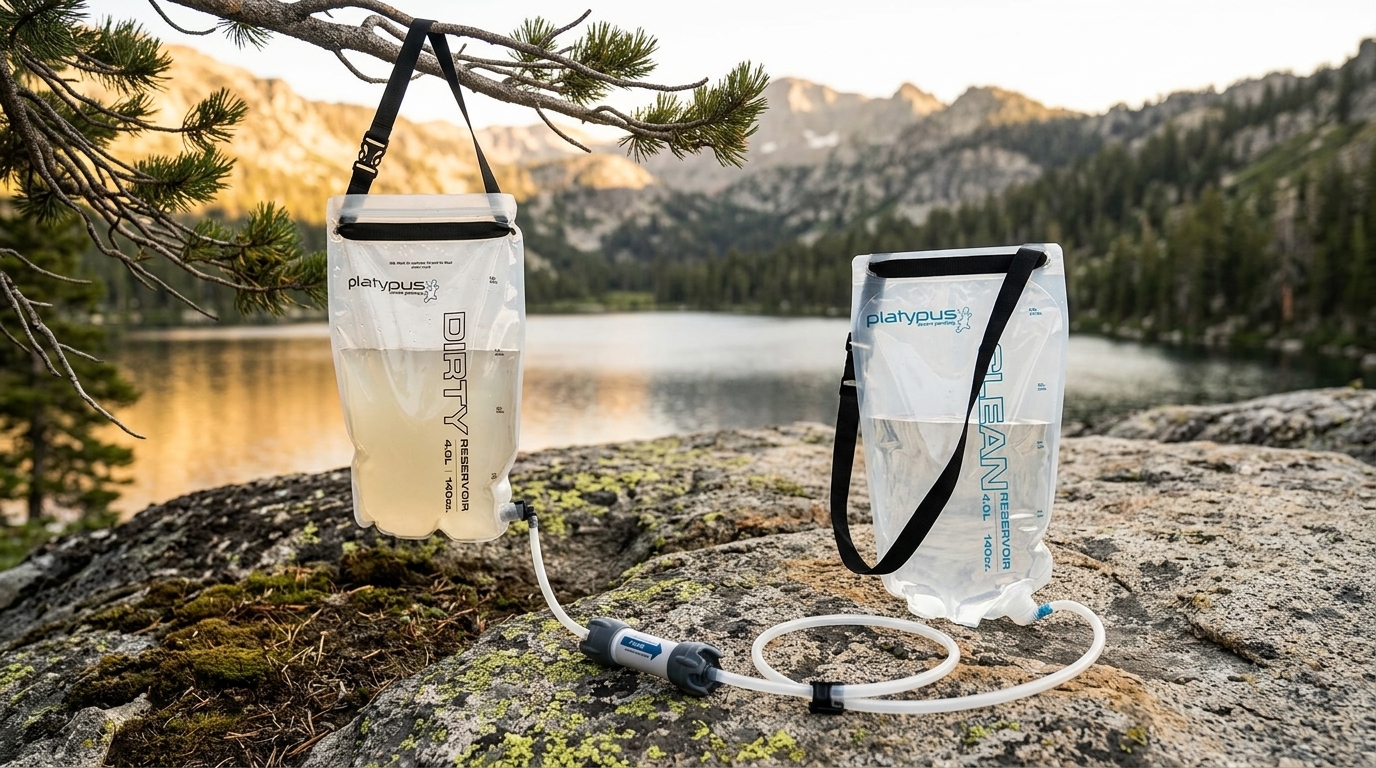
The Platypus GravityWorks is a gravity-fed hollow-fiber filter designed for groups of 2-6 who prioritize hands-free operation and high volume over packability. At 11.5 oz for the complete 4-liter system, it trades the ultralight efficiency of squeeze filters like the Sawyer Squeeze Water Filter System for the convenience of filtering large volumes without pumping—delivering 4 liters in approximately 2.5 minutes. The dual-reservoir design (separate dirty and clean bags) eliminates cross-contamination risk and provides dedicated storage for treated water, making it ideal for base camps, family outings, and scenarios where multiple people need reliable access to safe drinking water throughout the day.
Disclosure: Four Seasons Gear is reader-supported. When you buy through links on our site, we may earn an affiliate commission at no extra cost to you. Prices and availability are accurate as of the time we last checked.
Specifications
Specs
Construction and Filter Technology
The GravityWorks uses a hollow-fiber microfilter cartridge—the same technology found in the Sawyer Squeeze Water Filter System and Sawyer Mini Water Filter, but configured for gravity operation rather than manual squeezing. Hollow-fiber filters contain thousands of microscopic tubes with 0.2-micron pore size, physically blocking bacteria (E. coli, salmonella, cholera) and protozoan cysts (giardia, cryptosporidium) while allowing water molecules to pass. This mechanical filtration meets EPA and NSF guidelines for removal of 99.9999% of bacteria and 99.9% of protozoa, though like all microfilters it does NOT remove viruses (a non-issue in North American backcountry but relevant for international travel).
The dual-reservoir architecture separates dirty and clean water completely. The dirty reservoir (typically olive or gray) features a wide-mouth opening for scooping from shallow sources, while the clean reservoir (usually blue or marked) has a drink-through cap and fill port. Silicone hoses connect the reservoirs through the filter cartridge, with a shutoff clamp controlling flow. The system hangs from a tree or trekking pole via an integrated loop, using gravity head pressure (vertical drop) to push water through the filter media—no hand pumping required.
Platypus specifies a PFAS-free DWR (durable water repellent) coating on the storage sack, addressing growing concerns about per- and polyfluoroalkyl substances in outdoor gear. The coating sheds moisture to keep the filter cartridge dry during storage, reducing the risk of freeze damage or microbial growth between trips.
Field Performance and Use Cases
The GravityWorks excels in scenarios where you're filtering large volumes repeatedly: group backpacking trips, family car camping, paddling expeditions, and emergency preparedness kits. The 1.75 liters/minute flow rate means a full 4-liter batch takes approximately 2.5 minutes—fast enough that you can filter water for cooking dinner, washing dishes, and filling everyone's bottles in a single hang session. OutdoorGearLab's testing confirms this flow rate holds steady when the filter is clean and properly backflushed, though it slows as the cartridge loads with sediment.
Trail reports note the hands-free operation as the primary advantage over squeeze systems. While the Sawyer Squeeze Water Filter System weighs just 3 oz and packs smaller, it requires continuous squeezing to produce volume—fatiguing for groups needing multiple liters. The GravityWorks lets you hang the dirty reservoir, open the clamp, and walk away to set up camp or start cooking. The separate clean reservoir also provides secure storage for treated water, eliminating the risk of accidentally drinking from the dirty bag (a real concern with single-bag squeeze systems).
CleverHiker's review flagged the system's bulk as the main tradeoff: 11.5 oz and a packed size roughly equivalent to a 1-liter Nalgene bottle. Solo ultralight hikers typically prefer the 3-oz Sawyer Squeeze or even the 2-oz LifeStraw Personal Water Filter for weight savings, accepting slower filtering as a fair trade. The GravityWorks makes sense when the per-person weight (11.5 oz ÷ 4 people = 2.9 oz each) and time savings justify carrying the extra hardware.
Durability and Maintenance Considerations
Hollow-fiber filters are mechanically robust—the filter element itself is difficult to damage through normal use—but they're vulnerable to freezing. Water trapped inside the hollow fibers expands when frozen, rupturing the microscopic tubes and rendering the filter useless (and unsafe, since bacteria can pass through the cracks). Platypus doesn't publish a freeze-thaw tolerance, so the standard protocol is to never let the cartridge freeze after first use. The PFAS-free DWR storage sack helps by keeping the filter dry between trips, but you must thoroughly dry the cartridge before storing in freezing conditions.
The 1,500-gallon cartridge lifespan is generous for group use—a family of four using 8 liters per day would get approximately 710 days of use before replacement. However, Halfway Anywhere's field testing notes that flow rate degrades significantly before you hit the 1,500-gallon mark if you're filtering turbid water (glacial runoff, silty rivers). The hollow fibers clog with fine sediment, requiring frequent backflushing. Platypus includes a backflush adapter (you reverse-flow clean water through the filter to dislodge particles), but this adds maintenance time and doesn't fully restore original flow rates once the filter is heavily loaded.
The reservoirs are Platypus's proven welded-seam construction—the same bags used in their hydration systems. Seam failure is rare, but the wide-mouth dirty bag takes abuse during scooping from rocky streams. Inspect seams before each trip and carry a repair patch. The silicone hoses and shutoff clamp are the most common failure points; hoses can kink or develop pinhole leaks, and the clamp's spring tension weakens over seasons. Replacement parts are available individually, extending the system's usable life beyond the filter cartridge.
Comparison Context
The water filter category divides into four main types: squeeze filters (Sawyer Squeeze, 3 oz, $45), straw filters (LifeStraw Personal Water Filter, 2 oz, $20), gravity systems (Platypus GravityWorks, 11.5 oz, $134), and pump filters (MSR Guardian, 17.3 oz, $350). The GravityWorks sits in the middle of the weight and price spectrum, optimizing for group throughput rather than solo packability or viral protection.
Against the Sawyer Squeeze Water Filter System, the GravityWorks is 8.5 oz heavier and $89 more expensive but filters 4 liters in the time it takes to squeeze 1 liter through a Sawyer. For solo hikers or pairs willing to squeeze, the Sawyer wins on weight and cost. For groups of 3+, the GravityWorks's time savings and hands-free operation justify the extra weight. The Sawyer Mini Water Filter offers even lighter weight (2 oz) but with slower flow—not practical for group volumes.
The LifeStraw Personal Water Filter is a straw-style filter for drinking directly from sources—ultralight (2 oz) and cheap ($20) but impractical for cooking, washing, or filling group bottles. It's a backup or emergency filter, not a primary group system.
Pump filters like the MSR Guardian offer viral protection (critical for international travel) and work in any terrain (no hanging required), but they're heavier (17.3 oz) and require continuous pumping effort. The GravityWorks is the better choice for North American backcountry where viral contamination isn't a concern and you have trees or hanging points.
Value Assessment
At approximately $134 MSRP (verify current price), the GravityWorks costs roughly 3x a Sawyer Squeeze but includes two 4-liter reservoirs, hoses, clamp, and storage sack—components that would cost $60+ if purchased separately for a DIY gravity setup. The per-person cost for a group of four ($33.50 each) is competitive with individual squeeze filters when you factor in the time savings.
The 1,500-gallon cartridge lifespan translates to a cost-per-gallon of approximately $0.09 (assuming $134 ÷ 1,500 gallons), comparable to Sawyer's squeeze filters. Replacement cartridges run around $50, making long-term ownership costs reasonable for frequent users. For occasional campers (2-3 trips per year), the upfront cost is harder to justify versus a $45 Sawyer Squeeze that meets most needs.
The system's value peaks for specific users: families with young children (who can't effectively squeeze filters), base-camp-style backpackers (who stay in one location and filter large volumes daily), and paddlers (who have easy water access but need hands-free operation while managing boats). Solo ultralight hikers will find better value in lighter, cheaper squeeze systems.
What we like
Trade-offs
Best For
- Groups of 3-6 who need to filter 8+ liters daily
- Families with young children who can't operate squeeze filters
- Base-camp backpackers staying in one location multiple nights
- Paddlers and rafters with easy water access and hands-free needs
- Emergency preparedness kits requiring high-volume capability
- Car campers who prioritize convenience over packability
Not For
- Solo ultralight hikers counting every ounce
- International travelers needing viral protection
- Winter campers (freeze vulnerability)
- Flat terrain or treeless environments without hanging points
- Budget-conscious occasional users (2-3 trips/year)
- Fastpackers prioritizing speed over water processing time
Frequently Asked Questions
+Does the GravityWorks remove viruses?
No. Like all 0.2-micron hollow-fiber microfilters, the GravityWorks removes bacteria (99.9999%) and protozoa (99.9%) but NOT viruses, which are smaller than the filter pore size. This is acceptable for North American backcountry water sources where viral contamination is rare. For international travel or questionable water sources, add chemical treatment (chlorine dioxide tablets) or use a purifier with viral protection (UV light, pump with purifier cartridge).
+How do I prevent the filter from freezing?
After each use, backflush the filter cartridge thoroughly and blow out remaining water. Store the cartridge in the PFAS-free DWR storage sack in a warm location (inside your sleeping bag, vehicle cab, or heated shelter) if temperatures will drop below freezing. Once a hollow-fiber filter freezes with water inside, the ice expansion ruptures the fibers and the filter is permanently compromised—there's no way to verify integrity after a freeze, so replacement is required.
+Can I use the GravityWorks in flat terrain without trees?
Yes, but you'll need to improvise a hanging point. Trekking poles lashed together in an A-frame, a paddle propped against a rock, or a vehicle roof rack all work. The system requires approximately 3-4 feet of vertical drop between the dirty reservoir and clean reservoir to generate adequate flow—less drop means slower filtering. In truly flat, treeless environments (desert playas, tundra), a pump filter may be more practical.
+How often do I need to backflush the filter?
Backflush frequency depends on water turbidity. Clear alpine streams may require backflushing every 20-30 liters, while silty glacial runoff or muddy rivers may need backflushing every 4-8 liters. When flow rate drops noticeably (takes 4+ minutes to filter 4 liters instead of 2.5 minutes), it's time to backflush. Platypus includes a backflush adapter—connect the clean reservoir to the filter's output and squeeze to reverse-flow clean water through the hollow fibers, dislodging sediment particles.
+What's the actual per-person weight for a group of four?
The complete 11.5 oz system divided by four people equals 2.9 oz per person—lighter than each person carrying an individual Sawyer Squeeze Water Filter System (3 oz) or LifeStraw Personal Water Filter (2 oz). However, this assumes the group shares the system and doesn't need redundancy. Many groups carry a backup squeeze filter (adding 3 oz to the total) in case the GravityWorks fails or freezes, bringing the true per-person weight to approximately 3.6 oz.
The Bottom Line
The Platypus GravityWorks Group Camping Water Filter System is a specialized tool that excels in its intended role: providing hands-free, high-volume water filtration for groups of 3-6 in three-season backcountry conditions. The 11.5 oz weight and $134 price point are justified by the time savings and convenience of filtering 4 liters in 2.5 minutes without manual effort—a significant advantage over squeeze filters when you're processing 8-12 liters daily for cooking, cleaning, and hydration. The dual-reservoir design eliminates cross-contamination risk, and the 1,500-gallon cartridge lifespan supports multi-season use for frequent campers.
However, the system's bulk and gravity-dependence make it impractical for solo ultralight hikers or use in flat, treeless terrain. The filter cartridge's freeze vulnerability requires careful storage in shoulder-season conditions, and flow rate degradation in turbid water demands frequent backflushing. For groups who prioritize convenience and throughput over packability, the GravityWorks delivers measurable time savings that justify its weight and cost. Solo hikers and pairs are better served by the lighter, cheaper Sawyer Squeeze Water Filter System, accepting slower filtering as a reasonable tradeoff for 8.5 oz of weight savings.

Read next
More from this category
REVIEW
MSR Guardian Water Purifier Annual Maintenance Kit Review
REVIEW
GRAYL GeoPress 24 oz Water Purifier Bottle Review: Press-Filter Speed for Backcountry and Travel
REVIEW
KATADYN Steripen Classic 3 UV Water Purifier Review: Battery-Powered Pathogen Control for Clear Water
REVIEW
Katadyn Hiker Microfilter Review: Pump-Action Reliability for Group Trips
REVIEW
MSR HyperFlow Microfilter Maintenance Kit Review
REVIEW