
Review · spring · summer · fall
LifeStraw Personal Water Filter Review: The 0.2-Micron Straw That Defined Emergency Filtration
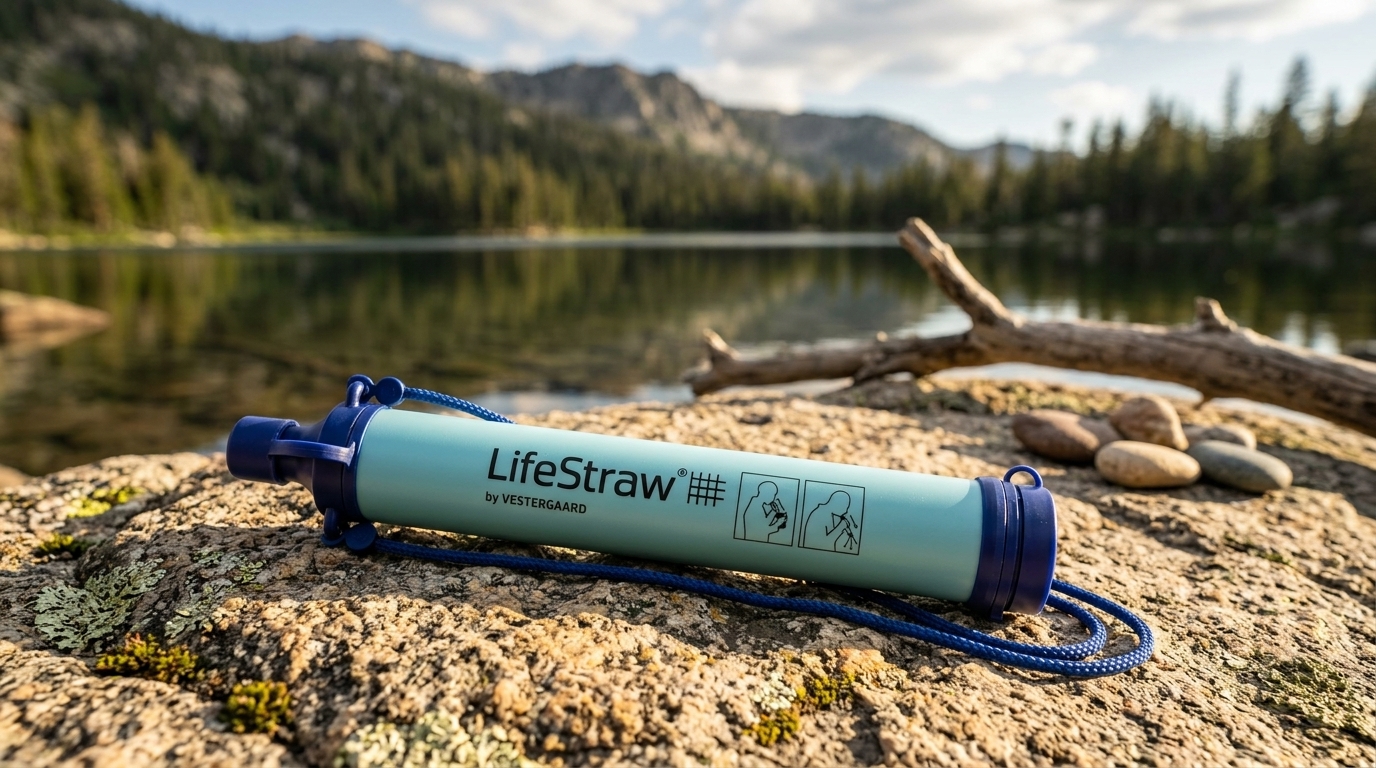
The LifeStraw Personal Water Filter is a 57-gram hollow-fiber membrane straw designed for emergency preparedness and minimalist day hiking where you can drink directly from sources. It filters to 0.2 microns (removing 99.999999% of bacteria and 99.999% of protozoa per EPA standards) but does not remove viruses, chemicals, or heavy metals. This is the tradeoff: unmatched simplicity and weight for scenarios where treated municipal sources or clean backcountry water is your baseline, but limited utility in developing-world travel or contaminated water environments.
Disclosure: Four Seasons Gear is reader-supported. When you buy through links on our site, we may earn an affiliate commission at no extra cost to you. Prices and availability are accurate as of the time we last checked.
Specifications
Specs
Construction and Filtration Mechanism
The LifeStraw uses a bundle of hollow-fiber membranes—thousands of microscopic tubes with 0.2-micron pore walls. Water is drawn through the fibers by suction; contaminants larger than 0.2 microns are physically blocked. The housing is BPA-free plastic with a lanyard loop and removable caps on both ends. There are no moving parts, no batteries, no cartridges to replace. The membrane is rated for 4,000 liters before the pores clog irreversibly, though real-world capacity depends heavily on source turbidity.
The straw measures 22.5 cm long and 2.5 cm in diameter, fitting easily in a side pocket or clipped to a pack. At 57 grams, it's lighter than most smartphone cases. The mouthpiece is rigid plastic—not soft silicone—so prolonged sucking can be uncomfortable. The intake end has no prefilter screen, so you're drawing silt and organic matter directly into the membrane if you're not careful about source selection.
Intended Use Cases and Drinking Workflow
The LifeStraw is designed for point-of-use filtration: you kneel at a stream, pond, or puddle and drink through the straw. Initial suction requires moderate effort (the membrane creates resistance), and flow slows noticeably as the filter loads with sediment. You cannot fill a bottle or hydration bladder without a separate adapter system (LifeStraw sells a bottle cap adapter, but it's not included). You cannot share filtered water with a hiking partner unless they drink from the same straw. You cannot cook with filtered water unless you draw it into your mouth and spit it into a pot—an impractical workflow.
This makes the LifeStraw ideal for solo day hikers on well-maintained trails with frequent stream crossings, emergency kits (car, bug-out bag), and international travel where you need a backup for questionable tap water. It is poorly suited for group trips, alpine environments with limited water access, or any scenario requiring hands-free hydration or camp cooking.
Category Context and Alternatives
The LifeStraw occupies the extreme minimalist end of the backcountry water filter spectrum. For comparison: the Sawyer Mini (also hollow-fiber, 0.1 microns, 56 grams) includes a squeeze pouch and bottle adapter, making it more versatile for the same weight. The Katadyn BeFree (0.1 microns, 59 grams with 0.6 L flask) integrates a collapsible bottle and higher flow rate. The MSR TrailShot (0.2 microns, 142 grams) adds a hand pump for faster filling. The LifeStraw trades all that functionality for simplicity: no setup, no learning curve, no accessories to lose.
Where the LifeStraw wins is price (typically $15–20) and idiot-proof operation. You cannot assemble it incorrectly or forget to close a valve. Where it loses is flexibility: if you need to filter into a container, hydrate on the move, or treat water for a group, you've bought the wrong tool.
Durability and Maintenance Considerations
Hollow-fiber membranes are mechanically robust—the fibers themselves resist tearing—but vulnerable to freezing and irreversible clogging. If water inside the LifeStraw freezes, ice crystals can rupture the membrane walls, rendering the filter useless (and you won't know until you test it). The manufacturer advises blowing out residual water after each use and storing the filter dry. In practice, this is difficult to verify in the field.
The 4,000-liter capacity assumes clear water. Muddy or algae-laden sources load the membrane faster, reducing effective lifespan. The LifeStraw includes a backflush function (blow air back through the straw to dislodge debris), which can restore flow temporarily, but once the pores are fully clogged, the filter is done. There is no replacement cartridge; you discard the unit. The plastic housing is durable enough for years of occasional use but will crack if stepped on or crushed in a pack.
Value Proposition
At $15–20, the LifeStraw delivers exceptional cost-per-liter for emergency preparedness. A single unit can theoretically filter 4,000 liters—enough for one person to drink 2 liters per day for 5.5 years. For a day hiker who encounters three streams per outing and hikes 20 times per season, the LifeStraw could last a decade. For a backpacker who needs to filter 6 liters per day for camp cooking and hydration, the workflow limitations outweigh the cost savings.
The value calculation hinges on use case. If you need a set-it-and-forget-it emergency filter for a car kit or a lightweight backup for international travel, the LifeStraw is hard to beat. If you need a primary backcountry filter for multi-day trips, spend the extra $10–15 for a Sawyer Squeeze or BeFree system that can fill bottles and bladders.
Pros and Cons
What we like
Trade-offs
Best For and Not For
- Solo day hikers on trails with frequent water access who drink directly from sources
- Emergency preparedness kits (car, home, bug-out bag) where weight and shelf life matter
- International travelers needing a backup filter for questionable tap water in hotels
- Minimalist gram-counters willing to trade convenience for weight savings
- Scout troops and youth groups teaching water safety on a budget
Frequently Asked Questions
+Can I use the LifeStraw to fill a water bottle?
Not directly. The LifeStraw is a personal drinking straw—you suck water through it. LifeStraw sells a separate bottle adapter cap that threads onto standard bottles, but it's not included with the Personal filter. For fill-and-go functionality, consider the Sawyer Mini or Sawyer Squeeze, which include squeeze pouches and inline adapters.
+Does the LifeStraw remove viruses?
No. The 0.2-micron pore size blocks bacteria (typically 0.5–3 microns) and protozoan cysts (5–15 microns) but not viruses (0.02–0.3 microns). In North American backcountry, waterborne viruses are uncommon; in developing countries or areas with human fecal contamination, pair the LifeStraw with chemical treatment (chlorine dioxide tablets) or use a filter with virus removal (e.g., Grayl GeoPress with purifier cartridge).
+How do I know when the filter is used up?
The LifeStraw doesn't have a built-in indicator. The manufacturer rates capacity at 4,000 liters, but real-world lifespan depends on water turbidity. When suction becomes extremely difficult despite backflushing, or when flow stops entirely, the membrane is clogged and the filter should be replaced. There is no way to visually inspect the membrane for damage, so if you suspect freezing or contamination, replace the unit.
+Can I clean or replace the filter element?
You cannot replace the hollow-fiber membrane—the LifeStraw is a sealed unit. You can backflush it by blowing air back through the straw (from the mouthpiece end toward the intake) to dislodge sediment, which temporarily restores flow. The manufacturer recommends backflushing after each use and storing the filter dry to prevent mold and freeze damage.
+What happens if the LifeStraw freezes?
Freezing can rupture the hollow-fiber membrane walls, creating pathways for contaminants to bypass filtration. The damage is invisible and irreversible. If your LifeStraw freezes, LifeStraw recommends discarding it. To prevent freezing, blow out residual water after each use and store the filter inside your sleeping bag or jacket when temperatures drop below 32°F (0°C).
The Verdict: A Specialist Tool for Specific Scenarios
The LifeStraw Personal Water Filter is not a do-everything backcountry filter—it's a 57-gram insurance policy for scenarios where you need to drink directly from a source and weight or simplicity is paramount. It excels in emergency kits, day-hike minimalism, and travel backup roles. It fails when you need to fill containers, hydrate on the move, or treat water for cooking. If your use case aligns with its strengths, the LifeStraw delivers exceptional value. If you need versatility, spend a few dollars more for a system with bottle adapters or squeeze pouches.

Read next
More from this category
REVIEW
MSR Guardian Water Purifier Annual Maintenance Kit Review
REVIEW
GRAYL GeoPress 24 oz Water Purifier Bottle Review: Press-Filter Speed for Backcountry and Travel
REVIEW
Platypus GravityWorks Group Camping Water Filter System Review
REVIEW
KATADYN Steripen Classic 3 UV Water Purifier Review: Battery-Powered Pathogen Control for Clear Water
REVIEW
Katadyn Hiker Microfilter Review: Pump-Action Reliability for Group Trips
REVIEW