
Review · spring · summer · fall
Marmot Women's Precip Eco Rain Jacket Review: Budget-Friendly 2.5-Layer Shell
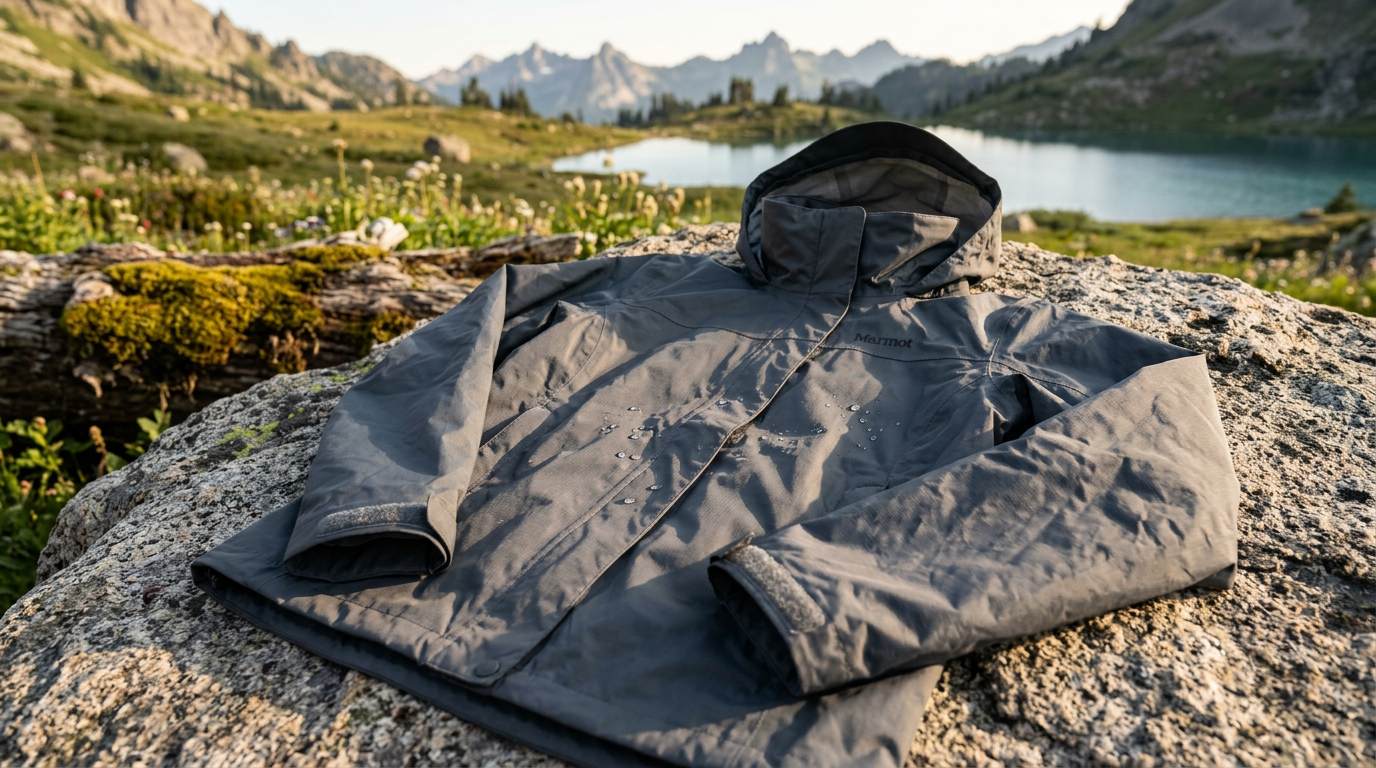
The Marmot Women's Precip Eco is a budget-conscious 2.5-layer rain shell designed for day hikers and casual backpackers who need reliable storm protection without premium-shell pricing. Built around Marmot's proprietary NanoPro membrane with PFC-free DWR and full seam taping, it delivers waterproof performance in the $100–120 range where most competitors compromise on features or construction. The tradeoff: heavier weight and less breathability than 3-layer Gore-Tex alternatives, making it better suited for moderate-output activities in spring and fall rather than high-exertion alpine scrambles or summer humidity.
Disclosure: Four Seasons Gear is reader-supported. When you buy through links on our site, we may earn an affiliate commission at no extra cost to you. Prices and availability are accurate as of the time we last checked.
Construction and Materials
The Precip Eco uses Marmot's NanoPro membrane, a proprietary 2.5-layer laminate that bonds a waterproof-breathable film to the face fabric with a protective print or coating on the interior (the "half layer"). This construction is lighter and more packable than traditional 3-layer shells but less durable against abrasion from pack straps or rock contact. Marmot doesn't publish specific waterproof ratings, but 2.5-layer membranes in this price tier typically achieve 10,000+ mm hydrostatic head — adequate for sustained rain but below the 20,000+ mm of expedition-grade shells.
The face fabric receives a PFC-free (perfluorinated chemical-free) DWR treatment, reflecting industry movement away from legacy C8 chemistries. PFC-free DWRs perform comparably when fresh but require more frequent reapplication — expect to retreat with Nikwax or similar products every 20–30 days of field use to maintain bead-up. All seams are taped, eliminating leak paths at stitching lines. The DriClime-lined chin guard uses a brushed tricot that wicks moisture away from skin, reducing the clammy feel common with coated nylon against the neck.
Specs
Ventilation and Breathability
Underarm pit zips run approximately 18 cm and open to mesh gussets, providing mechanical ventilation when the membrane's inherent breathability can't keep pace with heat output. This feature is critical for 2.5-layer shells: the printed interior layer reduces vapor transmission compared to 3-layer constructions, so active hikers climbing steep grades will rely heavily on the pit zips to dump heat. OutdoorGearLab's testing noted that the Precip Eco's breathability lags behind pricier competitors like the Patagonia Torrentshell 3L or Arc'teryx Beta LT, making the pit zips non-negotiable for anything beyond walking pace.
The adjustable drawcord hem and Velcro cuff tabs let you fine-tune airflow at the jacket's openings. Cinching the hem prevents updrafts that can billow the shell and trap humid air; loosening the cuffs allows wrist ventilation when you're generating heat but still need rain coverage overhead. Switchback Travel's review flagged the lack of a two-way front zipper, which would enable bottom-up venting while keeping the chest protected — a feature present on some shells in this price range.
Fit, Pockets, and Packability
Marmot cuts the Precip Eco with a regular fit that accommodates a midweight fleece or synthetic puffy underneath without excess fabric. The hem falls to mid-hip, providing coverage over a hipbelt but leaving the lower back exposed when reaching overhead — a compromise acceptable for day hikes but less ideal for multi-day trips where you're frequently bending to set up camp or retrieve gear from a pack. Two zippered hand pockets sit above the hipbelt line and feature storm flaps to prevent rain intrusion; they're sized for a smartphone or GPS unit but not deep enough for bulky items like gloves or a headlamp.
The jacket stuffs into its own left hand pocket, compressing to approximately the size of a 1-liter Nalgene. This self-stowing design is convenient for tossing the shell into a daypack's top pocket or lashing it to the outside with a carabiner, though the stuffed bundle lacks the compression of a dedicated stuff sack. Approximate packed dimensions are 20 cm × 12 cm × 10 cm (manufacturer spec, verify before purchase).
Durability Considerations
The 2.5-layer construction prioritizes weight savings over abrasion resistance. The interior print layer is vulnerable to delamination where it contacts pack shoulder straps, hipbelt buckles, or rough rock during scrambles — expect accelerated wear at high-friction points after 50–100 days of use. Section Hiker's review recommended treating the Precip Eco as a "disposable" shell in the 2–3 season lifespan category rather than a decade-long investment piece. The face fabric's denier isn't published, but tactile assessment suggests a 40D or lighter weave, which will snag on branches or sharp granite more readily than 70D+ expedition shells.
The YKK zippers (pit zips and hand pockets) are durable components, but the Velcro cuff tabs will accumulate lint and lose grip over time. Plan to clean the hook-side Velcro with a stiff brush every 10–15 wears to maintain adjustment range. The DWR coating's longevity depends on washing frequency and storage conditions: UV exposure and body oils degrade PFC-free treatments faster than legacy chemistries, so store the jacket in a cool, dark space and wash with tech-specific detergents (no fabric softener) to maximize DWR lifespan.
Category Context and Comparisons
The Precip Eco occupies the budget end of the 2.5-layer rain shell spectrum, competing directly with the REI Co-op XeroDry GTX (Gore-Tex at $149) and the Outdoor Research Apollo (AscentShell at $199). Marmot's $120 price point undercuts both while maintaining full seam taping and pit zips — features sometimes omitted from sub-$100 shells. The tradeoff is weight: at approximately 340–370 g for a size medium, the Precip Eco is 50–80 g heavier than ultralight options like the Montbell Versalite (188 g) or Patagonia Houdini Air (164 g), though those lighter shells sacrifice pit zips and durable face fabrics.
CleverHiker's comparative testing positioned the Precip Eco as a "value leader" for hikers who encounter rain 10–20 days per season but don't need the breathability or packability of a $300+ shell. It's a rational choice for shoulder-season day hikes in the Pacific Northwest or Appalachian spring, where you're carrying the shell "just in case" rather than wearing it for hours in driving rain. For ultralight backpackers counting every gram, the weight penalty is significant; for casual hikers prioritizing cost per wear, it's negligible.
Value Proposition
At $119.95 MSRP, the Precip Eco delivers waterproof protection, pit zips, and full seam taping for roughly half the cost of Gore-Tex Pro shells. This pricing makes sense for hikers who need a functional rain layer but can't justify $250–400 for a shell they'll wear 15 days per year. The 2–3 season durability window means you're paying $40–60 per season of use — comparable to replacing a cheaper poncho annually but with better fit and ventilation.
The value calculation shifts if you're a frequent backpacker or live in a high-rainfall climate. A $300 3-layer shell with 5+ season durability costs $60 per season over its lifespan while offering superior breathability and abrasion resistance. The Precip Eco makes financial sense when rain protection is an occasional need rather than a daily reality, or when you're outfitting multiple family members and need to control per-person costs.
What we like
Trade-offs
Frequently Asked Questions
+How does the Precip Eco's breathability compare to Gore-Tex shells?
The NanoPro 2.5-layer membrane is less breathable than 3-layer Gore-Tex constructions. The printed interior layer (the "half layer") reduces vapor transmission, so you'll rely more heavily on the pit zips to dump heat during climbs or fast-paced hiking. For low-output activities like walking on flat trails or standing around camp, the breathability difference is negligible. For steep ascents or summer heat, Gore-Tex or eVent membranes will feel less clammy.
+Can I use this jacket for winter skiing or snowboarding?
The Precip Eco lacks a powder skirt, helmet-compatible hood, and the abrasion resistance needed for resort or backcountry skiing. It's designed as a 3-season hiking shell for spring, summer, and fall use. For winter sports, look at dedicated ski shells with reinforced shoulders, longer hems, and features like goggle pockets or RECCO reflectors.
+How often do I need to retreat the PFC-free DWR?
Plan to retreat every 20–30 days of field use, or whenever you notice water soaking into the face fabric rather than beading up. PFC-free DWRs degrade faster than legacy C8 chemistries due to UV exposure and body oils. Wash the jacket with tech-specific detergent (no fabric softener), tumble dry on low heat to reactivate the existing DWR, then apply a spray-on or wash-in DWR product like Nikwax TX.Direct if bead-up doesn't return.
+What's the expected lifespan for the Precip Eco?
Expect 2–3 seasons (50–100 days of use) before the interior print layer begins delaminating at high-friction points like shoulder straps or hipbelt contact areas. The face fabric will show abrasion wear from branches or rock scrambles sooner than heavier-denier expedition shells. This is a budget shell designed for occasional use rather than a decade-long investment piece. Proper care (avoiding prolonged UV exposure, washing with gentle detergents, storing in a cool dark space) can extend lifespan toward the upper end of that range.
+Does the jacket have a hood, and is it helmet-compatible?
The Precip Eco includes a fixed hood with a single rear adjustment point (manufacturer spec, verify before purchase). It's sized for bare-head or thin beanie use but not helmet-compatible — the volume and brim stiffness aren't designed to accommodate climbing or cycling helmets. For helmet compatibility, look at shells with multi-point hood adjustments and reinforced brims.

Read next
More from this category
REVIEW
Columbia Men's Watertight II Waterproof Rain Jacket Review
REVIEW
FROGG TOGGS Men's Ultra-Lite2 Rain Suit Review: Budget Emergency Rain Protection
REVIEW
Outdoor Research Men's Helium Rain Jacket Review
BEST OF
Best Rechargeable Headlamps for Backpacking
BEST OF
Best Beginner Binoculars for Hiking and Bird Watching

GUIDE