Buying guide
Water Filter vs Purifier vs Chemical Treatment: A Backcountry Decision Tree
Disclosure: Four Seasons Gear is reader-supported. When you buy through links on our site, we may earn an affiliate commission at no extra cost to you. Prices and availability are accurate as of the time we last checked.
What You're Really Deciding
Every backcountry water treatment method trades off three variables: protection spectrum (what pathogens it removes), treatment speed (how quickly you get drinkable water), and system weight/complexity. Filters excel at fast treatment of bacteria and protozoa but miss viruses. Purifiers add virus protection at the cost of weight, price, or wait time. Chemical treatments cover everything including viruses but require 30+ minute wait times. Your destination's water quality and your tolerance for waiting determine which compromise makes sense.
Understanding Pathogen Classes and Real Risk
Backcountry water contains three pathogen categories, each with different size profiles and removal requirements. Protozoan cysts (Giardia, Cryptosporidium) measure 4-15 microns and cause the majority of North American waterborne illness. Bacteria (E. coli, Salmonella, Campylobacter) range from 0.2-10 microns. Viruses (norovirus, hepatitis A, rotavirus) measure 0.02-0.3 microns—small enough to pass through most filter media. The EPA defines filters as devices removing bacteria and protozoa (typically via 0.1-0.2 micron absolute pore size), while purifiers must also remove or inactivate viruses, meeting a 99.99% reduction standard for bacteria, 99.9% for protozoa, and 99.99% for viruses.
Mechanical Filters: Speed and Simplicity
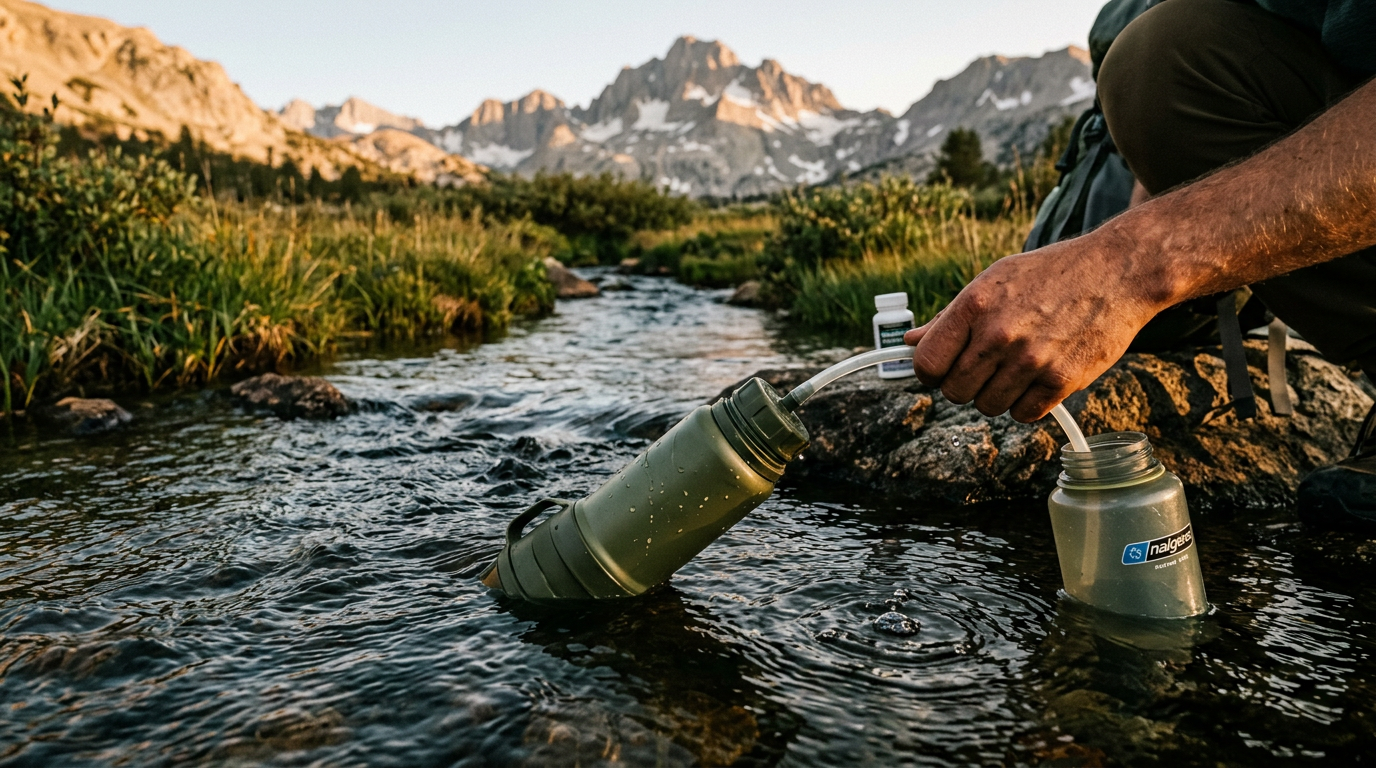
Mechanical filters use hollow-fiber membranes or depth media (pleated cartridges, ceramic elements) to physically strain out pathogens. Hollow-fiber designs like the Sawyer Squeeze Water Filter System dominate the lightweight backpacking category, offering 0.1 micron absolute filtration in a 3-ounce package. These filters provide immediate drinkable water—squeeze a pouch or drink through a straw with zero wait time. Flow rates range from 1-2 liters per minute for gravity and pump systems down to sip-rate for personal straws like the LifeStraw Personal Water Filter.
Specs
The critical limitation: filters don't remove viruses. In North American wilderness above treeline with minimal human impact, virus risk approaches zero—making filters entirely adequate. The Sawyer Mini Water Filter exemplifies this use case, providing robust protozoa and bacteria protection at 2 ounces for weekend trips where viral contamination is implausible. Filters also remove sediment and improve taste by catching particulates, though turbid water clogs media faster and requires backflushing or replacement.
When Filters Aren't Enough: The Virus Question
Viruses become a concern in three scenarios: international travel to regions with poor sanitation, domestic areas with high human traffic (popular front-country campsites, downstream of settlements), and anywhere fecal contamination from humans is likely. Hepatitis A and norovirus are the primary viral threats in backcountry contexts. A 0.1 micron filter pore is 3-5× larger than most viruses—they pass straight through. This is where purifiers or chemical treatment become necessary.
UV Purifiers: Electronic Virus Protection
UV-C light at 254 nanometers disrupts pathogen DNA, rendering viruses, bacteria, and protozoa unable to reproduce. Devices like the SteriPEN use a mercury or LED bulb to deliver 16-40 millijoule-seconds per square centimeter—enough to exceed EPA purification standards in 60-90 seconds per liter. UV purifiers weigh 3-5 ounces with batteries, treat water faster than chemicals, and leave no taste. The trade-offs: they require clear water (turbidity blocks UV transmission, necessitating pre-filtering), battery dependence (lithium cells lose capacity in cold), and careful technique (full immersion, proper stirring, no shadowing).
Specs
UV purifiers shine for international travel and fast-moving itineraries where you're treating 2-4 liters per day from varied sources. They're less ideal for extended trips (battery logistics), freezing conditions (lithium performance degrades below 0°C), or silty water sources requiring pre-filtration anyway.
Chemical Treatment: The Lightweight Backup
Chemical purifiers use chlorine dioxide, iodine, or mixed oxidants to oxidize pathogen cell structures. Chlorine dioxide tablets (Katadyn Micropur, Aquamira) are the current standard—they kill viruses, bacteria, and protozoa, leave minimal taste at proper dosing, and weigh essentially nothing (30 tablets treat 30 liters at 0.5 ounces). The mandatory wait time is the defining constraint: 30 minutes for bacteria and viruses, 4 hours for Cryptosporidium in cold water. Iodine works faster (30 minutes for everything except Crypto) but tastes worse and isn't recommended for pregnant women or people with thyroid conditions.
Specs
Chemical treatment excels as a backup system (toss 10 tablets in your first aid kit at 0.2 ounces) and for groups willing to plan ahead—treat water at lunch for dinner, or before bed for morning. It's the only practical option for treating large volumes (filling a camp dromedary bag) without pumping for 20 minutes. The taste issue is manageable: chlorine dioxide at correct dosing (1 tablet per liter, not overdosing) produces barely detectable flavor, and any residual dissipates if you leave the cap loose for 15 minutes post-treatment.
Combination Systems: Covering All Bases
Several manufacturers pair mechanical filtration with chemical or UV purification to deliver comprehensive protection. The MSR Guardian pump filter uses a 0.02 micron hollow fiber plus activated carbon and electrostatic adsorption to meet purifier standards—it's the only mechanical pump certified for viruses, at the cost of 17.3 ounces and $350. Grayl's press-style purifiers combine a 0.1 micron filter with electroadsorption media that captures viruses, treating 16 ounces in 10 seconds via a French-press motion. These systems make sense when you need virus protection but want faster treatment than chemicals and don't want battery dependence.
Maintenance and Lifespan Reality
Filter lifespan specs are theoretical maximums assuming clean source water. In practice, expect 50-70% of rated capacity if you're filtering from silty streams or alpine lakes with glacial flour. Hollow-fiber filters are backflushable—the Sawyer Squeeze can be restored to near-original flow rate by reverse-flushing with the included syringe every 10-20 liters in turbid conditions. Pleated cartridge filters (Katadyn Hiker Pro) aren't backflushable; flow rate degrades over their 750-liter lifespan and replacement cartridges cost $50-70.
Chemical tablets have fixed shelf lives: chlorine dioxide tablets last 4-5 years sealed, one year after opening the foil strip. Store them cool and dry—heat accelerates degradation. UV bulbs are rated for 8,000-10,000 activations (roughly 8,000 liters), but LED versions outlast mercury bulbs and maintain output better. Batteries are the weak link: carry spares and know that cold temperatures cut lithium battery capacity by 30-50%.
Field Technique: Where Systems Fail
Most water treatment failures stem from user error, not device malfunction. For filters, cross-contamination is the primary risk—touching the clean spout after handling the dirty intake, or storing a wet filter without drying the clean side. Hollow-fiber filters can freeze and crack if stored with water inside below 0°C; squeeze out all water and blow through the filter before freezing nights. UV purifiers fail when users don't stir adequately (leaving shadow zones untreated) or treat turbid water without pre-filtering. Chemical treatments fail when users don't wait the full time (that 30-minute minimum isn't negotiable) or overdose to compensate for cold water instead of simply waiting longer.
- Always dry-store hollow-fiber filters if overnight temps drop below freezing—a single freeze-thaw with water inside can crack fibers and allow pathogens through
- Pre-filter turbid water through a bandana or coffee filter before UV treatment or fine-pore filtration to extend media life and ensure UV transmission
- Mark your clean and dirty water containers distinctly—use a red stuff sack for dirty, blue for clean, or label with tape
- For chemical treatment in cold water (<10°C), double the wait time or warm the water first by keeping the bottle inside your jacket
- Backflush hollow-fiber filters in the field when flow rate drops to 50% of original—don't wait until you're home
Match the System to Your Trip
Your destination and trip style determine which treatment method makes sense. Here's how to map your parameters to appropriate systems:
**North American alpine backpacking (above treeline, minimal human impact, 2-5 days):** Hollow-fiber filter only. Virus risk is negligible, protozoa and bacteria are your only concerns, and you want minimal weight and immediate treatment. The Sawyer Squeeze Water Filter System at 3 ounces is the benchmark here—adequate protection, proven reliability, and you can filter straight into your water bottle or hydration bladder.
**Popular front-country trails or international travel (high human traffic, questionable sanitation, 3-10 days):** UV purifier or filter + chemical combination. You need virus protection. A SteriPEN gives you 90-second treatment with full pathogen coverage if you're treating clear water and have battery logistics sorted. Alternatively, pair a 2-ounce hollow-fiber filter with chlorine dioxide tablets—filter for immediate drinking, dose with tablets for overnight storage and virus kill.
**Group trips or base camping (treating large volumes, 4+ people, multi-day stays):** Gravity filter system or pump filter plus chemical treatment for bulk storage. Gravity systems (Platypus GravityWorks, Sawyer Squeeze with gravity bag) let you filter 4-10 liters hands-free while you set up camp. For base camp use, treat a 10-liter dromedary bag with chlorine dioxide tablets at arrival—your whole group has drinking water with zero ongoing effort.
**Ultralight fast-packing or trail running (minimal pack weight, high daily mileage, 1-3 days):** Straw-style filter or chemical tablets only. The LifeStraw Personal Water Filter at 2 ounces lets you drink directly from sources without carrying water weight between reliable streams. If water sources are spaced >5 miles apart, carry chemical tablets and a 1-liter bottle—dose at each source and drink treated water by the time you reach the next.
**Winter camping or high-altitude mountaineering (freezing temps, melting snow, 3-7 days):** Chemical treatment only, or no treatment if melting snow. Mechanical filters freeze and crack, UV purifiers suffer battery issues, but chlorine dioxide tablets work fine (just wait longer in cold water). If you're melting snow for all water, pathogens aren't a concern—bringing water to a boil for cooking provides automatic purification.
The Boiling Alternative
Boiling water kills all pathogens—viruses, bacteria, and protozoa—at any altitude. The CDC standard is one minute at a rolling boil at elevations below 6,500 feet, three minutes above that elevation (though recent studies suggest 30 seconds is sufficient even at altitude, as pathogens die at 160-185°F, well below boiling). Boiling requires no gear weight beyond your existing stove, works in any water quality, and has zero failure modes. The trade-offs are fuel consumption (roughly 0.25 oz of canister fuel per liter boiled) and time—you're waiting for water to cool before drinking, and you can't treat large volumes efficiently unless you're already cooking.
Boiling makes sense for short trips where you're cooking all meals anyway (the Jetboil Flash Cooking System brings water to boil in 100 seconds—treat your drinking water while you're heating dinner), winter camping where filters freeze, or emergency backup when your primary system fails. It's impractical for day hikes, hot weather when you want cold water immediately, or any scenario where you're not carrying a stove.
Cost-Per-Liter Reality Check
Initial purchase price misleads—cost per liter treated over the device lifespan matters more. A $25 Sawyer Squeeze rated for 100,000 gallons costs $0.00007 per liter. A $100 SteriPEN treating 8,000 liters on one bulb costs $0.0125 per liter, plus battery costs. Chlorine dioxide tablets at $15 per 30-liter supply cost $0.50 per liter—250× more than a hollow-fiber filter per liter treated. For weekend warriors treating 50 liters per year, the difference is negligible. For thru-hikers treating 3 liters daily for 150 days (450 liters), a filter saves $200+ over chemicals.
Replacement parts shift the math: UV purifier batteries cost $8-15 per set (treating 40-80 liters), and replacement bulbs run $50-70. Pump filter cartridges cost $40-70 every 750-1,500 liters. Hollow-fiber filters have no consumables if you maintain them properly—backflush regularly, dry before freezing, and they last indefinitely. This makes hollow-fiber filters the most economical option for high-volume users, while chemicals make sense for occasional users who want zero maintenance.
FAQ
+Do I really need to treat water in remote wilderness areas?
The conservative answer is yes—even remote sources can harbor Giardia from animal waste, and the consequences of infection (7-10 days of severe diarrhea starting 1-2 weeks post-exposure) ruin trips and can be dangerous in the backcountry. That said, actual infection rates are lower than often claimed. Studies show Giardia present in only 3-8% of tested alpine water sources, and many backpackers drink untreated water for years without incident. Treatment is risk management, not necessity—your risk tolerance and trip consequences (are you 2 days from a trailhead or 8?) should guide your decision. For most people, the minimal weight and effort of a Sawyer Mini Water Filter or chlorine dioxide tablets is worth the insurance.
+Can I use a filter in freezing conditions?
Hollow-fiber filters can be used in freezing conditions, but you must prevent water from freezing inside the fibers—ice expansion cracks the hollow fibers, creating pathways for pathogens to bypass filtration. In the field, squeeze or blow out all water after each use, then store the filter inside your jacket or sleeping bag at night. If a filter does freeze with water inside, assume it's compromised and switch to chemical treatment or boiling. Some users carry a filter in freezing conditions and rely on chemical tablets as primary treatment, using the filter only for particulate removal and taste improvement without depending on it for pathogen protection. For extended winter trips, chemical treatment or boiling is more reliable than trying to keep a filter from freezing.
+How do I know when my filter needs replacing?
Flow rate is the primary indicator—when backflushing no longer restores flow to 70-80% of original rate, the filter media is clogged beyond recovery. For hollow-fiber filters, this typically happens at 50-70% of rated capacity in real-world conditions with turbid water. Pleated cartridge filters show gradual flow decline over their 750-1,500 liter lifespan. Physical damage is the other replacement trigger: if you freeze a hollow-fiber filter with water inside, drop a ceramic filter hard enough to crack it, or see visible tears or holes in any filter media, replace immediately. Some filters have built-in indicators (color-changing tabs, mechanical counters), but these are approximations—trust flow rate and visual inspection over indicator widgets. For safety-critical applications (international travel, long expeditions), replace filters at 50-60% of rated capacity rather than pushing them to failure.
+What's the real difference between 0.1 and 0.2 micron filters?
Both pore sizes remove protozoa (4-15 microns) and bacteria (0.2-10 microns) with >99.9% efficiency—the difference is marketing more than performance. A 0.1 micron absolute filter (Sawyer, LifeStraw) provides a larger safety margin for bacteria removal, while 0.2 micron filters (many pump-style filters) still exceed EPA standards for bacteria and protozoa removal. Neither removes viruses (0.02-0.3 microns). The practical difference is flow rate—0.2 micron filters typically flow faster than 0.1 micron filters, all else equal. For North American backcountry use where viruses aren't a concern, both pore sizes provide equivalent real-world protection. Focus on system design (hollow fiber vs. pleated, gravity vs. pump) and maintenance requirements rather than obsessing over 0.1 vs. 0.2 micron specs.
+Can I trust a $20 filter as much as a $100 purifier?
For bacteria and protozoa removal in North American wilderness, yes—a $20 Sawyer Squeeze Water Filter System provides equivalent protection to a $100+ pump filter or purifier. The price difference reflects features (pump convenience, faster flow, durability), not pathogen removal efficacy. Both meet EPA standards for filter performance. The question is whether you need virus protection: if you're traveling internationally or in high-traffic domestic areas with human waste concerns, a $20 filter isn't adequate regardless of its bacteria/protozoa performance. In that case, you need a true purifier (UV device, chemical treatment, or combination system) that addresses viruses. But for most weekend backpacking in North America above treeline, a $20 hollow-fiber filter provides the same safety as devices costing 5× more.
+Why do some sources recommend both filtering and chemical treatment?
Layered treatment provides defense in depth—filtering removes particulates and most pathogens immediately, while chemical treatment kills any viruses that passed through the filter and provides residual protection if you're storing water for hours or days. This combination is overkill for most North American backcountry use but makes sense for international travel (comprehensive virus protection), long expeditions where equipment failure is high-consequence, or treating highly questionable water sources. The other reason to combine methods is practical: filter for immediate drinking when you're thirsty, then dose filtered water with tablets for overnight storage—you get speed and virus coverage without waiting 30 minutes every time you want a drink. The weight penalty is minimal (a hollow-fiber filter plus 10 chlorine dioxide tablets is under 4 ounces), making it reasonable insurance for trips where water quality is uncertain.