Buying guide
How to Pick Ski Gloves vs Mittens for the Resort and the Backcountry
Disclosure: Four Seasons Gear is reader-supported. When you buy through links on our site, we may earn an affiliate commission at no extra cost to you. Prices and availability are accurate as of the time we last checked.
What You're Really Deciding
The core trade-off is dexterity versus warmth. Gloves give you independent finger movement for zippers, buckles, and phone screens, but each finger loses heat through its own surface area. Mittens keep four fingers together in a shared pocket, drastically reducing heat loss—mittens are typically 10–15°F warmer than gloves with identical insulation—but you sacrifice fine motor control. The second axis is insulation type: synthetic fills dry faster and work when wet, while down packs smaller and offers better warmth-to-weight at the cost of performance in damp conditions. The third is shell construction—removable liners add versatility but bulk, while single-wall designs are sleeker and more packable. Your choice hinges on your coldest expected temperature, whether you're mostly riding lifts or skinning uphill, and how often you need to fiddle with gear.
Gloves vs Mittens: The Warmth-Dexterity Spectrum
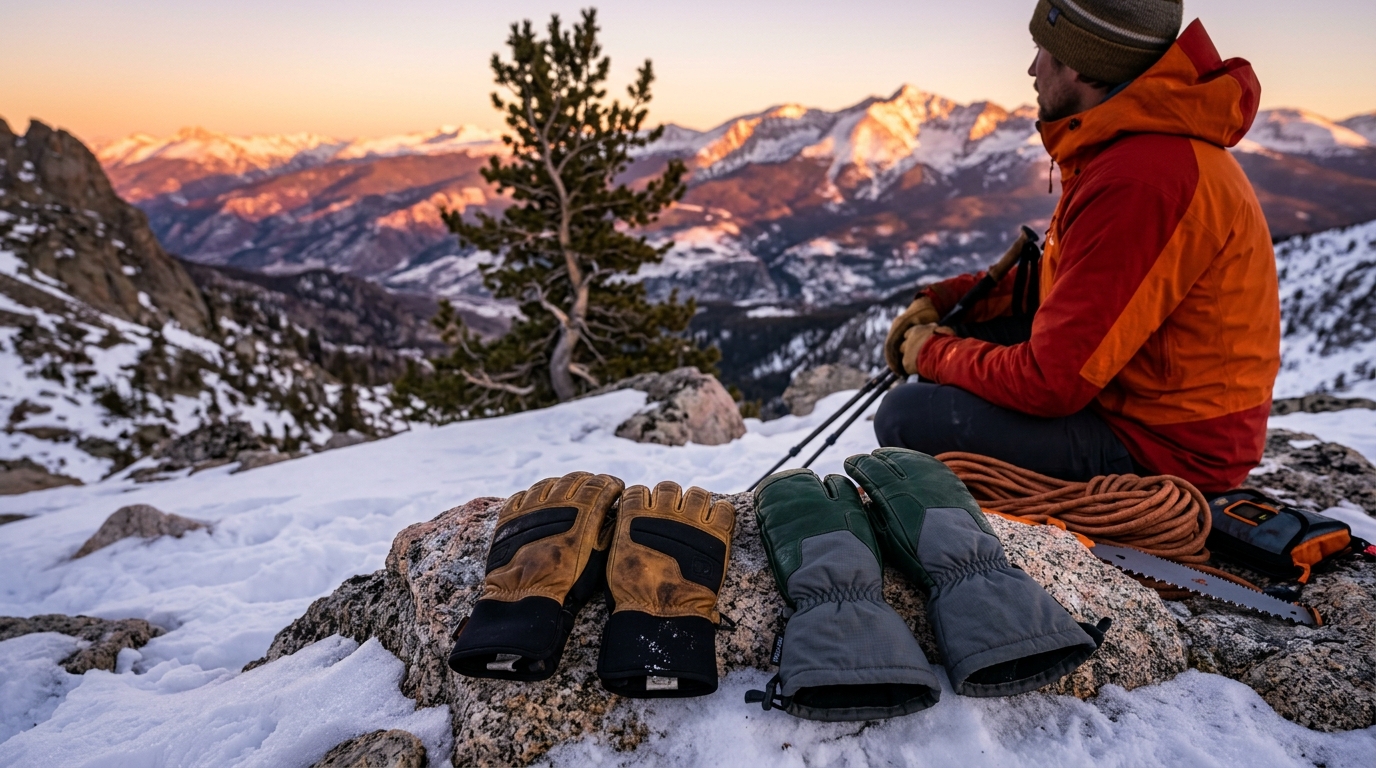
Mittens dominate in sub-zero resort days and long backcountry tours where warmth is non-negotiable. Because your fingers share body heat, mittens maintain core hand temperature even when you're stationary on a chairlift. Gloves shine when you're constantly adjusting layers, operating a GPS like the Garmin GPSMAP 67 Handheld GPS, or managing avalanche safety gear in the backcountry. Lobster-claw mittens (also called three-finger mittens) split the difference: index finger separate for trigger control and zipper pulls, three fingers together for warmth. They're about 5–8°F warmer than gloves but less warm than true mittens.
For resort skiing in temperatures above 15°F, most skiers prefer gloves for convenience—you can grab your phone, adjust boots, and handle chairlift bars without removing them. Below 0°F or on high-altitude backcountry missions, mittens become the pragmatic choice unless you're willing to carry a backup pair or accept numb fingers. Many serious backcountry skiers carry both: insulated mittens for the descent and lighter gloves for the skin track, when exertion keeps hands warm and you need dexterity for pole straps and pack adjustments.
Insulation Type: Synthetic vs Down
Synthetic insulation (PrimaLoft, Thinsulate, proprietary polyester blends) is the workhorse for resort and wet-climate skiing. It retains roughly 80% of its warmth when damp, dries in hours, and costs less. Typical insulation weights range from 40g (light resort glove, good to 20°F) to 200g+ (expedition mitten, good to -30°F). Down-insulated gloves and mittens pack smaller and weigh 15–25% less for equivalent warmth, but they're a niche choice: if snow melts inside your glove or you're sweating hard on a skin track, wet down clumps and loses insulating power. Hydrophobic down treatments (DownTek, DriDown) help but don't eliminate the problem.
For resort-only skiing, synthetic is the default unless you're chasing the lightest possible packed weight for sidecountry laps. For backcountry touring, synthetic still wins for most users—your hands sweat during the ascent, and synthetic handles that moisture better. Down mittens make sense for cold, dry environments (think late-season Colorado corn missions or Canadian Rockies powder) where you're not generating much hand sweat and the weight savings matter for long approaches.
Waterproofing and Breathability: Membrane Specs
A waterproof-breathable membrane (Gore-Tex, OutDry, proprietary laminates) is non-negotiable for all-day resort skiing and mandatory for backcountry use. Waterproof ratings are measured in millimeters of water column pressure; 10,000mm is the minimum for serious use, 20,000mm+ is ideal for wet climates or long days. Breathability is measured in grams of moisture vapor transmitted per square meter per 24 hours (g/m²/24h)—look for 10,000g minimum, 20,000g+ for high-output touring.
Gore-Tex remains the benchmark: durable, reliably waterproof, and widely available in glove liners. Event and proprietary membranes from brands like Black Diamond or Outdoor Research often match Gore-Tex performance at lower cost. Avoid gloves marketed as 'water-resistant' or 'DWR-treated' without a membrane—they'll soak through in an hour of wet snow. Leather palms (goat or cowhide) add durability and grip but require more frequent DWR reapplication; synthetic palms are lower-maintenance but wear faster on rope or ski edges.
Liner Systems: Removable vs Fixed
Removable liners let you dry gloves overnight (critical for multi-day hut trips), adjust warmth by swapping liners, and replace a worn liner without buying new shells. The trade-off is bulk—removable-liner gloves are typically 20–30% thicker and less dexterous than equivalent single-wall designs. Fixed-liner gloves are sleeker, pack smaller, and eliminate the hassle of liners bunching or pulling out when you remove the glove, but you can't dry them as easily or customize warmth.
For resort skiing, fixed liners are fine unless you ski multiple days in a row in wet conditions. For backcountry touring, removable liners are worth the bulk if you're doing overnight trips—being able to dry liners in your sleeping bag or by a stove is a significant comfort and safety upgrade. Some backcountry skiers carry a spare set of thin liner gloves (merino or synthetic) to swap in if their primary liners get soaked on a long tour.
Fit and Sizing: The Pre-Curved Hand
Gloves and mittens should fit snug but not tight—excess air space reduces warmth, but constriction cuts off circulation and makes hands colder. Most brands size by hand circumference measured around the knuckles (excluding the thumb): 7.5–8 inches is typically a men's small, 10–10.5 inches a men's XL. Women's-specific models are cut narrower through the palm and fingers. Pre-curved construction (fingers shaped to a natural grip) reduces fatigue and improves dexterity; flat-pattern gloves feel stiff and force your hand to work harder.
Gauntlet cuffs (extending 4–6 inches past the wrist) are standard for skiing—they overlap your jacket sleeve to seal out snow. Under-cuff designs (short cuffs that tuck inside your jacket) are lighter and less bulky but only work if your jacket has snug wrist closures. Wrist leashes are essential for backcountry use—dropping a glove on a ridgeline is a dangerous mistake—but optional for resort skiing.
Key Spec Dimensions Explained
Specs
Myth vs Reality: 'Mittens Are Only for Extreme Cold'
Match the Gear to Your Trip
Use this decision tree to narrow your options based on intended use:
- Resort skiing, temps 20–40°F, dry snow: Synthetic-insulated gloves (60–100g), fixed liner, 10,000mm waterproofing. Prioritize dexterity for lift ops and gear adjustments.
- Resort skiing, temps 0–20°F or wet/heavy snow: Synthetic-insulated gloves (100–150g) or lobster-claw mittens, removable liner optional, 20,000mm waterproofing. Leather palms for durability.
- Resort skiing, temps below 0°F or poor circulation: Synthetic or down mittens (150–200g+), removable liner recommended, 20,000mm waterproofing. Accept reduced dexterity for warmth.
- Backcountry touring, temps 20–40°F: Lightweight synthetic gloves (40–80g), fixed liner, 15,000mm+ waterproofing. Bring a spare liner glove for the descent if you sweat heavily on the ascent.
- Backcountry touring, temps 0–20°F: Synthetic gloves (80–120g) for the ascent, synthetic mittens (120–180g) for the descent. Removable liners. Carry both in your pack.
- Backcountry touring, temps below 0°F or high-altitude: Down or synthetic mittens (180g+), removable liner, 20,000mm waterproofing. Bring lightweight gloves for technical sections requiring dexterity (e.g., setting up a Garmin inReach Mini 2 Satellite Communicator for emergency comms).
- Spring corn skiing or warm, wet conditions: Lightweight synthetic gloves (40–60g), aggressive DWR treatment, 20,000mm waterproofing. Bring a backup pair—gloves will get soaked.
Layering Strategies: Liner Gloves and Shell Combos
Serious backcountry skiers often use a modular system: thin merino or synthetic liner gloves (100–200 weight) worn under waterproof shell mittens or gloves. This setup lets you strip down to liners for high-output ascents, then add shells for descents or rest stops. Liner gloves alone are good to about 30°F during active touring; shells alone (no insulation) work for spring skiing or very high-output days. The combo handles a wider temperature range than any single glove, but it's more expensive and requires managing multiple pieces.
For resort skiing, a liner-plus-shell system is overkill unless you're doing sidecountry laps that involve significant hiking. A single pair of insulated gloves or mittens with removable liners is simpler and sufficient. If you do opt for a modular system, make sure your shell gloves have enough room to accommodate liners without constricting your hands—some shells are cut too tight for this purpose.
Touchscreen Compatibility: When It Matters
Conductive fingertips (usually index finger and thumb) let you operate a phone or GPS without removing gloves. This feature is useful for quick trail map checks, photos, or emergency calls, but it's not a dealbreaker—most skiers just pull off a glove for 10 seconds. Touchscreen compatibility works better on lightweight gloves than heavily insulated ones; thick insulation reduces sensitivity. If you're navigating with a GPS device like the Garmin Instinct 2 Solar GPS Watch on your wrist, touchscreen gloves are less critical—you can operate watch buttons with any glove.
In the backcountry, touchscreen gloves are a minor convenience, not a necessity. If you need to operate a satellite communicator or GPS in an emergency, you'll remove your gloves regardless—precision matters more than speed. For resort skiing, touchscreen compatibility is nice for lift-line photo ops but shouldn't drive your buying decision. Prioritize warmth, waterproofing, and fit over this feature.
Care and Maintenance: Extending Glove Lifespan
Waterproof membranes fail when the DWR (durable water repellent) coating wears off, causing the outer fabric to 'wet out' and preventing breathability. Reapply DWR spray (Nikwax, Granger's) every 10–15 days of use, or when you notice water no longer beading on the shell. Wash gloves in a front-loading machine on gentle cycle with technical-fabric detergent (never regular detergent, which clogs membranes), then tumble dry on low heat to reactivate DWR. Leather palms need periodic treatment with a leather conditioner or waterproofing wax.
Store gloves flat or hanging, never crumpled in a pack—creases in the membrane can create leak points. If your gloves get soaked in the field, wring out excess water and dry them inside your jacket (body heat) or in your sleeping bag overnight. Never dry gloves over a fire or stove—high heat delaminates membranes and melts synthetic insulation. With proper care, quality gloves last 100+ days of skiing; neglect them and they'll fail in 20.
When to Carry Backup Gloves
For resort skiing, a backup pair is unnecessary unless you're skiing multiple consecutive days in wet conditions. For backcountry touring, always carry a lightweight spare pair (thin synthetic or merino gloves, 2–3 oz) in your pack. If your primary gloves get soaked on a long skin track or you drop one on a ridgeline, having a backup can prevent frostbite. Store spares in a waterproof stuff sack in an easily accessible pocket—not the bottom of your pack.
On multi-day hut trips or expeditions, bring two full sets of gloves or mittens: one for daily use, one for emergencies or if the first set doesn't dry overnight. The weight penalty (8–16 oz) is trivial compared to the safety margin. Some skiers also carry chemical hand warmers (HotHands, Grabber) as a backup heat source—they're not a substitute for proper gloves, but they can buy you time if your gloves fail or your hands get dangerously cold.
Frequently Asked Questions
+Can I use the same gloves for resort skiing and backcountry touring?
Yes, but with compromises. A mid-weight synthetic glove (80–120g insulation, removable liner, 15,000mm+ waterproofing) handles both resort days in moderate temps and backcountry tours where you're moving constantly. The limitation is temperature range: this glove will be too warm for high-output spring touring and not warm enough for sub-zero resort days or long rest stops in the backcountry. Serious users eventually buy two pairs—lighter gloves for touring ascents, heavier mittens for resort laps or tour descents. If you're only buying one pair, prioritize the use case where failure is most dangerous: for backcountry touring, that means warm enough for emergencies, even if it's overkill on sunny spring days.
+How do I know if my gloves are too tight or too loose?
Too tight: You can't make a full fist without the glove fabric pulling taut, or your fingertips feel compressed. Tight gloves restrict blood flow and make hands colder, not warmer. Too loose: More than a half-inch of dead space at your fingertips when you make a fist, or the glove shifts around when you grip a pole. Excess air space reduces warmth and control. Correct fit: You can make a fist comfortably, fingertips just touch the end of the glove, and there's a thin layer of air (1–2mm) around your hand but no bunching. Pre-curved gloves should match your natural hand shape when relaxed. Try gloves on with any liner gloves you plan to wear underneath—fit changes significantly with a liner.
+Do I need different gloves for men and women?
Women's-specific gloves are cut narrower through the palm and fingers and have shorter finger lengths for the same hand circumference. If you're a woman with proportionally longer fingers or wider palms, men's gloves may fit better; if you're a man with narrow hands, women's gloves may be a better match. Ignore the label and focus on fit: hand circumference (measured around knuckles, excluding thumb) is the primary sizing metric, but finger length and palm width matter too. Many brands now offer unisex sizing or publish detailed fit specs—compare your measurements to the size chart rather than assuming gender-based sizing will work. Insulation weight and waterproofing specs are identical across men's and women's versions; the only difference is cut.
+How do I dry gloves overnight on a multi-day trip?
If you have removable liners, pull them out and sleep with them in your sleeping bag (near your core, not down by your feet). The shells can air-dry hanging inside the hut or tent—they'll still be damp in the morning but functional. If you have fixed-liner gloves, your options are limited: wring out as much water as possible, then wear them inside your jacket (tucked into armpits) while you sleep to use body heat for drying. This is uncomfortable but effective. Never put wet gloves in a stuff sack or pack—they'll stay wet and may freeze. Some backcountry skiers carry a small mesh bag to hang gloves from the tent ceiling for better airflow. Chemical hand warmers placed inside gloves can speed drying but use them sparingly—you may need them for actual hand warming later.
+Are heated gloves worth it for skiing?
Battery-heated gloves are a niche solution for skiers with severe circulation issues (Raynaud's, frostbite history) who can't stay warm in even the heaviest mittens. They add 4–8 oz of battery weight, require charging, and batteries lose capacity in extreme cold—expect 2–6 hours of heat per charge depending on setting. For most skiers, properly insulated mittens are warmer, lighter, more reliable, and cheaper. If you're considering heated gloves, first try upgrading to expedition-weight mittens (200g+ insulation) or a liner-plus-shell system. Heated gloves make sense if you've exhausted those options and still have cold hands, or if you have a medical condition that impairs circulation. They're not a substitute for adequate insulation—they're a supplement for edge cases.
+What's the difference between ski gloves and snowboard gloves?
Functionally, none—the specs (insulation, waterproofing, membrane) are identical. Snowboard-specific gloves sometimes have extra padding on the palms and knuckles for impact protection when you're learning to ride or doing park laps, and they may have a shorter gauntlet cuff since snowboard jackets tend to have longer sleeves. Ski gloves sometimes have a reinforced index finger for pole grips. These are minor differences; any glove or mitten marketed for 'skiing' or 'snowboarding' works for both sports. Focus on insulation weight, waterproofing, and fit rather than the label. If you're a skier buying a 'snowboard glove,' just make sure it has enough dexterity for pole straps and buckles.