
Head-to-head
Sawyer Squeeze vs Sawyer Mini Water Filter: Which Sawyer Filter Is Right for You?
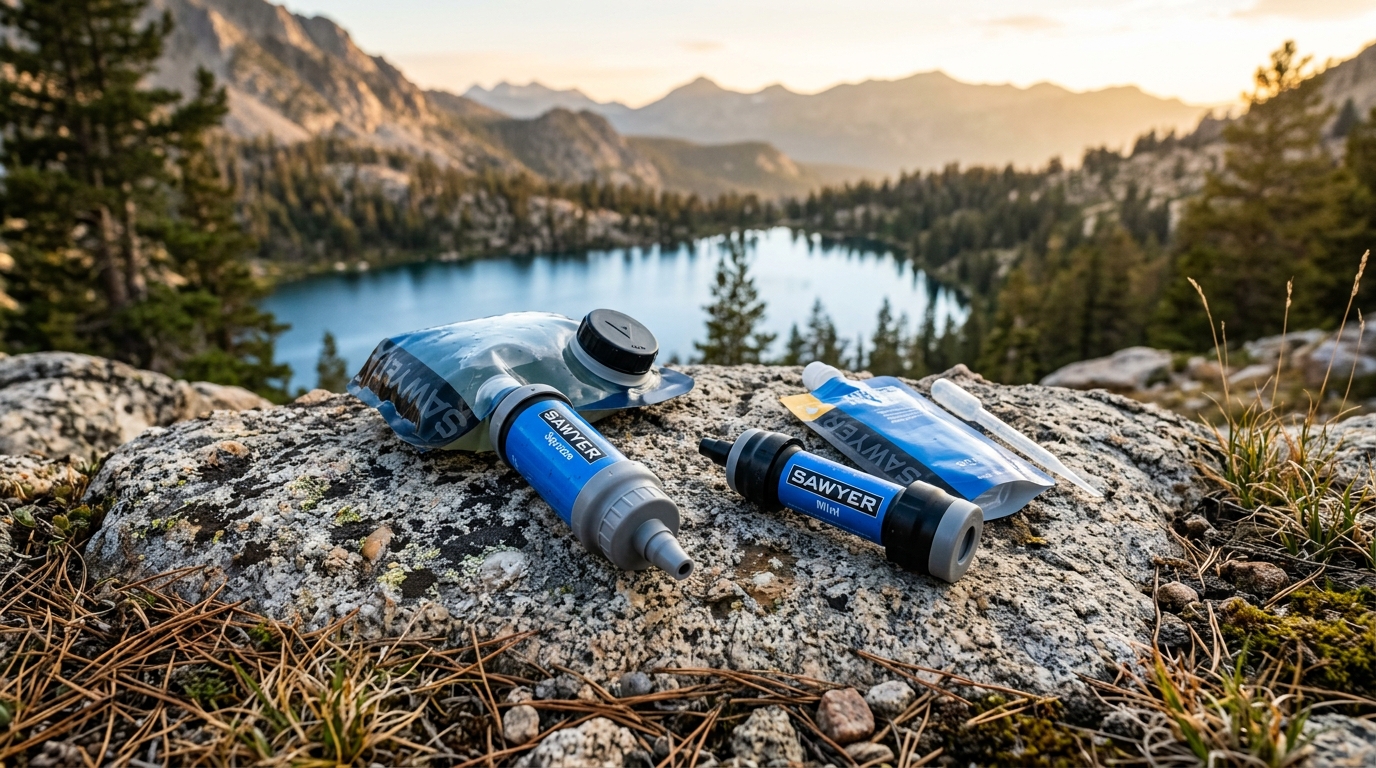
The Sawyer Squeeze wins for most backpackers and serious hikers due to its significantly faster flow rate (1.7 liters per minute vs 1 liter per minute), larger filter surface area, and better long-term durability. However, the Sawyer Mini is the better choice for ultralight enthusiasts, day hikers, or emergency kits where every gram counts—it weighs just 56 grams compared to the Squeeze's 85 grams and costs roughly $10 less while delivering the same 0.1 micron absolute filtration.
Disclosure: Four Seasons Gear is reader-supported. When you buy through links on our site, we may earn an affiliate commission at no extra cost to you. Prices and availability are accurate as of the time we last checked.
Sawyer's hollow fiber membrane filters have dominated the lightweight backpacking market for over a decade, and the Squeeze and Mini represent two points on the same technology spectrum. Both use identical 0.1 micron absolute filtration to remove 99.99999% of bacteria and 99.9999% of protozoa, both attach to standard disposable water bottles or included squeeze pouches, and both can be backflushed in the field to restore flow rate. The critical differences come down to filter size, flow rate, and weight—variables that matter differently depending on whether you're thru-hiking the PCT or packing an emergency kit for your car.
Spec Comparison
Specs
Flow Rate: Where the Squeeze Pulls Ahead
The Sawyer Squeeze delivers 1.7 liters per minute when new, while the Mini manages 1.0 liter per minute—a 70% advantage that becomes critical when you're filtering water for a group or refilling multiple bottles at a water source. In real terms, filling a 1-liter bottle takes roughly 35 seconds with the Squeeze versus 60 seconds with the Mini. That difference compounds: filtering 3 liters for dinner and breakfast takes under 2 minutes with the Squeeze but over 3 minutes with the Mini.
The flow rate gap widens as the filters age. Both models slow down as particulate matter clogs the hollow fibers, but the Squeeze's larger 42mm diameter filter body contains more fiber surface area, so it maintains usable flow rates longer between backflush cycles. Field reports consistently show the Squeeze requiring backflushing every 20-30 liters of turbid water, while the Mini needs attention every 10-15 liters under similar conditions.
Weight and Packability: The Mini's Core Advantage
At 56 grams, the Sawyer Mini undercuts the Squeeze's 85 grams by 29 grams—roughly the weight of a standard energy gel. For ultralight backpackers counting every gram, that's meaningful savings. The Mini's compact 13cm length also packs more efficiently in a hipbelt pocket or the corner of a stuff sack, while the Squeeze's 15cm body and wider diameter demand slightly more real estate.
The included pouches amplify this difference. The Mini ships with a 16-ounce pouch that weighs 21 grams, while the Squeeze includes a 32-ounce pouch at 28 grams. If you're using the provided pouches rather than threading the filters onto disposable water bottles, the total system weight gap narrows to 22 grams—still notable for gram-counters, but less dramatic than the filter-only comparison suggests.
Durability and Longevity
Both filters carry the same 378,541-liter lifetime rating—essentially a lifetime warranty for recreational use. The hollow fiber membranes themselves are equally robust. The practical durability difference emerges in the filter housings and how they tolerate field abuse. The Squeeze's larger diameter body distributes squeeze pressure across more surface area, reducing stress on the hollow fibers during aggressive squeezing. The Mini's narrower body concentrates that pressure, and anecdotal field reports suggest slightly higher rates of fiber breakage (evidenced by cloudy water passing through) after extended hard use.
The included squeeze pouches are the weak link in both systems. The seams fail after 50-100 squeeze cycles regardless of which filter you choose. Serious backpackers budget for replacement pouches or switch to disposable bottles early. The Mini's smaller 16-ounce pouch actually holds up marginally better than the Squeeze's 32-ounce version simply because there's less material to stress at the seams.
Versatility and Use Cases
The Squeeze's faster flow rate and larger pouch make it more practical for group use, base camping, or situations where you're filtering large volumes. The 32-ounce pouch lets you collect water once and filter enough for cooking and drinking without multiple trips to the source. The Mini's 16-ounce pouch requires more frequent refills, which becomes tedious when you need 3+ liters for a camp dinner.
Both filters can be configured as inline filters in hydration bladder systems or gravity setups using aftermarket adapters. The Squeeze's higher flow rate makes it more suitable for gravity systems where flow rate directly impacts filtering speed. The Mini works adequately inline for personal hydration bladders where you're sipping rather than chugging.
For buyers comparing these Sawyer models to other lightweight options, the LifeStraw Personal Water Filter offers an even lighter alternative at 57 grams, though it lacks the Sawyer filters' versatility—you can only drink directly through the straw rather than filtering into containers.
Value Proposition
The Mini typically retails for $25-28, while the Squeeze runs $35-40—roughly a $10 premium for the larger filter. That $10 buys you 70% faster flow, better long-term durability, and a larger collection pouch. For anyone planning multi-day trips or regular backcountry use, the Squeeze's efficiency gains justify the upcharge. The Mini makes more sense as a backup filter, an emergency kit component, or for truly weight-obsessed ultralight hikers where the 29-gram savings matter more than convenience.
Decision Framework
Buy the Sawyer Squeeze if:
- You're filtering water for more than one person regularly
- You value faster flow rates and less time spent at water sources
- You're planning multi-day or thru-hiking trips where filter durability matters
- You need to filter large volumes for cooking and camp use
- The 29-gram weight penalty is acceptable for better performance
Buy the Sawyer Mini if:
- You're building an ultralight kit where every gram counts
- You're primarily doing day hikes or short overnight trips
- You need a compact backup filter or emergency kit component
- You're filtering for one person and don't mind slower flow
- Budget is a primary concern and you want to save $10
Frequently Asked Questions
+Can either filter remove viruses?
No. Both the Squeeze and Mini use 0.1 micron filtration, which removes bacteria and protozoa but not viruses (which are smaller, typically 0.02-0.3 microns). For international travel or areas with known viral contamination, you need chemical treatment (chlorine dioxide tablets) or a purifier with smaller pore size. In North American backcountry, viral contamination is rare enough that most hikers accept the risk.
+How often do I need to backflush these filters?
Backflush frequency depends on water turbidity. In clear alpine streams, you might go 50+ liters between backflushes. In silty desert water sources, you may need to backflush every 10-15 liters to maintain flow rate. The Squeeze's larger filter body tolerates more particulate before flow rate drops noticeably. Both filters include a cleaning syringe—backflushing takes 30-60 seconds and restores most of the original flow rate.
+What happens if these filters freeze?
Freezing can rupture the hollow fiber membranes, creating pathways for contaminated water to pass through unfiltered. Both Sawyer filters must be kept above freezing when wet. If you're winter camping, sleep with the filter in your sleeping bag or keep it in an interior jacket pocket. If a filter freezes, Sawyer recommends discarding it—there's no reliable way to verify membrane integrity after freeze damage.

Read next
More comparisons + reviews
REVIEW
MSR Guardian Water Purifier Annual Maintenance Kit Review
REVIEW
GRAYL GeoPress 24 oz Water Purifier Bottle Review: Press-Filter Speed for Backcountry and Travel
REVIEW
Platypus GravityWorks Group Camping Water Filter System Review
REVIEW
KATADYN Steripen Classic 3 UV Water Purifier Review: Battery-Powered Pathogen Control for Clear Water
REVIEW
Katadyn Hiker Microfilter Review: Pump-Action Reliability for Group Trips
REVIEW