
Head-to-head
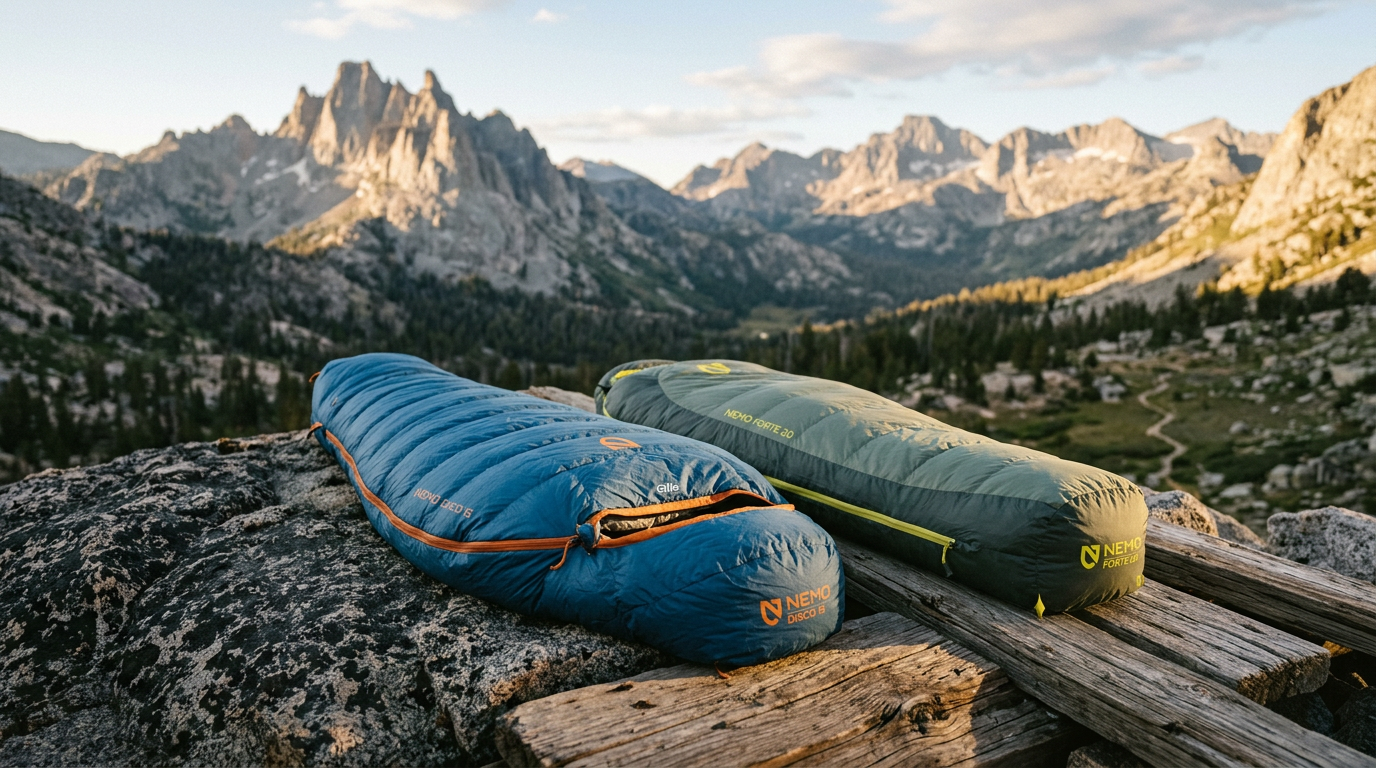
NEMO Disco Endless Promise Down vs. NEMO Forte Endless Promise Synthetic Sleeping Bag
The NEMO Disco Endless Promise Down is the clear winner for three-season backpackers who prioritize warmth-to-weight ratio and packability, justifying its $329.95 price with premium 650-fill down insulation. However, the Forte Endless Promise Synthetic at $147.34 is the smarter choice for wet-climate campers, budget-conscious buyers, and anyone who needs a bag that maintains insulation when damp.
Disclosure: Four Seasons Gear is reader-supported. When you buy through links on our site, we may earn an affiliate commission at no extra cost to you. Prices and availability are accurate as of the time we last checked.
NEMO's Endless Promise line represents the brand's commitment to sustainable materials and ethical sourcing, but these two bags take radically different approaches to insulation. The Disco uses responsibly-sourced 650-fill down while the Forte relies on synthetic fill, creating a $182 price gap and fundamentally different performance profiles. Both bags share NEMO's signature spoon-shaped cut and integrated pillow sleeve, but the insulation choice dictates which environments and users each bag serves best.
Specifications Comparison
Specs
Insulation Performance: Down vs. Synthetic
The Disco's 650-fill down delivers approximately 30% more warmth per ounce than the Forte's synthetic insulation, which translates to a noticeably lighter and more compressible package for the same temperature rating. The Disco achieves a 15°F comfort rating while the Forte stops at 20°F, meaning the down bag provides an extra 5 degrees of warmth despite weighing less. In dry conditions above treeline or in desert environments, down's superior loft creates more dead air space and better thermal efficiency.
The Forte's synthetic fill, however, maintains roughly 70% of its insulating capability when wet, while down collapses to near-zero insulation when saturated. For Pacific Northwest backpackers, spring shoulder-season campers dealing with condensation, or anyone who camps near water sources where humidity is unavoidable, the Forte's moisture resistance is a genuine safety advantage. Synthetic insulation also dries 3-4 times faster than down when you can hang it in morning sun.
Packed Size and Portability
Down compresses to roughly one-third the volume of synthetic insulation at equivalent warmth levels. The Disco stuffs into a compression sack approximately 8 x 14 inches, while the Forte requires a 10 x 18-inch stuff sack to achieve similar compression. For backpackers working with 50-60L packs on multi-day trips, that 40% volume difference determines whether the sleeping bag rides inside the main compartment or gets lashed to the outside. Thru-hikers and ultralight enthusiasts will immediately notice the Disco's advantage when organizing their pack.
Durability and Shell Construction
The Forte uses a burlier 30D ripstop polyester shell compared to the Disco's 20D nylon, giving the synthetic bag better abrasion resistance when sliding in and out of tents or rubbing against tent walls. The Disco's thinner shell fabric shaves weight but requires more careful handling around sharp objects, rough tent floors, and Velcro. The Forte's 50D taffeta lining is also more durable than the Disco's 30D stretch polyester, making the synthetic bag more suitable for rental fleets, scout troops, or families with kids who are harder on gear.
Both bags feature DWR-treated shells to shed light moisture, but the Disco's down fill demands more vigilant care. A small tear in the Disco's shell can leak expensive down fill, while the Forte's continuous synthetic batts stay in place even if the shell develops a hole. Field repairs on synthetic bags are also simpler—a patch of duct tape restores function immediately, whereas down bags may need professional repair to prevent continued fill loss.
Value Proposition and Long-Term Cost
At $329.95, the Disco costs 124% more than the $147.34 Forte, but down bags typically last 10-15 years with proper care versus 5-8 years for synthetic insulation, which gradually loses loft through compression cycles. The Disco's cost-per-season works out to roughly $22-33 annually, while the Forte runs $18-29 per season. For occasional campers (10-15 nights per year), the Forte's lower upfront cost makes more financial sense. For frequent backpackers logging 40+ nights annually, the Disco's durability and performance justify the premium.
The Disco also offers better resale value—quality down bags retain 40-50% of their original price on the used market after 3-5 years, while synthetic bags drop to 20-30% of retail. This matters for gear enthusiasts who upgrade regularly or need to recoup costs when their camping habits change.
Shared Features Worth Noting
Both bags incorporate NEMO's Thermo Gill venting system—zippered vents at the feet that dump excess heat without exposing your core to cold drafts. This feature extends the usable temperature range upward by 10-15 degrees, letting you use a 15°F bag comfortably into the 40s. Both also include the Blanket Fold draft collar, which seals around your shoulders without the claustrophobic feel of traditional mummy bag hoods.
The integrated pillow sleeve on both models accommodates clothing or a dedicated camp pillow up to 16 x 12 inches. The full-length zipper on each bag allows complete opening for use as a quilt in warm weather, and both bags can mate with a partner bag (sold separately) to create a double-wide sleep system. These shared features mean your choice comes down to insulation type, budget, and expected conditions rather than feature set.
Decision Framework
Buy the Disco Endless Promise Down if:
- You backpack primarily in dry climates (Southwest, Rockies above treeline, Sierra Nevada)
- Packed size and weight are critical factors for your pack setup
- You camp 30+ nights per year and want a bag that lasts a decade
- You can commit to proper down care (storage uncompressed, occasional washing with down-specific detergent)
- You need maximum warmth for cold-weather camping down to 15°F
Buy the Forte Endless Promise Synthetic if:
- You camp in wet climates (Pacific Northwest, Appalachian spring/fall, anywhere with high humidity)
- Budget is a primary concern and you need capable performance under $150
- You're new to backpacking and want a forgiving bag while you learn proper gear care
- You need a bag for kids, scouts, or situations where rough handling is likely
- You camp fewer than 20 nights per year and don't need maximum longevity
- You want insulation that works when damp and dries quickly
+Can I wash both bags in a home washing machine?
Yes, but with different care requirements. The Forte synthetic bag tolerates standard front-loading washers with mild detergent and can be machine-dried on low heat. The Disco down bag requires down-specific wash (like Nikwax Down Wash) and must be dried on low heat with tennis balls or dryer balls to break up clumps—expect 2-3 hours of drying time. Never use top-loading agitator washers with the Disco, as the agitator can tear baffles. Both bags should be washed only when visibly dirty or after 20-30 uses, not after every trip.
+How much warmer is the Disco's 15°F rating compared to the Forte's 20°F rating in real use?
The 5-degree difference is noticeable but not dramatic for most campers. In practice, the Disco provides comfortable sleep for average sleepers down to about 20°F and survivable sleep to 10°F, while the Forte is comfortable to 25°F and survivable to 15°F. Cold sleepers should add 10 degrees to these numbers, warm sleepers can subtract 5 degrees. The bigger real-world difference is that down's superior loft creates a more comfortable microclimate at any temperature—you feel less constricted and the bag breathes better when you're not pushing its lower limit.
+Will the Forte's synthetic insulation really keep me warm if it gets wet?
Partially, but don't overestimate this advantage. If the Forte gets thoroughly soaked (like falling in a stream), you'll retain maybe 60-70% of its dry insulation value—enough to prevent hypothermia but not enough for comfortable sleep. The real advantage is that synthetic handles the moisture you can't avoid: tent condensation dripping on the bag, humidity from your breath, or light rain while packing up camp. In these scenarios, the Forte maintains near-full performance while the Disco would lose noticeable loft. Neither bag is a substitute for keeping your sleep system dry through proper tent site selection and waterproof stuff sacks.

Read next
More comparisons + reviews
REVIEW
Kelty Galactic Down 30 Degree Sleeping Bag Review
REVIEW
NEMO Disco Endless Promise Down Sleeping Bag Review
REVIEW
ZOOOBELIVES AlpliveD1500 10°F Down Sleeping Bag Review
REVIEW
Therm-a-Rest 20F/-6C Down Sleeping Bag Review: 900-Fill Premium Insulation with Ethical Sourcing
REVIEW
Big Agnes Women's Torchlight Sleeping Bag w/600 DownTek Review
REVIEW