
Review · spring · summer · fall · winter
Kelty Galactic Down 30 Degree Sleeping Bag Review
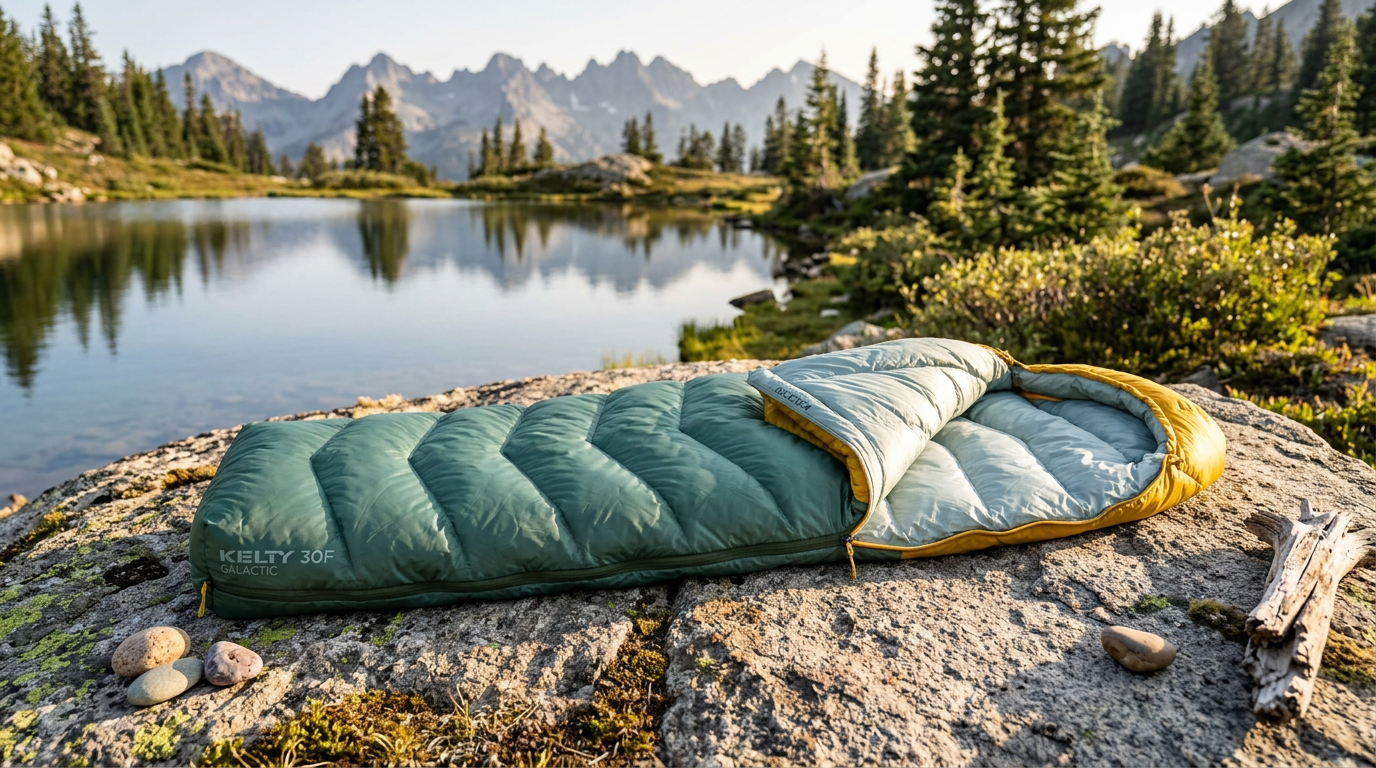
The Kelty Galactic Down 30 is a budget-conscious three-season sleeping bag that prioritizes value over cutting-edge performance. With 550 fill power RDS-certified down, a 30°F comfort rating, and a total weight of 2 lbs 14 oz (1.3 kg), it occupies the sweet spot for car campers and occasional backpackers who want natural insulation without premium pricing. The tradeoff is clear: you sacrifice the warmth-to-weight ratio of 650+ fill down and the packability of ultralight bags, but gain a durable polyester shell, couple-friendly zip-together capability, and a sub-$200 price point that makes down accessible to newcomers.
Disclosure: Four Seasons Gear is reader-supported. When you buy through links on our site, we may earn an affiliate commission at no extra cost to you. Prices and availability are accurate as of the time we last checked.
Construction and Materials
The Galactic 30 uses a polyester taffeta shell treated with PFC-free DWR, paired with 21 oz (595 g) of 550 fill power down insulation. The 550 fill rating means each ounce of down lofts to approximately 550 cubic inches — adequate for three-season use but noticeably less efficient than the 650-850 fill down found in premium bags. Kelty sources RDS-certified down, providing traceability to farms that meet animal welfare standards. The shell fabric prioritizes durability over weight savings; polyester taffeta resists abrasion better than the ripstop nylon common in ultralight designs, though it adds 4-6 oz compared to 10D or 15D alternatives.
The bag features a two-way zipper system — a full-length YKK zipper on one side with both head-end and foot-end sliders. This allows foot ventilation without opening the entire bag, a practical feature for temperature regulation on warmer nights. A draft tube runs the zipper's length to prevent cold spots. The mid-section cinch cord creates a tapered fit that reduces dead air space around the torso, improving thermal efficiency. Kelty includes a basic stuff sack; compressed dimensions measure approximately 15 x 8 inches (38 x 20 cm), larger than ultralight competitors but manageable for weekend trips.
Specs
Intended Use and Performance Context
The 30°F comfort rating positions this bag for spring through fall camping in temperate climates, with shoulder-season use extending into early winter for warm sleepers or those layering with a liner. The 550 fill down provides adequate loft for these conditions but requires more material than higher-loft alternatives to achieve the same warmth — hence the 21 oz fill weight. For reference, a 650 fill bag targeting the same temperature rating typically uses 16-18 oz of down, translating to 4-6 oz of total weight savings and 15-20% better compression.
The 2 lbs 14 oz total weight makes this a borderline backpacking option. Thru-hikers and gram-counting backpackers will find it heavy compared to bags like the Western Mountaineering UltraLite (1 lb 9 oz for a 20°F bag with 850 fill) or even mid-tier options in the 2-2.5 lb range with 650 fill. However, for weekend warriors splitting gear weight across a short trip, or car campers prioritizing comfort over ounces, the weight penalty is negligible. The zip-together feature adds versatility for couples or families willing to carry two bags for double-wide sleeping.
Durability Considerations
The polyester taffeta shell offers superior abrasion resistance compared to ultralight nylon ripstop, making this bag more forgiving in high-use scenarios — ground camping without a pad, rough tent floors, or frequent stuffing/unstuffing by less-experienced users. Polyester also absorbs less moisture than nylon, maintaining loft slightly better in humid conditions. The tradeoff is weight and packability; polyester's higher denier count (likely 50-70D based on typical Kelty specs) adds structure but bulk.
The 550 fill down itself is less fragile than 800+ fill down, which uses larger, more delicate clusters. Lower fill power down tolerates compression cycles better over the product's lifespan, though all down requires proper storage (uncompressed, in a large breathable sack) to maintain loft. The PFC-free DWR treatment is an environmental positive but may require more frequent reapplication than older PFAS-based treatments — expect to retreat the shell every 20-30 nights of use in wet conditions. Kelty's construction quality since their 1952 founding suggests adequate baffle stitching and down distribution, though the budget price point likely means simpler sewn-through baffles rather than box baffles, which can create minor cold spots along seams.
Value Proposition
At approximately $190, the Galactic 30 delivers down insulation at a price point typically occupied by synthetic bags. This is the core value argument: natural down's superior warmth-to-weight ratio and compressibility compared to synthetic, without the $300-500 investment required for 650+ fill premium bags. For buyers graduating from big-box synthetic bags or testing whether they prefer down's characteristics, this represents a low-risk entry point.
The cost savings come from the 550 fill rating and polyester shell. Higher fill power down commands exponential pricing — 650 fill costs roughly 30% more per ounce than 550 fill, while 800+ fill doubles the material cost. The polyester taffeta is cheaper to source than technical nylon ripstop. These choices create a bag that performs adequately for its rating but won't match the efficiency of bags costing 50-100% more. For car campers or casual backpackers making 5-10 trips per year, the performance gap rarely justifies the price premium. For dedicated backpackers logging 30+ nights annually, investing in a lighter, more compressible bag pays dividends in comfort and pack space.
What we like
Trade-offs
Best For
- Car campers prioritizing natural insulation over weight savings
- Weekend backpackers making 5-10 trips per year in three-season conditions
- Couples seeking zip-together capability for double sleeping
- Budget-conscious buyers testing down vs. synthetic preferences
- Families outfitting multiple users without premium investment per bag
- Campers in dry to moderate humidity environments (down performs best when dry)
Not For
- Gram-counting thru-hikers or ultralight backpackers needing sub-2 lb bags
- Users over 6 feet tall (inadequate length creates cold spots)
- Cold sleepers requiring true 20°F or lower ratings for shoulder-season use
- Wet-climate campers (synthetic bags maintain warmth when damp better than budget down)
- Backpackers with limited pack volume (compressed size is bulky)
- Buyers seeking maximum warmth-to-weight efficiency (650+ fill down outperforms)
Frequently Asked Questions
+How does 550 fill power compare to 650 or 800 fill down?
Fill power measures down's loft per ounce — 550 fill expands to 550 cubic inches per ounce, while 650 fill reaches 650 cubic inches, and 800+ fill exceeds 800 cubic inches. Higher fill power means more warmth per ounce of down, allowing lighter bags with smaller packed size. A 550 fill bag requires approximately 20-30% more down weight than a 650 fill bag for the same temperature rating, and 40-50% more than an 800 fill bag. The tradeoff is cost: 550 fill down costs significantly less, making it viable for budget bags like the Galactic 30.
+Can I use this bag in winter or below-freezing temperatures?
The 30°F comfort rating is designed for temperatures down to freezing with a warm sleeper in base layers. For consistent below-freezing use, you would need additional insulation — a sleeping bag liner adds approximately 5-10°F of warmth, and sleeping in insulated clothing extends the range further. However, for true winter camping (sustained 20°F and below), a dedicated cold-weather bag with 15°F or lower rating and higher fill power down is more appropriate. The Galactic 30 is optimized for spring through fall in temperate climates.
+What's the advantage of the zip-together feature?
Two Galactic 30 bags can be zipped together to create a double-wide sleeping system. This works because one bag has a right-hand zipper and the other a left-hand zipper (verify zipper orientation when purchasing pairs). The advantage is shared warmth for couples or families, reduced gear redundancy, and the flexibility to separate into individual bags when needed. The combined weight of two bags (5 lbs 12 oz) is comparable to many two-person quilts, though less efficient than dedicated double bags from cottage manufacturers.
+How do I maintain the down insulation over time?
Store the bag uncompressed in a large breathable cotton or mesh sack — prolonged compression degrades down's loft. Wash only when necessary (every 20-40 nights of use) using down-specific detergent in a front-loading machine on gentle cycle, then tumble dry on low heat with tennis balls to break up clumps. Retreat the DWR finish when water no longer beads on the shell fabric, using a spray-on or wash-in treatment (PFC-free to match the original finish). Avoid ground contact when possible; always use a sleeping pad or groundsheet to protect the shell from abrasion and moisture.
+Is the 6-foot length limit a hard constraint?
Yes. Sleeping bags rely on dead air space around the body for insulation; if your height compresses the foot box or forces your head against the hood, you create cold spots and reduce thermal efficiency. Users over 5'10" should strongly consider a long or tall version if Kelty offers one for this model, or look at bags with 6'6" length ratings. Sleeping in a too-short bag is consistently uncomfortable and compromises warmth, particularly in the foot box where compression eliminates loft.

Read next
More from this category
REVIEW
NEMO Disco Endless Promise Down Sleeping Bag Review
REVIEW
ZOOOBELIVES AlpliveD1500 10°F Down Sleeping Bag Review
REVIEW
Therm-a-Rest 20F/-6C Down Sleeping Bag Review: 900-Fill Premium Insulation with Ethical Sourcing
REVIEW
Big Agnes Women's Torchlight Sleeping Bag w/600 DownTek Review
REVIEW
Mountain Hardwear Bishop Pass 15°F Women's Sleeping Bag Review
REVIEW