
Head-to-head
GRAYL GeoPress vs KATADYN Steripen Classic 3: Which Water Purifier Is Right for You?
The GRAYL GeoPress wins for most backcountry users thanks to its simpler operation, no-battery design, and ability to handle sediment-heavy water straight from the source. The KATADYN Steripen Classic 3 is the better choice for ultralight travelers moving through developed areas with relatively clear water who prioritize pack weight and don't mind carrying batteries.
Disclosure: Four Seasons Gear is reader-supported. When you buy through links on our site, we may earn an affiliate commission at no extra cost to you. Prices and availability are accurate as of the time we last checked.
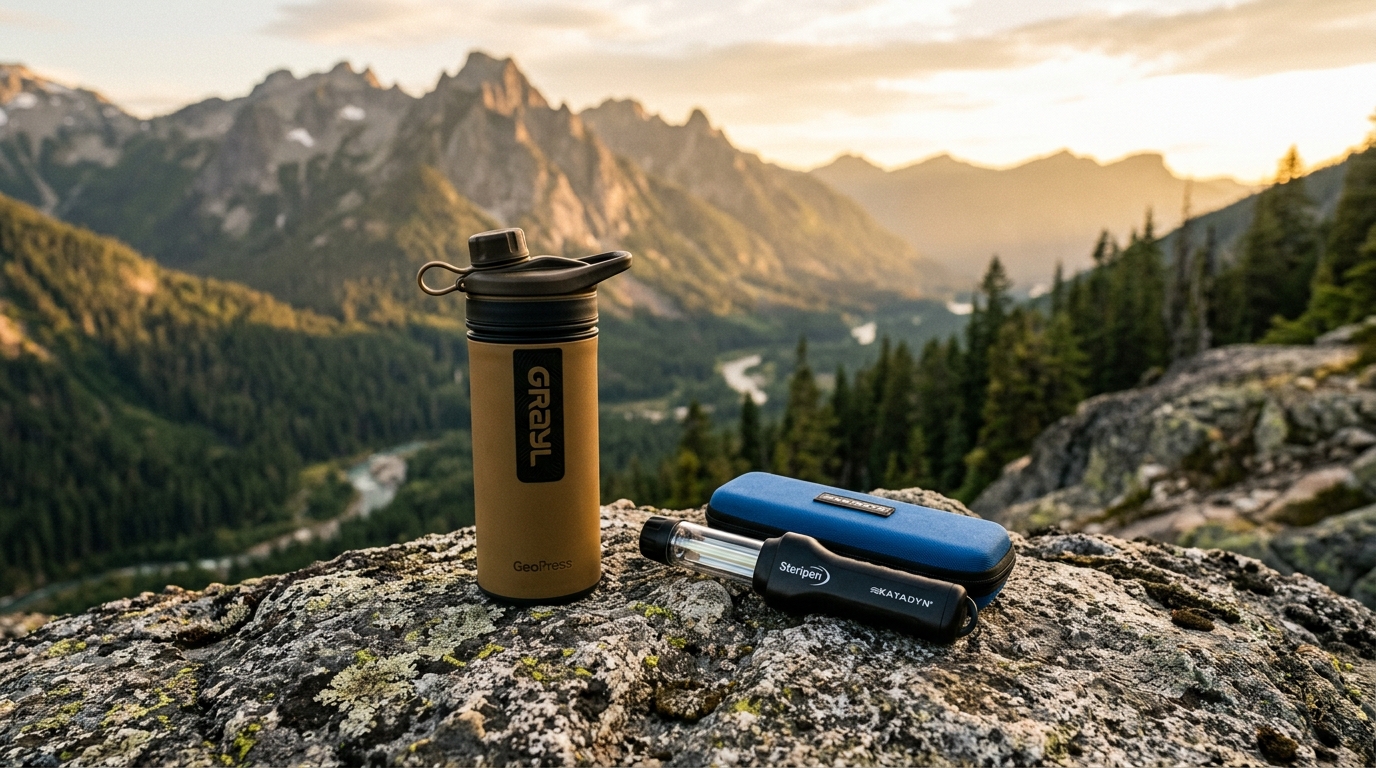
The GRAYL GeoPress and KATADYN Steripen Classic 3 represent fundamentally different approaches to water purification in the field. The GeoPress uses a mechanical press-and-filter system that physically removes contaminants, while the Steripen relies on UV-C light to neutralize pathogens. Both achieve purification-level protection against viruses, bacteria, and protozoa, but their operational requirements, weight profiles, and ideal use cases diverge sharply.
Specifications at a Glance
Specs
Operational Simplicity: Press vs. Stir
The GeoPress delivers purified water in 8 seconds via a single downward press—no setup, no batteries, no waiting. You fill the outer bottle from any freshwater source, insert the filter cartridge, and press down with 10-15 pounds of force. The system forces water through an electroadsorptive media that captures viruses (99.99%), bacteria (99.9999%), and protozoan cysts (99.9%), while also removing sediment, chemicals, and heavy metals. This makes it genuinely foolproof: if you can press, you can drink.
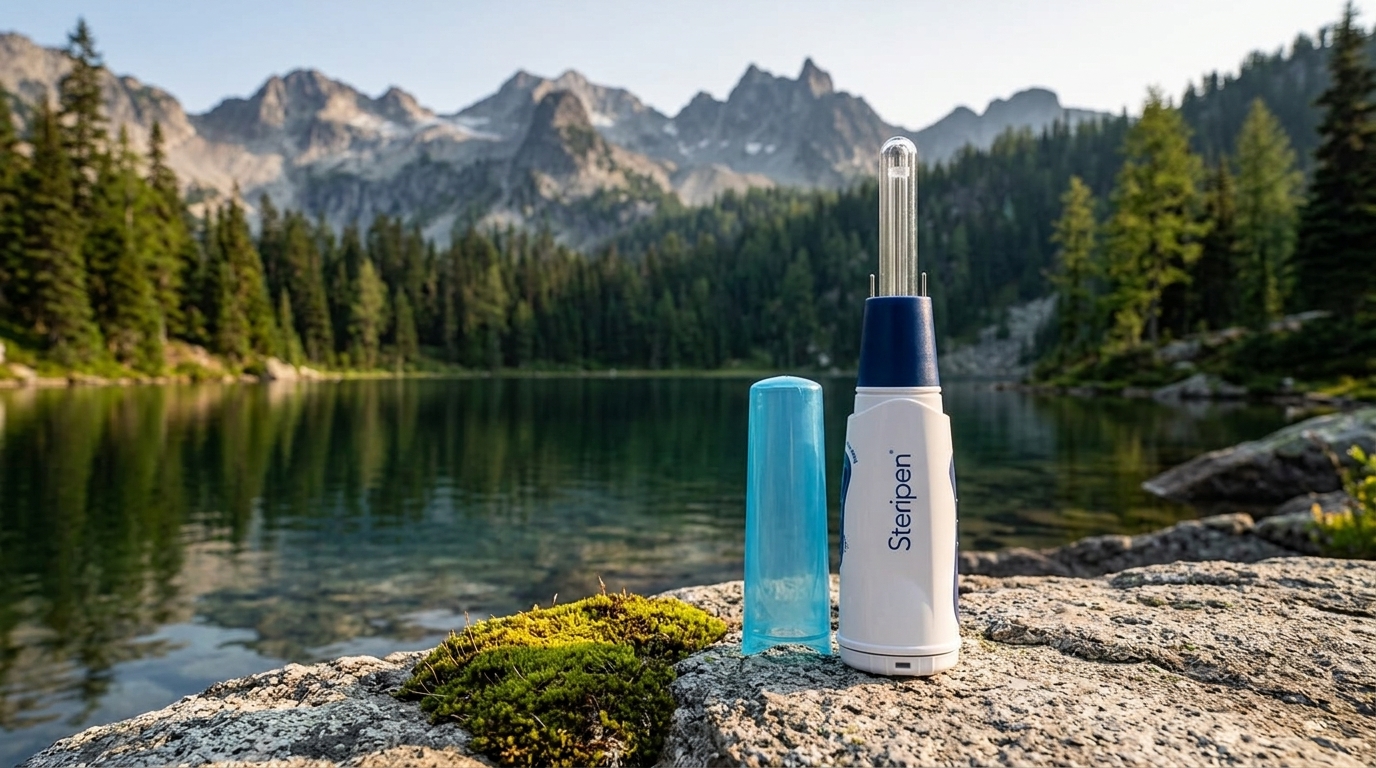
The Steripen Classic 3 requires you to submerge its UV-C lamp in a container of water and stir continuously for 90 seconds per liter. The UV light disrupts pathogen DNA, rendering them unable to reproduce. However, UV purification has two critical limitations: it doesn't remove sediment or chemicals, and it requires clear water for the UV rays to penetrate effectively. Murky water scatters the light, reducing effectiveness. If you're drawing from a silty alpine stream, you'll need to pre-filter with a bandana or coffee filter—adding steps and time. The Steripen also depends on 4× AA batteries (good for approximately 50 liters), meaning you must carry spares on multi-day trips.
Weight and Packability
The Steripen Classic 3 weighs approximately 5 ounces without batteries, and a set of 4× AA alkaline batteries adds another 3.2 ounces—totaling around 8.2 ounces for the purification system. The GeoPress, by contrast, weighs roughly 16 ounces as a complete bottle-and-filter unit. That's a 7.8-ounce penalty, but the GeoPress also serves as your water bottle, eliminating the need for a separate vessel. If you're already carrying a 32 oz bottle like the Nalgene 32 oz Wide Mouth Water Bottle (which weighs 6.25 oz empty), the net weight difference narrows considerably.
For ultralight thru-hikers counting every gram, the Steripen's lower base weight is appealing—especially if you're resupplying batteries in towns and treating relatively clear water. But for weekend warriors, international travelers, or anyone prioritizing simplicity over ounces, the GeoPress's all-in-one design is more practical. It also fits standard backpack side pockets (3.1-inch diameter), whereas the Steripen requires a separate container and careful packing to protect the UV lamp.
Filter Lifespan and Long-Term Cost
The GeoPress cartridge is rated for 65 gallons (250 liters or approximately 350 presses). At $73.65 for the full unit and roughly $30 for replacement cartridges, you're looking at about $0.12 per liter over the cartridge's life. The Steripen Classic 3 is rated for 8,000 treatments (8,000 liters), which works out to approximately $0.01 per liter—not counting battery costs. A set of AA batteries lasts about 50 liters, so over 8,000 liters you'd need 160 batteries. At $0.50 per battery (bulk pricing), that's an additional $80, bringing the per-liter cost closer to $0.02.
For occasional users (a few weekend trips per year), the GeoPress's higher per-liter cost is negligible. For long-distance hikers or frequent travelers purifying hundreds of liters annually, the Steripen's economics improve—but only if you're disciplined about battery management and water clarity. The GeoPress's simpler consumable model (one cartridge, no batteries) reduces logistical overhead.
Water Quality: Sediment, Taste, and Chemicals
The GeoPress's activated carbon and ion exchange media remove not just pathogens but also sediment, chlorine, heavy metals (lead, arsenic), and many organic chemicals. This means water from questionable sources—think livestock ponds, urban streams, or developing-world taps—comes out tasting clean. The Steripen only neutralizes living organisms; it does nothing for taste, odor, or chemical contaminants. If you're treating tap water in a foreign city with chlorine or industrial runoff, the Steripen leaves those compounds untouched.
For backcountry use in pristine alpine environments, this distinction matters less. But for international travel, post-disaster scenarios, or any situation where water quality is unknown, the GeoPress's comprehensive filtration is a significant advantage. Buyers comparing these systems should also consider the Sawyer Squeeze Water Filter System, which offers similar sediment removal and a much longer filter life (100,000 gallons), though it lacks virus protection and requires a squeeze bag.
Durability and Field Reliability
The GeoPress is built like a tank: BPA-free polypropylene body, silicone seals, and a press mechanism that's survived thousands of cycles in testing. The only failure point is the cartridge itself, which clogs gradually and predictably as it reaches capacity. There are no electronics, no fragile components, and no consumables beyond the filter. It's survived drops onto rock, freezing nights (though not recommended), and rough handling in checked luggage.
The Steripen Classic 3's UV lamp is its Achilles' heel. The quartz glass tube is fragile—drop it on a hard surface and you're done. The unit includes a protective case, but that adds bulk. Battery contacts can corrode in humid environments, and the electronics are vulnerable to moisture if the O-ring seal fails. KATADYN rates the lamp for 8,000 uses, but real-world longevity depends heavily on handling care. For rough backcountry use, the GeoPress's mechanical simplicity is more forgiving.
Value Proposition
At $73.65, the GeoPress is $26.30 cheaper upfront than the Steripen's $99.95. Factor in the Steripen's ongoing battery costs and the need for a separate water container, and the GeoPress's value proposition strengthens further. The Steripen makes sense if you're already carrying a lightweight bottle and prioritize the 7.8-ounce weight savings, but for most users, the GeoPress's simplicity, durability, and comprehensive filtration justify the slightly higher system weight.
Decision Framework
Frequently Asked Questions
+Can the GeoPress handle saltwater or extremely turbid water?
No. The GeoPress is designed for freshwater sources only—it does not desalinate. While it handles sediment far better than the Steripen, extremely turbid water (think chocolate-milk consistency) will clog the filter faster, reducing its 65-gallon lifespan. For very silty sources, let water settle for 10-15 minutes before filling, or pre-filter through a bandana.
+How do I know when the Steripen has successfully treated my water?
The Steripen Classic 3 has an indicator light that blinks during treatment and displays a smiley face when the 90-second cycle is complete. However, this only confirms the lamp functioned—it doesn't verify water clarity or UV penetration. In murky water, pathogens may survive even after a full cycle. Always pre-filter sediment for reliable purification.
+Which system works better in freezing temperatures?
The GeoPress operates reliably in near-freezing conditions (though the cartridge should not be stored frozen, as ice expansion can crack the media). The Steripen's battery performance degrades significantly below 40°F, and the lamp is more prone to breakage when cold and brittle. For winter camping or high-altitude use, the GeoPress is the safer choice.

Read next
More comparisons + reviews
REVIEW
MSR Guardian Water Purifier Annual Maintenance Kit Review
REVIEW
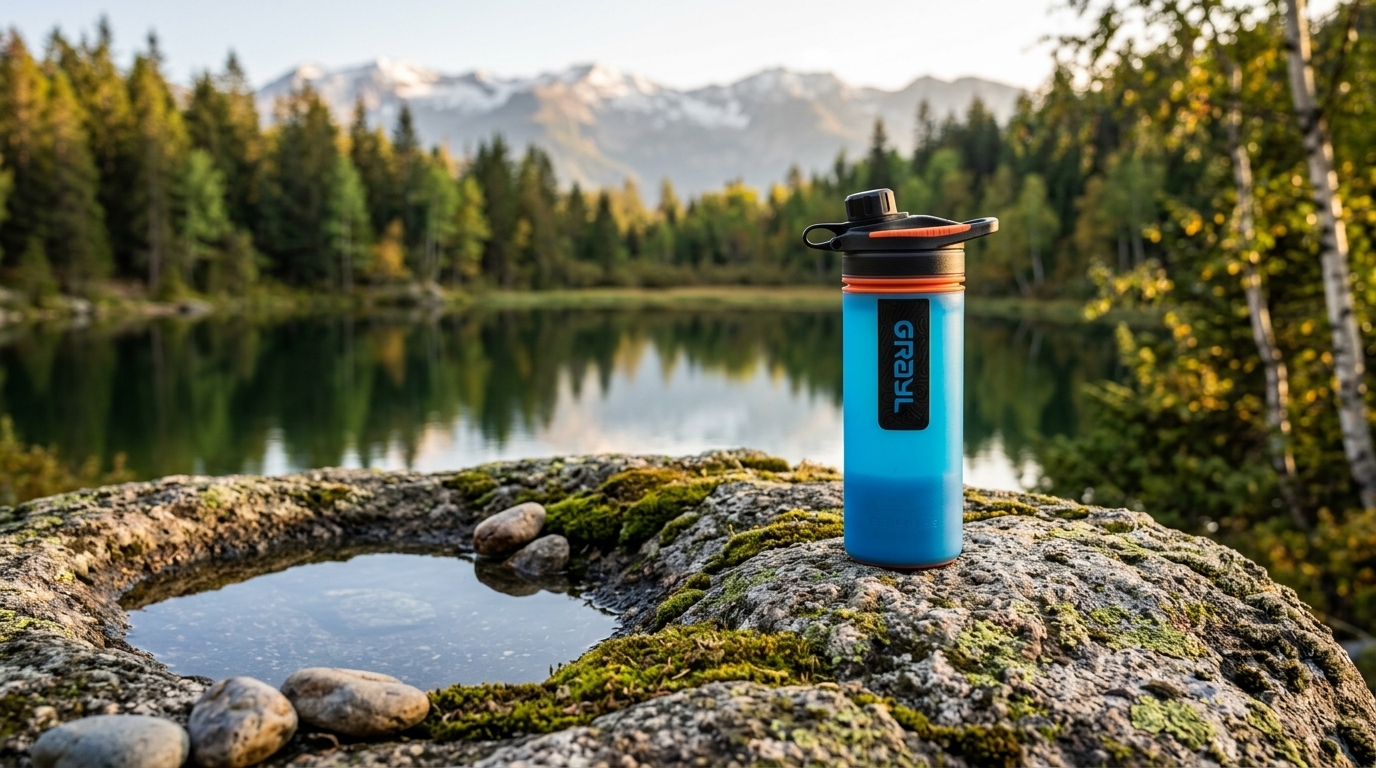
GRAYL GeoPress 24 oz Water Purifier Bottle Review: Press-Filter Speed for Backcountry and Travel
REVIEW
Platypus GravityWorks Group Camping Water Filter System Review
REVIEW
KATADYN Steripen Classic 3 UV Water Purifier Review: Battery-Powered Pathogen Control for Clear Water
REVIEW
Katadyn Hiker Microfilter Review: Pump-Action Reliability for Group Trips
REVIEW