
Review · spring · summer · fall
MSR WhisperLite Universal Compact Hybrid Fuel Camping and Backpacking Stove Review
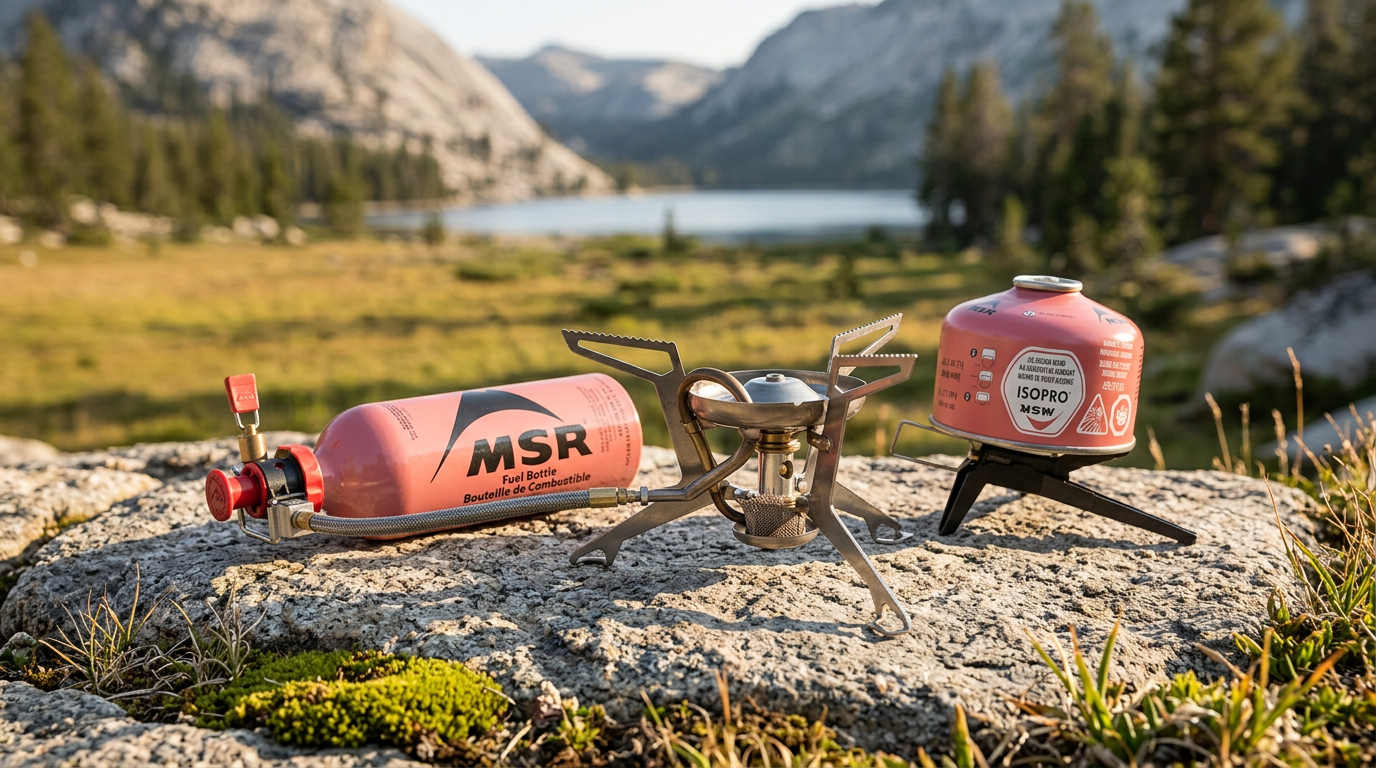
The MSR WhisperLite Universal is for backpackers and expedition travelers who need fuel flexibility across multiple trips or international destinations. At 11.2 oz (318 g) with patent-pending AirControl technology, it burns canister fuel, white gas, kerosene, and unleaded gasoline—a capability set unmatched by single-fuel designs like the MSR PocketRocket 2 Stove. You trade simplicity and packed volume for adaptability: this is a liquid-feed system with a pump, fuel bottle, windscreen, and multiple jets, not a minimalist screw-on canister stove. If your itinerary spans cold alpine starts, international treks where canister fuel is scarce, or long expeditions where white gas offers better cost-per-BTU, the Universal delivers proven MSR engineering across the fuel spectrum.
Disclosure: Four Seasons Gear is reader-supported. When you buy through links on our site, we may earn an affiliate commission at no extra cost to you. Prices and availability are accurate as of the time we last checked.
Construction and Materials
The WhisperLite Universal employs a lightweight aluminum mixer tube and stainless steel legs to keep the burner assembly compact. The legs fold against the body for transport and deploy into a stable tripod with a 4 in footprint. MSR's self-cleaning Shaker Jet technology uses a needle housed in the jet orifice; shaking the stove dislodges carbon buildup without disassembly. The redesigned leg assembly (compared to older WhisperLite models) simplifies field maintenance and reduces the number of small parts prone to loss.
The patent-pending AirControl valve optimizes the fuel-to-air ratio for each fuel type, a refinement over earlier multi-fuel stoves that required more manual priming and adjustment. The canister liquid-feed system draws liquid propane/isobutane from the canister bottom (via an included canister stand) rather than vapor from the top, improving cold-weather performance and maintaining consistent output as canister pressure drops. Liquid and canister fuel couplers swap quickly; each fuel type uses a dedicated jet (included in the small-parts kit).
Specs
Intended Use and Performance Context
This stove targets three-season backpackers, alpinists, and international trekkers who encounter variable fuel availability. Canister fuel dominates North American trailheads, but white gas (Coleman fuel) and kerosene remain standard in parts of Asia, South America, and Africa. The Universal lets you carry one stove system and adapt to local fuel sources. The liquid-feed canister mode extends usability into shoulder-season conditions (spring/fall mornings near freezing) where vapor-feed canister stoves like the MSR PocketRocket 2 Stove lose pressure and simmer control.
OutdoorGearLab's testing confirms the Universal's strong simmer control and consistent heat output across fuel types, though boil times vary: canister mode is fastest (approximately 3.5 minutes for 1 liter), white gas slightly slower, kerosene slowest. The windscreen and heat reflector (both included) are essential for efficiency; without them, wind significantly degrades performance. The stove requires priming when burning liquid fuels (white gas, kerosene, gasoline)—a 30-second procedure involving preheating the fuel line—which adds a learning curve absent from canister-only designs.
Comparison Context
The WhisperLite Universal sits between ultralight canister stoves and expedition-grade liquid-fuel-only models. The MSR PocketRocket 2 Stove weighs 2.6 oz and packs smaller, but it burns only canister fuel and struggles below 20°F. The original MSR WhisperLite (liquid-fuel-only, discontinued in favor of the WhisperLite Internationale) weighed 10.9 oz and required a separate stove for canister trips. The Universal consolidates both fuel systems into one 11.2 oz package, adding 0.3 oz for the versatility.
Compared to integrated canister systems (Jetboil, MSR Reactor), the Universal sacrifices boil speed and wind protection for fuel flexibility. Compared to the Primus OmniFuel (another multi-fuel option), the Universal is 1.4 oz lighter and benefits from MSR's North American service network and spare-parts availability. The Coleman Classic Propane Camping Stove offers a different tradeoff entirely: car-camping convenience with propane bottles, zero backpacking portability, and 11 lb weight.
Durability Considerations
Stainless steel legs and an aluminum mixer tube resist corrosion and mechanical wear. The Shaker Jet's self-cleaning mechanism extends service intervals; MSR publishes a 5-year maintenance schedule (seal replacement, pump cup lubrication) for the fuel pump. The small-parts kit includes spare O-rings, jet orifices, and a cable tool, acknowledging that expedition use will eventually require field repairs. The redesigned leg assembly reduces the number of threaded connections prone to cross-threading or loosening under repeated thermal cycling.
The canister coupler and liquid-fuel coupler are brass, a softer metal than stainless but less prone to galling. Cross-threading these fittings (common during cold-fingered setup) can damage threads; hand-tightening only is specified. The windscreen is thin aluminum and will dent if packed carelessly; the included stuff sack provides minimal crush protection. The fuel pump's leather cup requires occasional oiling (included in the small-parts kit) to maintain pressure; neglecting this maintenance causes pump failure in the field.
Value and Market Position
At approximately $200 MSRP (verify current price), the WhisperLite Universal costs 4× more than a basic canister stove but eliminates the need to own separate stoves for different fuel types. For a single three-season backpacking trip in North America, a canister stove offers better value. For multi-trip users, international trekkers, or alpinists who need cold-weather canister performance, the Universal's fuel flexibility justifies the premium. White gas costs roughly $0.15 per boil versus $0.40 for canister fuel, so high-volume users recoup the upfront cost over 500+ boils.
The included accessories (pump, windscreen, heat reflector, canister stand, small-parts kit) would cost $80+ if purchased separately, making the package competitive with buying a liquid-fuel stove and canister stove individually. MSR's USA manufacturing and established warranty support (lifetime on burner, 3 years on pump) add long-term value. Switchback Travel notes the Universal as a top pick for 'versatility-focused backpackers,' a category where few competitors offer equivalent fuel range at comparable weight.
What we like
Trade-offs
Best For
- International trekkers visiting regions with limited canister fuel availability
- Alpinists and mountaineers needing reliable cold-weather canister performance
- Expedition users who prefer white gas for cost-per-BTU efficiency on long trips
- Multi-trip backpackers who want one stove for variable conditions (spring/fall cold snaps, summer canister convenience)
- Users who value fuel flexibility and are comfortable with priming procedures
Not For
- Ultralight gram-counters prioritizing minimum packed weight (consider MSR PocketRocket 2 Stove at 2.6 oz)
- First-time backpackers seeking plug-and-play simplicity without priming steps
- Car campers who need high BTU output and don't require portability (consider Coleman Classic Propane Camping Stove)
- Users who backpack exclusively in summer with reliable canister fuel access
Frequently Asked Questions
+Can I switch between canister and liquid fuels mid-trip?
Yes. Swapping fuel types requires changing the coupler (canister or liquid-fuel) and installing the appropriate jet from the small-parts kit. The process takes approximately 2 minutes once familiar with the procedure. Carry both couplers and jets if you anticipate needing fuel flexibility on a single trip.
+How does the liquid-feed canister mode differ from standard canister stoves?
Standard canister stoves draw fuel vapor from the top of the canister; as pressure drops (cold weather or low fuel), output decreases. The Universal's liquid-feed system uses the included canister stand to invert the canister, drawing liquid fuel from the bottom. This maintains consistent pressure and heat output down to approximately 20°F and through the last 25% of canister fuel, where vapor-feed stoves lose performance.
+What is the priming procedure for white gas or kerosene?
Priming preheats the fuel line so liquid fuel vaporizes before reaching the burner. Close the stove's flame adjuster, pump the fuel bottle to 15-20 strokes, open the fuel valve slightly to release a small amount of fuel into the priming cup (located below the burner), then ignite the fuel in the cup. Once the priming flame dies (approximately 30 seconds), open the fuel valve fully and ignite the main burner. MSR's instructions include detailed steps; practice at home before field use.
+How often does the Shaker Jet need cleaning?
The self-cleaning Shaker Jet reduces carbon buildup automatically during use. MSR recommends shaking the stove (with fuel valve closed) every 5-10 uses when burning liquid fuels, and inspecting the jet orifice every 20-30 uses. The small-parts kit includes a jet-cleaning cable for manual cleaning if buildup occurs. Canister fuel burns cleaner and requires less frequent maintenance.
+Can I use automotive gasoline in an emergency?
Yes, the Universal burns unleaded automotive gasoline, making it suitable for remote expeditions where refined fuels are unavailable. Automotive gasoline contains additives that increase soot and carbon buildup compared to white gas; expect more frequent jet cleaning. Use the highest octane available and avoid gasoline with ethanol (E10, E15) if possible, as ethanol can degrade fuel system seals over time.
+What size fuel bottle should I pair with this stove?
MSR offers 11 oz, 20 oz, and 30 oz fuel bottles. A 20 oz bottle provides approximately 120 minutes of burn time on white gas (enough for 40+ boils), balancing capacity and weight for most backpacking trips. The 30 oz bottle suits expeditions or group cooking; the 11 oz bottle works for ultralight solo trips where you'll refuel frequently. The fuel bottle threads are compatible with the Universal's pump.
Final Recommendation
The MSR WhisperLite Universal earns its place in packs where fuel flexibility matters more than minimum weight or plug-and-play convenience. Its 11.2 oz weight, four-fuel compatibility, and liquid-feed canister mode make it the most versatile stove in MSR's lineup, suited to alpinists, international trekkers, and multi-season backpackers who encounter variable fuel availability. You'll spend more upfront and invest time learning priming procedures, but the Universal consolidates what would otherwise require two separate stoves into one proven platform with USA manufacturing and long-term parts support.

Read next
More from this category
REVIEW
MSR WindBurner Personal Windproof Camping and Backpacking Stove System Review
REVIEW
Jetboil MiniMo Camping and Backpacking Stove Cooking System with Adjustable Heat Control Review
REVIEW
Jetboil Flash Camping and Backpacking Stove System Review
REVIEW
SOTO WindMaster Canister Stove with 4Flex Review
REVIEW
Primus Lite Plus Stove System Review: Integrated Pot-Burner for Fast Solo Meals
REVIEW