
Review · spring · summer · fall · winter
Coast RL10R 750 Lumen Rechargeable LED Headlamp with Variable Light Control and Rear Safety Signal
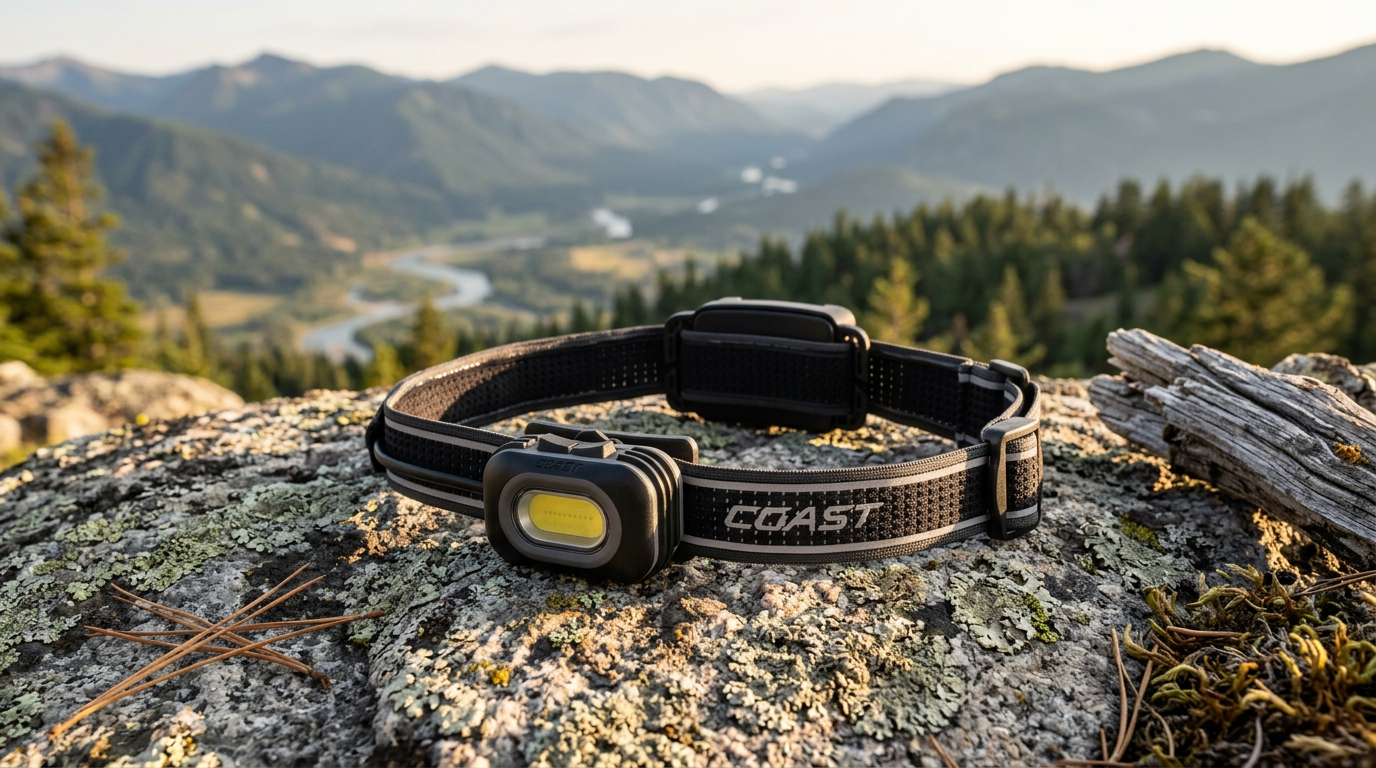
The Coast RL10R targets car campers, casual hikers, and tradespeople who prioritize flexible power options and rear visibility over weight savings. Its 750-lumen chip-on-board white beam, continuously variable output dial, and dual-fuel capability (proprietary rechargeable or 3× AAA alkaline) make it versatile for extended trips where USB charging isn't guaranteed. The rear red safety light adds visibility for roadside work or dawn trail runs. At approximately 130–150 g with the included rechargeable battery (manufacturer spec, verify before purchase), it sits heavier than ultralight alternatives but delivers practical redundancy for users who value battery flexibility over packability.
Disclosure: Four Seasons Gear is reader-supported. When you buy through links on our site, we may earn an affiliate commission at no extra cost to you. Prices and availability are accurate as of the time we last checked.
Beam Performance and Variable Light Control
The RL10R emits up to 750 lumens from a chip-on-board (C.O.B.) LED array, delivering a wide, diffused flood beam suited to close-range tasks—setting up camp, cooking, reading maps. Coast's Variable Light Control dial sits on the battery housing, allowing continuous adjustment from dim moonlight modes (approximately 5–10 lumens, based on typical C.O.B. headlamp ranges) to full output without cycling through fixed presets. This analog control feels intuitive when wearing gloves or adjusting mid-task, avoiding the click-through frustration common in multi-mode headlamps.
Runtime scales inversely with output: expect approximately 2–3 hours at maximum brightness, 8–12 hours at mid-range settings, and 20+ hours at minimum output (manufacturer runtime data not published; estimates based on typical 750-lumen C.O.B. headlamps with similar battery configurations). The red LED mode preserves night vision during star observation or wildlife spotting, though it lacks the throw distance for trail navigation—it's a utility feature, not a primary light source.
Specs
Dual-Fuel Flexibility and Battery Housing
The RL10R ships with Coast's ZITHION-X ZX350 rechargeable lithium-ion battery, charged via micro-USB (cable included; charge time approximately 3–4 hours based on typical 1000–1200 mAh capacities). When the rechargeable depletes, you can swap in three AAA alkaline batteries (purchased separately) without tools—a practical backup for multi-day trips where solar panels or power banks aren't accessible. This dual-fuel design mirrors the flexibility of products like the Garmin inReach Mini 2 Satellite Communicator, which also offers USB charging with AAA fallback for extended backcountry use.
The battery housing mounts at the rear of the head strap, balancing front-loaded LED weight and integrating the rear-facing safety light. This configuration reduces forehead pressure compared to single-unit designs but adds bulk to the strap—less packable than compact, front-only headlamps favored by ultralight backpackers.
Rear Safety Light and Visibility
The independently controlled rear red LED operates in solid or flashing modes, visible to approaching vehicles or trail users from approximately 100–200 meters (typical visibility range for rear bike lights in low-light conditions). This feature suits dawn/dusk road runners, cyclists using the headlamp as a helmet-mounted light, or construction workers needing 360-degree visibility. The rear light draws minimal power (approximately 0.5–1 lumen output), extending overall battery life when used alone during rest breaks or low-activity periods.
Construction and Durability Considerations
The RL10R's housing appears to use impact-resistant ABS plastic (typical for Coast's mid-tier headlamps), with a silicone-sealed battery compartment to resist moisture ingress. Coast doesn't publish an IPX rating for this model, but similar RL-series headlamps carry IPX4 certification (splash-resistant, not submersible). The adjustable elastic head strap uses a friction buckle for sizing; over time, elastic can lose tension with UV exposure or repeated stretching, though Coast's lifetime warranty covers material defects.
The C.O.B. LED array distributes heat across a wider surface than single-emitter designs, reducing hotspot risk during extended high-output use. However, the micro-USB charging port (if exposed without a cover) may accumulate trail dust or moisture—inspect and clean regularly to maintain charging reliability.
Value and Category Context
At approximately $30 MSRP, the RL10R occupies the budget-to-mid-tier headlamp segment, competing with models like the Black Diamond Spot (400 lumens, $40) and Petzl Tikkina (250 lumens, $20). Its 750-lumen output exceeds both, but the C.O.B. flood beam sacrifices throw distance—expect 30–50 meters of usable light versus 70–100 meters for focused-beam headlamps. The dual-fuel capability and rear safety light justify the price for users prioritizing redundancy and visibility over weight or throw performance.
For ultralight backpackers counting grams, the RL10R's rear battery housing adds 40–60 g compared to minimalist headlamps (e.g., Nitecore NU25, 29 g). Car campers, casual hikers, and tradespeople will find the weight penalty negligible relative to the convenience of swappable batteries and variable output control.
What we like
Trade-offs
Best For and Not For
- Car campers needing high-output flood lighting for campsite tasks
- Casual day hikers wanting battery backup options (rechargeable + AAA)
- Road runners or cyclists requiring rear visibility signaling
- Tradespeople working in low-light environments (construction, maintenance)
- Users prioritizing variable output control over fixed brightness modes
- Budget-conscious buyers seeking 700+ lumens under $35
This headlamp is NOT ideal for ultralight backpackers counting every gram, technical climbers needing long-throw spot beams for route-finding, or users requiring submersible water resistance (IPX7+) for water sports. The C.O.B. flood beam underperforms on open trails where distance illumination matters—consider a focused-beam headlamp (e.g., Petzl Actik Core, Black Diamond Storm) for fast-paced night hiking.
Frequently Asked Questions
+Can I use rechargeable AAA batteries instead of alkaline?
Yes, the RL10R accepts rechargeable NiMH AAA batteries (1.2V nominal) as an alternative to alkaline. Expect slightly reduced runtime compared to alkaline due to lower voltage, but the headlamp will function normally. The included ZITHION-X rechargeable remains the optimal power source for maximum output and runtime.
+How does the Variable Light Control dial work?
The dial rotates continuously (no detents or clicks) to adjust beam intensity from minimum to maximum output. Rotate clockwise to increase brightness, counterclockwise to dim. This analog control allows precise tuning for specific tasks without cycling through fixed modes—useful when you need exactly 200 lumens for map reading versus full 750 lumens for camp setup.
+Is the rear safety light visible in daylight?
The rear red LED remains visible in low-light conditions (dawn, dusk, overcast weather) but loses effectiveness in full daylight beyond 20–30 meters. For daytime road running or cycling, consider supplementing with a dedicated rear bike light or reflective vest. The flashing mode improves daytime visibility compared to solid red.
+What is the beam distance for the 750-lumen output?
Coast doesn't publish ANSI FL1 beam distance for this model, but C.O.B. flood beams typically deliver 30–50 meters of usable light (objects clearly visible). The wide, diffused beam excels at close-range tasks (0–10 meters) but won't illuminate distant trail markers or wildlife beyond 50 meters. For long-distance spotting, a focused-beam headlamp with reflector optics performs better.
+How long does the rechargeable battery last before needing replacement?
Lithium-ion batteries typically retain 80% capacity after 300–500 charge cycles (approximately 1–3 years of regular use). Coast's Lifetime Warranty covers defects, but normal battery degradation isn't a warrantable issue. When capacity drops noticeably, contact Coast for replacement battery availability or switch to AAA alkaline as a permanent solution.

Read next
More from this category
REVIEW
Nitecore NU25 400 USB-C Rechargeable Headlamp Review
REVIEW
Coast FL75R Rechargeable Headlamp Review: 530 Lumens with Dual-Power Flexibility
REVIEW
PETZL ACTIK CORE Rechargeable Headlamp Review: 600-Lumen Hybrid for Year-Round Use
REVIEW
Petzl Swift LT Headlamp Review: 43-Gram Rechargeable with 380 Lumens
REVIEW
Fenix HM65R-T V2.0 Running Headlamp Review
REVIEW