
Review · spring · summer · fall
Naturehike Insulated Inflatable Sleeping Pad Review: 4.6 R-Value at 770 g
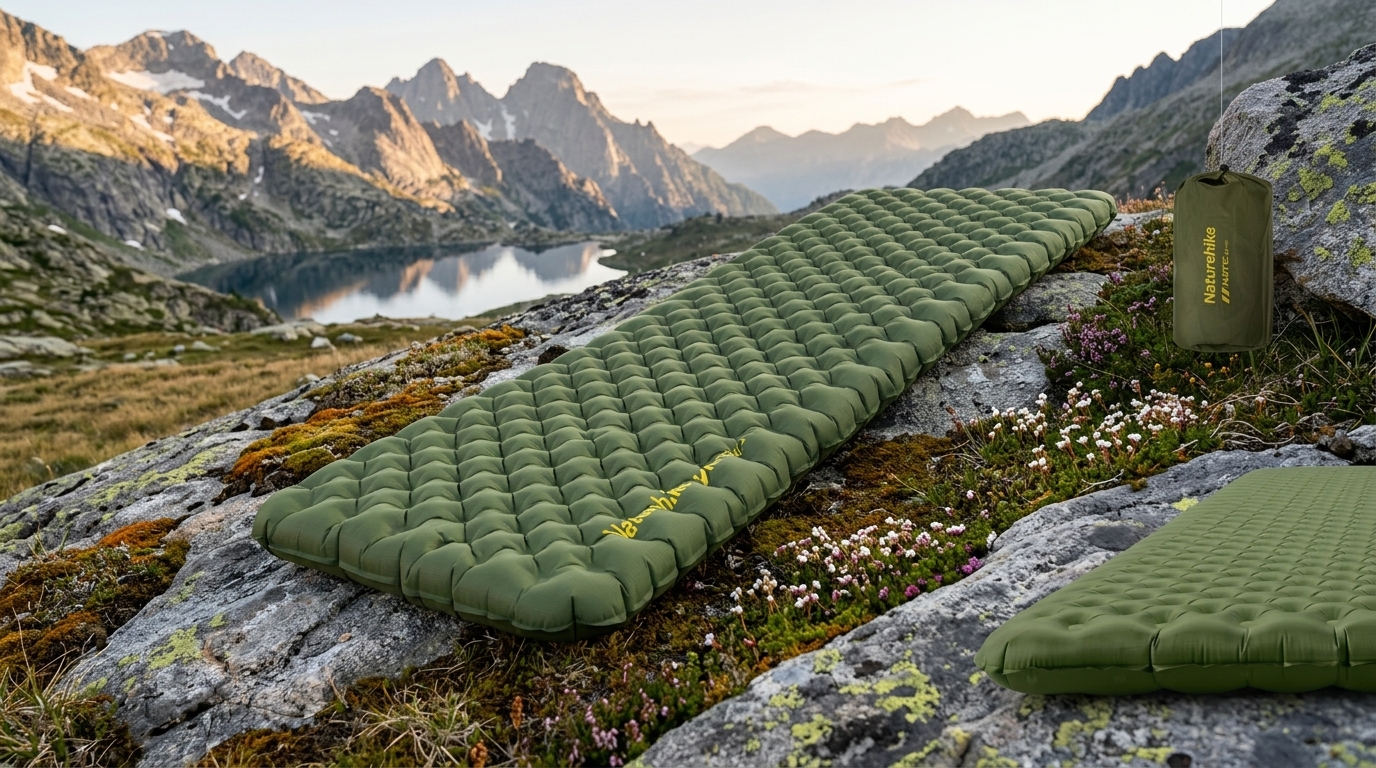
The Naturehike Insulated Inflatable Sleeping Pad targets three-season backpackers who prioritize warmth-to-weight ratio over proven brand heritage. At 770 g (27.2 oz) with a claimed R-value of 4.6, it undercuts many Western competitors by 100–200 g while promising insulation suitable down to -4°F/-20°C. The tradeoff: you're betting on a newer brand's durability claims and a proprietary eight-layer aluminum construction (NKTR AIR) that lacks independent third-party testing. For budget-conscious lightweight campers willing to accept some uncertainty around long-term reliability, the spec sheet delivers compelling numbers.
Disclosure: Four Seasons Gear is reader-supported. When you buy through links on our site, we may earn an affiliate commission at no extra cost to you. Prices and availability are accurate as of the time we last checked.
Specifications
Specs
Construction and Materials
Naturehike employs a 20-denier nylon face fabric bonded to a TPU (thermoplastic polyurethane) layer rather than the silicone-coated polyester or polyurethane-coated nylon common in Western pads. TPU offers superior abrasion resistance and cold-weather flexibility compared to standard PU coatings, which can stiffen below freezing. The eight-layer aluminum structure inside creates discrete air chambers; perforations in the aluminum reduce the crinkle noise typical of reflective insulation while theoretically limiting convective heat loss within each chamber.
The punching-point (dimpled) surface topology distributes body weight across many small contact zones, similar to the baffling strategy in pads like the Therm-a-Rest NeoAir series. At 8 cm inflated thickness, the pad provides enough loft to prevent most sleepers from bottoming out on uneven ground, assuming proper inflation. The dual-vent valve system uses an outer cover for one-way inflation (reducing accidental air loss during setup) and an inner cover for rapid deflation—a practical detail for cold mornings when you want to pack quickly.
Insulation Performance and Temperature Range
The claimed R-value of 4.6 positions this pad in the shoulder-season to winter-fringe category. For context, an R-value of 4.0–5.0 typically supports comfortable sleep down to the low 20s°F when paired with an appropriate sleeping bag; Naturehike's -4°F/-20°C rating assumes you're using a bag rated for those extremes. The manufacturer does not specify whether this R-value was measured under ASTM F3340-18 (the industry standard since 2020), so treat it as an approximate benchmark rather than a certified figure.
The eight-layer aluminum construction aims to reflect radiant body heat back toward the sleeper while the discrete chambers limit convective currents. In practice, reflective layers add 0.5–1.5 R-value depending on implementation; the bulk of insulation still comes from trapped air volume. At 770 g, this pad is roughly 150 g lighter than a Therm-a-Rest XTherm (R-7.3, 430 g for regular) but offers less total insulation—a reasonable tradeoff for three-season use where you don't need winter-grade warmth.
Durability Considerations
TPU laminates generally outlast PU coatings in abrasion and hydrolysis resistance, which matters for pads stored damp or used on rough ground. The 20D nylon face is thin enough to demand a footprint or careful site selection; a sharp twig or rock edge can puncture any lightweight pad, but thinner fabrics offer less margin for error. Naturehike includes a TPU repair patch, acknowledging the reality of field damage.
The proprietary valve and internal aluminum structure are harder to assess without long-term field data. Aluminum layers can fatigue or delaminate over hundreds of inflation cycles, and the perforated design—while quieter—introduces more potential failure points than solid foil. The manufacturer advises against over-inflation (a common user error that stresses seams and baffles), noting that proper inflation leaves the pad firm but not drum-tight. This is standard guidance for any inflatable pad.
Comparison Context
In the sub-$100 insulated pad market, the Naturehike competes with the Klymit Insulated Static V (R-4.4, 680 g, $80) and the Sea to Summit Ether Light XT Insulated (R-3.2, 460 g regular, $230). The Klymit is lighter but offers similar insulation and a V-chamber design that some side sleepers find less stable. The Sea to Summit costs triple but delivers a 10 cm thickness and quieter fabric. For backpackers accustomed to Western brands, the Naturehike's appeal hinges on the warmth-to-weight-to-price triangle: you get near-winter insulation at a summer-pad weight for a budget price, accepting brand-newness risk.
The 196 × 64 cm dimensions (labeled "XL") are closer to a standard "long-wide" in Western sizing, suitable for sleepers up to about 6'2" who move around at night. Naturehike does not publish narrower or shorter variants in this product line, so smaller-framed users carry extra weight and bulk.
Value Proposition
At $70, the Naturehike undercuts comparable R-value pads by $30–$80. The included inflation bag (which doubles as a stuff sack) and compression straps add convenience without extra cost. For a backpacker building their first lightweight kit or replacing a worn budget pad, this represents a calculated gamble: the specs suggest strong performance, but you're relying on a brand without decades of warranty track record or widespread repair infrastructure. If the pad performs as claimed through 50+ nights, the value is exceptional. If it delaminates or develops a slow leak after 20 nights, you've saved money upfront but face replacement costs sooner.
Pros and Cons
What we like
Trade-offs
Frequently Asked Questions
+Is the 4.6 R-value tested under ASTM F3340-18?
Naturehike does not specify ASTM testing in the product documentation. Treat the 4.6 R-value as a manufacturer estimate rather than a certified measurement. For reference, ASTM-certified pads in the 4.0–5.0 range typically support comfortable sleep in the low 20s°F when paired with an appropriate sleeping bag.
+How many breaths does it take to inflate?
The manufacturer does not publish a breath count, but the 196 × 64 × 8 cm volume calculates to approximately 100 liters of air. Using the included inflation bag (which captures 10–15 liters per fill) typically requires 7–10 cycles. Lung inflation takes 20–30 breaths for most users, though this introduces moisture that can degrade insulation over time.
+Can I use this pad in winter?
The -4°F/-20°C rating suggests marginal winter capability, but only when paired with a bag rated for those temperatures and assuming you're a warm sleeper. For dedicated winter camping below 10°F, consider a pad with R-6.0 or higher (like the Therm-a-Rest XTherm or NEMO Tensor Extreme) to provide a larger thermal margin.
+What's the difference between TPU and PU coatings?
TPU (thermoplastic polyurethane) resists hydrolysis better than standard PU (polyurethane), meaning it degrades more slowly when exposed to moisture. TPU also remains flexible at lower temperatures, which matters for cold-weather setup. The tradeoff is slightly higher cost and manufacturing complexity.
+Does the aluminum layer make noise when I move?
The perforated aluminum design reduces crinkle noise compared to solid foil reflective layers, but some sound is inevitable with any metallized insulation. Users sensitive to pad noise may still notice rustling during position changes, though it's generally less pronounced than unperforated designs.
Best For
- Three-season backpackers prioritizing warmth-to-weight ratio on a budget
- Lightweight campers willing to accept newer-brand risk for spec advantages
- Shoulder-season users (spring, fall) needing insulation down to the low 20s°F
- Taller sleepers (up to ~6'2") who need length and width to move at night
- Hikers building a first ultralight kit without premium-brand budget
Not For
- Winter campers needing R-6.0+ insulation for sub-10°F conditions
- Gear buyers who prioritize established warranty and repair networks
- Smaller-framed sleepers (under 5'8") who would benefit from a shorter, lighter pad
- Users who demand ASTM-certified R-value measurements for trip planning
- Backpackers who prefer self-inflating foam or closed-cell pads for puncture immunity
Final Verdict
The Naturehike Insulated Inflatable Sleeping Pad delivers a compelling warmth-to-weight proposition for three-season backpackers willing to trust a less-established brand. The 770 g weight, 4.6 R-value, and $70 price create a value triangle that's hard to match in the Western market, and the TPU laminate suggests better durability than budget PU-coated competitors. The lack of ASTM certification and limited long-term field data are the primary question marks. If you're comfortable with some brand risk and prioritize specs over heritage, this pad merits consideration for spring-through-fall trips where you need more insulation than a summer pad but less bulk than a winter workhorse.

Read next
More from this category
REVIEW
Therm-a-Rest NeoAir XTherm NXT MAX Review: 7.3 R-Value in 650 Grams
REVIEW
Nemo Tensor Trail Ultralight Insulated Sleeping Pad Review: Wide Comfort at 3.5-Inch Loft
REVIEW
Therm-a-Rest NeoAir XTherm NXT Ultralight Camping and Backpacking Sleeping Pad Review
REVIEW
Klymit Insulated Static V Luxe Sleeping Pad Review
REVIEW
Klymit Static V Sleeping Pad Review: Budget-Friendly V-Chamber Design for Three-Season Backpackers
REVIEW