Buying guide
How to Pick a Camping Stove: Canister vs Liquid vs Alcohol
Disclosure: Four Seasons Gear is reader-supported. When you buy through links on our site, we may earn an affiliate commission at no extra cost to you. Prices and availability are accurate as of the time we last checked.
What You're Really Deciding
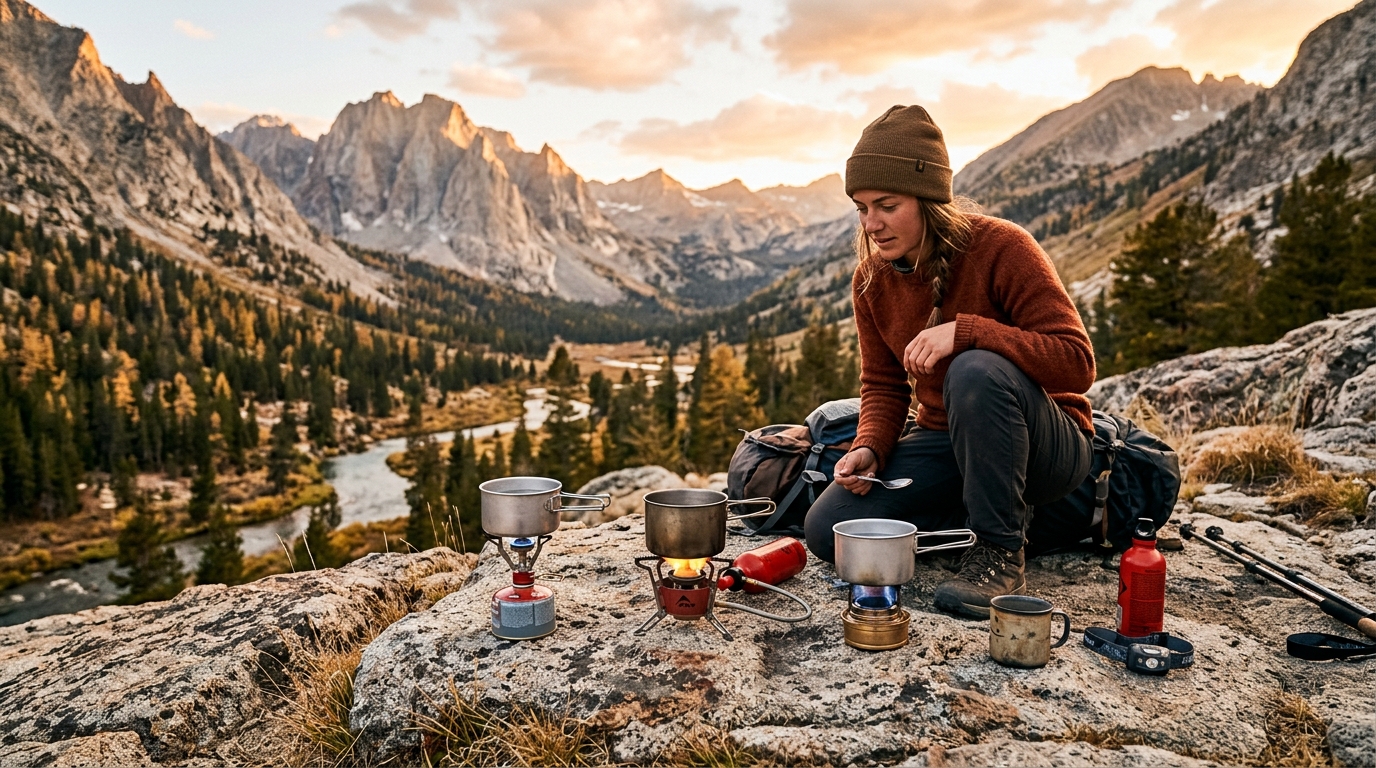
The stove decision hinges on three trade-offs. First: convenience versus cold-weather reliability. Canister stoves are twist-and-go simple but lose pressure below 20°F; liquid-fuel stoves require priming and maintenance but work at -40°F. Second: weight versus cooking speed. Alcohol stoves weigh under an ounce but take 8+ minutes to boil a liter; canister stoves like the MSR PocketRocket 2 Stove weigh 2.6 oz and boil in 3.5 minutes. Third: fuel availability versus pack weight. Isobutane canisters are sold globally at outdoor shops but can't be flown; white gas requires specialty stores but you carry exactly what you need. Your trip profile—weekend car camping, winter mountaineering, thru-hiking the PCT—determines which compromises you should accept.
Canister Stoves: The Default for Three-Season Use
Canister stoves thread onto pressurized isobutane-propane cartridges. They're the most popular category because they require zero setup: attach canister, open valve, ignite. Boil times range from 2.5 minutes (integrated systems like the Jetboil Flash Cooking System) to 4 minutes (ultralight models). Weight spans 2–4 oz for the burner alone, plus 7–13 oz per 110g fuel canister depending on brand.
Specs
The critical spec is the fuel blend. Standard canisters are 70% isobutane / 30% propane; winter blends increase propane to maintain vapor pressure in cold. Isobutane has higher energy density but lower vapor pressure than propane—the blend balances performance and weight. Below 20°F, liquid isobutane won't vaporize fast enough to sustain a flame; you'll need to invert the canister (feeding liquid fuel, which requires a stove rated for inverted use) or switch to a liquid-fuel stove.
When Canister Stoves Make Sense
- Three-season backpacking where temps stay above 20°F at night
- International travel where isobutane canisters are widely available (Europe, Asia, South America)
- Weekend trips where you can estimate fuel needs accurately—a 110g canister provides 60–90 minutes of burn time, enough for 6–9 boil-only meals
- Fast-and-light missions where every ounce matters and you're only boiling water, not cooking complex meals
- Car camping where convenience trumps all other factors and the Coleman Classic Propane Camping Stove offers two burners and adjustable heat
Canister stoves subdivide into three categories. Ultralight burners (2–3 oz) like the MSR PocketRocket 2 Stove prioritize pack weight; they lack windscreens and have minimal simmer control. Mid-range models (4–6 oz) add pot supports and better valves. Integrated systems like the Jetboil Flash Cooking System mate the burner to a proprietary pot with a heat exchanger, cutting boil time to 2.5 minutes but locking you into one cookware size.
Liquid-Fuel Stoves: Cold-Weather Workhorses
Liquid-fuel stoves burn white gas (Coleman fuel), kerosene, or unleaded gasoline from a refillable bottle. They require manual pressurization via a pump and priming (preheating the fuel line) before each use. This complexity buys you two advantages: consistent performance from -40°F to 100°F, and the ability to carry exactly the fuel you need rather than disposable canisters.
Specs
White gas (also called naphtha or Coleman fuel) is the cleanest-burning liquid fuel, leaving minimal soot and requiring less frequent maintenance. Kerosene burns hotter but soots heavily and smells; it's the go-to in developing countries where it's cheaper than white gas. Unleaded gasoline works in multi-fuel stoves but clogs jets faster due to additives. The MSR WhisperLite Universal and XGK-EX are the benchmark multi-fuel models.
Priming is the learning curve. You open the fuel valve slightly to fill the priming cup, ignite it, and let the flame preheat the fuel line. Once the stove roars to life, you adjust the valve for your desired flame. In extreme cold, priming paste (alcohol gel) helps; in moderate temps, the fuel itself primes adequately. After 20–30 hours of use, you'll need to disassemble the fuel line and clear the jet with a cleaning needle—a 10-minute task that intimidates new users but becomes routine.
When Liquid-Fuel Stoves Make Sense
- Winter camping or mountaineering where overnight temps drop below 10°F—liquid fuel maintains pressure when canisters fail
- Expeditions longer than 7–10 days where refillable bottles save weight versus carrying multiple canisters
- International travel to regions where isobutane is scarce but gasoline or kerosene is ubiquitous (Central Asia, parts of Africa and South America)
- Group cooking where you need sustained high heat for 20+ minutes—liquid fuel is more economical than burning through canisters
- Cooking meals that require simmering (rice, stews) rather than just boiling water—liquid-fuel valves offer finer control
Alcohol Stoves: The Ultralight Minimalist Choice
Alcohol stoves are passive burners—no moving parts, no pressurization. You pour denatured alcohol (ethanol with additives to make it undrinkable) into a small container, light it, and place your pot on a stand above the flame. They weigh 0.5–1.5 oz and cost $5–15 for a DIY model or $20–40 for a commercial version like the Trangia or Evernew.
Specs
The appeal is simplicity and weight. A complete alcohol setup—stove, windscreen, pot stand, and fuel bottle—weighs under 4 oz for a weekend trip. There's nothing to break or clog. The downside is speed: alcohol has half the energy density of isobutane, so boil times double. Wind exacerbates this; a windscreen is mandatory, and even then, gusty conditions can triple your fuel consumption.
Alcohol stoves are popular on long-distance trails like the Appalachian Trail and Pacific Crest Trail, where thru-hikers resupply in small towns that may not stock isobutane canisters but always have hardware stores selling denatured alcohol. The slow boil time matters less when you're cooking one meal per day and have time to spare. For weekend backpackers or anyone who values fast meal prep, the time penalty is harder to justify.
When Alcohol Stoves Make Sense
- Thru-hiking where you resupply in small towns without outdoor shops—denatured alcohol is available at any hardware store
- Solo ultralight trips where every gram counts and you're patient with 10-minute boil times
- Backup stove for emergency use—alcohol stoves have no parts to fail and fuel stores indefinitely
- Warm-weather trips where you're primarily rehydrating freeze-dried meals, not cooking from scratch
- Environments with fire restrictions where open flames are prohibited but alcohol stoves may be allowed (check local regulations)
Alternative Fuels: Wood, Solid Tablets, and Propane Hybrids
Wood-burning stoves (like the Solo Stove Lite) use twigs as fuel, eliminating the need to carry any fuel at all. They work well in forested areas with dry wood but are impractical above treeline or in wet conditions. Boil times are highly variable (5–15 minutes depending on wood quality), and they require constant feeding. They're best for casual car camping or as a backup system.
Solid-fuel tablets (Esbit) are compact and lightweight (0.5 oz per tablet, enough for one boil) but burn slowly (10+ minutes per liter) and leave a sticky residue on pots. They're a niche choice for emergency kits or ultralight enthusiasts willing to trade convenience for minimal weight.
Propane-only stoves like the Coleman Classic Propane Camping Stove use 16 oz disposable propane cylinders. They're bulkier than isobutane canisters but cheaper and available at any gas station. They're ideal for car camping where weight doesn't matter, offering two burners and excellent simmer control. Propane performs better than isobutane in cold (down to 0°F), but the cylinders are too heavy for backpacking.
Key Specs Explained: What Matters and What Doesn't
BTU Output
BTU (British Thermal Units) measures heat output per hour. Backpacking stoves range from 7,000 BTU (ultralight canister stoves) to 12,000 BTU (liquid-fuel stoves). Higher BTU means faster boil times, but only in calm conditions—wind and altitude matter more. A 10,000 BTU stove in a 15 mph wind performs like a 5,000 BTU stove. Integrated systems like the Jetboil Flash Cooking System achieve fast boils with lower BTU (9,000) by enclosing the flame and using a heat exchanger. Practical takeaway: BTU is useful for comparing stoves within the same category, but boil-time tests in real conditions are more meaningful.
Burn Time per Fuel Unit
Manufacturers often cite total burn time (e.g., "60 minutes per 110g canister"), but this assumes full-blast operation. Real-world usage—boiling water, simmering, relighting—cuts efficiency by 20–30%. A 110g canister realistically provides 6–8 boil cycles (1L each) in three-season conditions. In cold weather, expect 4–6 boils as the stove works harder to vaporize fuel. For liquid fuel, 1 oz of white gas boils roughly 1L of water; a 20 oz bottle yields 20 boils. For alcohol, 1 oz boils 2 cups (0.5L); a 12 oz fuel bottle provides 24 boils.
Packed Size
Canister stoves nest inside pots, making them space-efficient. Liquid-fuel stoves pack bulkier due to the fuel bottle and pump assembly—expect a 4" × 8" footprint. Alcohol stoves are the smallest (2" × 3"), but you're also carrying a separate fuel bottle. If you're packing a tight backpack, integrated canister systems win; the Jetboil Flash Cooking System stores the burner and 110g canister inside its pot, occupying one 6" × 4" cylinder.
Ignition System
Piezo igniters (push-button spark) fail in wet conditions and at high altitude (above 10,000 feet, the thin air makes sparking unreliable). Always carry waterproof matches or a lighter as backup. Liquid-fuel and alcohol stoves require manual ignition. Some canister stoves have built-in igniters, but seasoned users consider them unnecessary weight—a mini Bic lighter weighs 0.4 oz and never fails.
Match the Stove to Your Trip
Use this decision tree to narrow your options:
- **Weekend backpacking, temps above 20°F, boil-only meals**: Ultralight canister stove (MSR PocketRocket 2 Stove, BRS-3000T). Weight: 2–3 oz. Cost: $20–45.
- **Weekend backpacking, need to simmer or cook**: Mid-range canister stove with valve control (MSR WindBurner, Soto WindMaster). Weight: 5–7 oz. Cost: $60–120.
- **Car camping, 2+ people, varied cooking**: Two-burner propane stove (Coleman Classic Propane Camping Stove). Weight: 10–12 lbs (irrelevant for car camping). Cost: $40–80.
- **Winter camping, temps below 10°F**: Liquid-fuel stove (MSR WhisperLite, XGK-EX). Weight: 12–16 oz. Cost: $110–160.
- **Thru-hiking, resupply in small towns**: Alcohol stove (Trangia, Evernew, DIY). Weight: 0.5–1.5 oz. Cost: $5–40.
- **International expedition, uncertain fuel availability**: Multi-fuel liquid stove (MSR WhisperLite Universal). Weight: 14 oz. Cost: $150–180.
- **Fast-and-light, speed matters most**: Integrated canister system (Jetboil Flash Cooking System). Weight: 13 oz (with pot). Cost: $110–130.
Fuel Efficiency: How to Stretch Your Supply
Fuel consumption varies wildly based on technique. A windscreen cuts fuel use by 30–50% in breezy conditions—mandatory for alcohol stoves, highly recommended for canister stoves (but never use a windscreen that fully encloses a canister; overheating can cause explosions). Starting with warm water (carried in a bottle inside your jacket) saves 20% of fuel. Using a lid while boiling reduces heat loss by another 15%. Cooking one-pot meals instead of boiling multiple times per meal can halve your fuel needs on a week-long trip.
Altitude affects all stoves. At 10,000 feet, water boils at 194°F instead of 212°F, which sounds helpful but isn't—the lower air pressure also reduces oxygen for combustion, and thinner air provides less convective heat transfer. Net result: boil times increase 10–20% per 5,000 feet of elevation gain. Budget an extra 110g canister or 4 oz of white gas per week above 8,000 feet.
Safety and Regulations
Canister stoves are banned in some wilderness areas during high fire danger (check local regulations). Liquid-fuel stoves are generally allowed because the fuel bottle is sealed when not in use. Alcohol stoves occupy a gray area—they're open flames, but the fuel evaporates quickly if spilled. Always operate stoves on mineral soil or a fire pan, never on dry grass or duff.
Isobutane canisters cannot be checked or carried on flights (they're pressurized). Plan to buy fuel at your destination or ship canisters ahead via ground transport. White gas and denatured alcohol are also flight-restricted but easier to source locally. If you're flying to a trailhead, a liquid-fuel or alcohol stove offers more flexibility than a canister system.
Carbon monoxide is a risk when cooking inside tents or enclosed spaces. All combustion stoves consume oxygen and produce CO. Even with ventilation, prolonged use in a tent can lead to dangerous CO buildup. Cook in the vestibule with the door open, or outside under a tarp. The only truly safe indoor option is a catalytic heater (which doesn't cook food) or an electric stove (impractical for backpacking).
Frequently Asked Questions
+Can I use a canister stove in winter if I keep the canister warm?
Yes, with caveats. Sleeping with the canister in your bag overnight keeps it warm enough to function down to 10–15°F in the morning. But once you start cooking, the canister cools rapidly as fuel evaporates (evaporative cooling). In sustained sub-20°F temps, even a warm canister will lose pressure after 2–3 minutes of burn time. Winter-blend canisters (higher propane content) extend this, but below 0°F, liquid-fuel stoves are the reliable choice. Keeping the canister warm is a good tactic for occasional cold snaps, not a replacement for proper cold-weather gear.
+How do I know when a canister is empty?
Shake it—empty canisters feel light and don't slosh. For precise measurement, weigh the canister on a digital scale and subtract the tare weight (printed on the canister, usually 3–4 oz for a 110g size). A full 110g canister weighs ~11 oz total; when it drops to 4 oz, it's empty. Most backpackers carry a spare canister and swap when the flame weakens noticeably, then use the partial canister for the next trip. Partially used canisters are safe to store indefinitely—the fuel doesn't degrade.
+Do I need a different stove for high altitude?
No, but expect reduced performance. All stoves work at altitude; they just take longer to boil water due to lower oxygen and air pressure. Liquid-fuel stoves handle altitude best because you can adjust the air-fuel mix (some models have a jet-size adjustment). Canister stoves lose 10–15% efficiency above 10,000 feet but remain usable. The bigger issue is cold—high camps are often below freezing at night, which compounds canister performance issues. If you're climbing above 14,000 feet, a liquid-fuel stove is the standard choice for reliability.
+Can I refill disposable isobutane canisters?
Technically yes, using a refill adapter, but it's not recommended. Refilling introduces air into the canister, diluting the fuel and reducing performance. It also voids any safety certifications—if a refilled canister fails, you're liable. The cost savings are minimal (maybe $2–3 per refill), and the risk of explosion or leak isn't worth it. If you want refillable fuel, use a liquid-fuel stove. Disposable canisters are designed to be recycled (puncture them with a can opener and toss in metal recycling).
+What's the best stove for cooking real meals, not just boiling water?
Liquid-fuel stoves offer the best simmer control for cooking rice, sautéing vegetables, or simmering stews. The valve adjusts flame height precisely, and the fuel bottle keeps pressure consistent. Among canister stoves, look for models with a separate valve control (not just on/off)—the MSR WindBurner and Soto WindMaster are known for good simmer capability. Integrated systems like the Jetboil Flash Cooking System are optimized for boiling and struggle with low-heat cooking. Alcohol stoves have no simmer control at all—they're full-blast until the fuel burns out.
+How much fuel should I bring for a week-long trip?
For canister stoves: budget one 110g canister per person per 3–4 days of boil-only meals (two boils per day—morning coffee and evening dinner). If you're cooking from scratch or melting snow, double that. For liquid fuel: 2 oz of white gas per person per day for boil-only; 4 oz per day if cooking or melting snow. For alcohol: 1 oz per person per day for boil-only. These are conservative estimates—track your actual usage on a weekend trip and adjust. Carrying 20% extra fuel is standard practice; running out is miserable, and fuel is cheap insurance.
+Are integrated canister systems worth the cost?
If speed and fuel efficiency matter most, yes. The Jetboil Flash Cooking System boils a liter in 2.5 minutes and uses 30% less fuel than a separate stove and pot due to its heat exchanger. The downside is you're locked into one pot size and shape—fine for solo boil-only meals, limiting for group cooking or varied recipes. For weekend warriors who primarily rehydrate freeze-dried meals, integrated systems are excellent. For longer trips or cooks who want flexibility, a separate stove and cookware set offers more versatility for similar weight.