Buying guide
Best Binoculars for Hunting: How to Pick by Terrain and Game
Disclosure: Four Seasons Gear is reader-supported. When you buy through links on our site, we may earn an affiliate commission at no extra cost to you. Prices and availability are accurate as of the time we last checked.
What You're Really Deciding
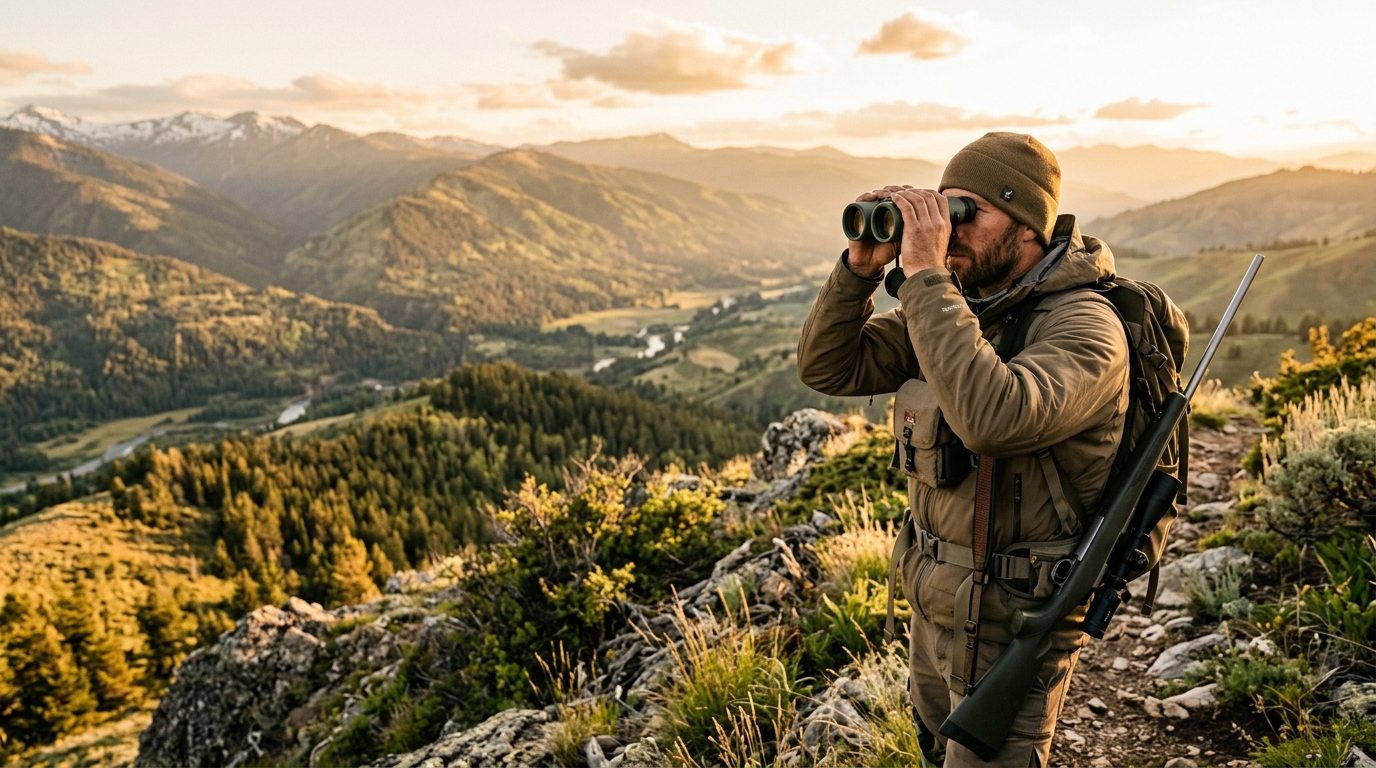
The hunting binocular decision collapses into three core trade-offs. First: magnification versus field of view and hand-shake stability. Higher power (12x, 15x) resolves detail at distance but narrows your view cone and amplifies every tremor in your hands. Second: objective lens diameter versus weight and low-light performance. Larger front lenses (50mm, 56mm) gather more photons for dawn and dusk but add bulk you'll feel on hour six of a stalk. Third: optical quality versus budget. ED (extra-low dispersion) glass, phase-corrected prisms, and multi-layer coatings deliver measurably sharper images with better color fidelity, but you pay $200–$2,000 more than basic roof-prism models. Your terrain, target game, and typical engagement distances determine which trade-offs matter.
Magnification: Match Power to Terrain
Magnification is expressed as the first number in binocular specs (8x42, 10x50). It tells you how many times closer an object appears compared to naked eye. For hunting, the practical range is 8x to 15x. Each step up trades field of view and shake tolerance for resolving power at distance.
Specs
The Vortex Optics Diamondback HD 10x42 Binoculars exemplify the 10x sweet spot—enough magnification to judge antler points at 400 yards, enough field of view to track moving game, and light enough at 21 oz to carry all day without a harness.
Objective Lens Diameter: Light Gathering vs Weight
The second number in binocular specs (8x42, 10x50) is the objective lens diameter in millimeters. Larger objectives gather more light, extending usable glassing time into dawn and dusk—critical for hunting since game movement peaks in low light. But diameter directly drives weight and bulk.
Specs
Exit pupil—the diameter of the light beam leaving the eyepiece—is calculated by dividing objective diameter by magnification (42mm ÷ 10x = 4.2mm). The human pupil dilates to about 5–7mm in darkness, 2–4mm in daylight. A 4–5mm exit pupil ensures you use all available light in typical hunting conditions. The Nikon Prostaff P3 8x42 Binoculars deliver a 5.25mm exit pupil, making them particularly effective in the dim light of forest edges at dawn.
Optical Quality: What You're Paying For
Budget binoculars ($100–$300) use basic BaK-4 prisms and multi-coated optics. Mid-tier models ($300–$800) add phase-corrected prisms and fully multi-coated lenses. Premium glass ($800–$2,500) incorporates ED or HD glass elements that minimize chromatic aberration—the color fringing you see around high-contrast edges like antlers against sky.
- ED/HD glass: Reduces color fringing by 60–80%; most noticeable when glassing backlit subjects or in high-contrast snow/rock environments
- Phase-corrected prisms: Improves contrast and sharpness by correcting light wave interference; measurable difference in resolving fine detail like tine tips at distance
- Fully multi-coated optics: Every air-to-glass surface coated; increases light transmission from ~85% to 90–95%; translates to noticeably brighter image in low light
- Dielectric prism coatings: Reflect 99%+ of light vs 95% for aluminum coatings; premium feature that adds $200–$500 but delivers measurably brighter, higher-contrast images
The Bushnell H2O Waterproof 10x42 Binoculars represent the entry tier—fully multi-coated, BaK-4 prisms, IPX7 waterproof, and adequate optical performance for hunters on a $150 budget. They won't resolve the fine detail of premium glass, but they'll get you glassing effectively while you save for an upgrade.
Field of View: Why It Matters More Than You Think
Field of view (FOV) is the width of the observable area at 1,000 yards, expressed in feet. A wider FOV makes it easier to locate game, track movement, and maintain situational awareness. Narrow FOV forces you to constantly pan and scan, increasing the chance you'll miss movement in your peripheral zone.
Specs
FOV is inversely related to magnification—you cannot have both high power and wide field in the same optical design. This is why western guides often carry both an 8x56 for scanning and a 12x50 or 15x56 for detailed inspection of distant animals.
Close Focus Distance: The Overlooked Spec
Close focus is the minimum distance at which the binocular can focus sharply. Most hunting binoculars focus down to 6–20 feet. This matters when you're glassing from a blind and a deer walks to 30 yards, or when you want to inspect a track, scat, or rub up close. High-magnification models (12x, 15x) typically have longer minimum focus distances (15–25 feet) due to optical design constraints. If you hunt from ground blinds or tree stands where close encounters are common, verify the close focus spec is under 10 feet.
Eye Relief: Critical for Eyeglass Wearers
Eye relief is the distance your eye can be from the eyepiece while still seeing the full field of view. If you wear eyeglasses while glassing, you need 15–17mm of eye relief to see the entire image circle without vignetting (dark edges). Most modern binoculars offer 14–20mm of eye relief with twist-up or fold-down eyecups. If you don't wear glasses, shorter eye relief (13–15mm) is fine and often provides a more immersive viewing experience.
Waterproof and Fogproof: Non-Negotiable for Hunting
Hunting binoculars experience temperature swings, condensation, rain, snow, and humidity. Any binocular you consider must be purged with nitrogen or argon and O-ring sealed to IPX7 standard minimum (submersible to 1 meter for 30 minutes). This prevents internal fogging when you move from a warm truck into freezing air, or from shade into direct sun.
Rubber armoring protects against drops and provides grip in wet conditions. All serious hunting binoculars include it. The difference is in durability—premium models use thicker, more impact-resistant rubber that survives years of abuse, while budget models may show wear after a season of hard use.
Weight and Carry: The All-Day Reality
Binocular weight ranges from 12 oz (compact 8x32) to 48 oz (large 15x56). For spot-and-stalk hunting where you're covering miles, every ounce matters. For stationary glassing from a truck or blind, weight is irrelevant. For backcountry hunts, 20–28 oz (standard 10x42 size) is the practical maximum before you need a harness system.
Specs
A quality binocular harness (chest-mounted) distributes weight across your torso, keeps optics accessible, and protects them from impacts. Budget $30–$80 for a harness if your binoculars weigh over 24 oz or you're hunting in rough terrain.
Match the Gear to Your Hunt
Your optimal binocular configuration depends on terrain, game, and hunting style. Here's how to match specs to conditions:
Specs
If you hunt multiple species across varied terrain, a quality 10x42 with good low-light performance covers 80% of situations. Add a compact 8x32 for thick cover or a 12x50 for open country as budget allows.
Roof Prism vs Porro Prism: Does It Matter?
Modern hunting binoculars overwhelmingly use roof prism designs—the straight-barrel shape you're familiar with. Roof prisms allow compact, waterproof construction and are more durable in the field. Porro prism binoculars (the classic wide-body shape with offset objectives) offer slightly better depth perception and are often less expensive for equivalent optical quality, but they're bulkier and harder to seal against moisture. For hunting, roof prism is the standard choice unless you're specifically seeking a budget porro model for stationary use.
Tripod Mounting: When You Need It
Any binocular over 12x magnification or 40 oz weight benefits from tripod mounting for extended glassing sessions. Hand tremor at 12x magnification reduces effective resolution by 20–40% compared to a tripod-stabilized view. Most binoculars include a threaded tripod adapter socket (standard 1/4"-20 thread) on the hinge post. Budget $40–$120 for a fluid-head tripod or $25–$60 for a window mount if you glass from a vehicle.
For backcountry use, a lightweight carbon fiber tripod (2–3 lbs) paired with 10x42 binoculars provides stable glassing without excessive weight penalty. This setup is standard for serious western hunters glassing distant basins for hours.
Warranty and Durability: What to Expect
Premium binocular manufacturers (Vortex, Leupold, Swarovski, Zeiss) offer unconditional lifetime warranties covering defects and damage. Mid-tier brands typically offer 10–25 year warranties. Budget models may have 1–5 year limited warranties. For hunting gear that experiences drops, temperature extremes, and rough handling, warranty quality correlates strongly with long-term satisfaction.
Expected lifespan for quality hunting binoculars is 15–25 years with reasonable care. Premium models often outlast their owners. Budget models may show optical degradation (coating wear, prism misalignment) after 5–10 years of hard use. Factor warranty and expected lifespan into your cost-per-use calculation.
Budget Allocation: Where to Spend
Hunting binoculars span $100 to $3,000+. Here's what each tier delivers:
Specs
For most hunters, the $400–$800 range delivers optimal cost-to-performance. You get phase-corrected prisms, good low-light capability, and a warranty that outlasts the product. The jump from $800 to $2,000 yields real but incremental improvements that matter most to hunters who glass for hours daily.
Testing Before You Buy: What to Look For
If possible, test binoculars before purchase. Focus on these evaluations:
- Edge sharpness: Focus on a distant object in the center, then look at the edges without refocusing. Premium optics stay sharp to 80–90% of the field; budget models soften noticeably past 60%.
- Chromatic aberration: Glass a high-contrast edge (dark tree branch against bright sky). Look for purple or green fringing. ED glass reduces this dramatically.
- Low-light performance: Compare binoculars at dusk or in shade. The difference in brightness and contrast between mid-tier and premium optics is most obvious in poor light.
- Focus mechanism: The focus wheel should turn smoothly with no play or grinding. It should move your focus from close to infinity in 1.5–2.5 turns—too fast and you can't fine-tune, too slow and you can't acquire targets quickly.
- Ergonomics: Hold the binoculars in glassing position for 2–3 minutes. Note pressure points, balance, and whether your hands fatigue. This matters more than spec sheets suggest.
Many outdoor retailers allow field testing or have generous return policies. Take advantage—optical preference is partly subjective, and what works for one hunter may not suit another's eye physiology or glassing style.
+Do I really need waterproof binoculars for hunting, or is water-resistant enough?
You need fully waterproof (IPX7 minimum) binoculars for hunting. Water-resistant means the housing resists splashes but isn't sealed—moisture will eventually penetrate and fog the internal optics, which cannot be cleaned without disassembly. Hunting exposes binoculars to rain, snow, condensation from temperature changes, and humidity. Nitrogen-purged, O-ring sealed construction prevents internal fogging and is now standard even in budget hunting binoculars. The small upcharge for true waterproofing is non-negotiable for field reliability.
+What's more important for low-light hunting: larger objective lenses or better glass quality?
Both matter, but they work differently. Larger objectives (50mm vs 42mm) gather 42% more light mathematically, which translates to extending usable glassing time by 15–25 minutes into dusk. Better glass quality (ED elements, dielectric coatings) increases light transmission from 85% to 92–95%, which delivers a brighter, higher-contrast image in the same light conditions. For practical hunting, a quality 10x42 with premium coatings will outperform a budget 10x50 in low light because the superior coatings transmit more of the light that enters the objective. If you're choosing between 42mm and 50mm objectives in the same quality tier, the 50mm gives you a real but modest advantage at the cost of 6–10 oz additional weight.
+Should I get 8x or 10x binoculars for all-around hunting?
For most hunters in varied terrain, 10x42 is the optimal compromise. The 10x magnification provides enough power to judge antler quality and count points at 400–600 yards while maintaining a 330–360 ft field of view adequate for tracking movement. The 8x configuration excels in dense timber, close-range hunting, and situations where you need maximum field of view, but you sacrifice detail resolution at distance. If you primarily hunt eastern whitetail in thick cover or frequently glass from a moving vehicle, 8x is superior. If you hunt western big game, open country, or need to glass distant ridges, 10x is more versatile. The difference in hand-shake stability between 8x and 10x is real but manageable for most hunters—proper bracing technique (elbows on knees, leaning against a tree) stabilizes 10x adequately.
+How much should I spend on hunting binoculars?
Allocate $400–$800 for binoculars you'll use for 10+ years of serious hunting. This range delivers phase-corrected prisms, fully multi-coated optics, good low-light performance, and warranties of 10 years to lifetime. Below $400, you're compromising optical quality in ways that matter in low light and at distance. Above $800, you're paying for incremental improvements (ED glass, dielectric coatings) that deliver real but diminishing returns. If you glass extensively—multiple hours per hunt, western spot-and-stalk, alpine hunting—the jump to $1,000–$1,500 binoculars is justified by measurably better edge sharpness, color fidelity, and low-light performance. If you hunt occasionally or primarily from stands where glassing sessions are short, a quality $300–$500 binocular will serve you well.
+Can I use the same binoculars for hunting and general outdoor use like birding or hiking?
Yes, with one consideration: hunting binoculars prioritize durability, waterproofing, and low-light performance, which makes them excellent for any outdoor use. Birding-specific binoculars sometimes prioritize close focus distance (down to 4–6 feet) and wider field of view over ruggedness, but a quality 8x42 or 10x42 hunting binocular will perform well for birding, wildlife observation, hiking, and general outdoor use. The main trade-off is weight—hunting binoculars in the 24–28 oz range are heavier than ultralight birding models (16–20 oz), but the durability and waterproofing make them more versatile for variable conditions. If you want one binocular for multiple uses, choose based on your primary activity and accept minor compromises for secondary uses.
+Do I need a rangefinding binocular for hunting?
Rangefinding binoculars integrate a laser rangefinder into one barrel, eliminating the need to carry separate optics. They're useful for rifle hunters who need precise distance measurements for shot placement, but they add $400–$1,500 to the cost, increase weight by 4–8 oz, and require battery management. For bowhunters, the rangefinding function is essential and the integration is valuable. For rifle hunters in open country, a separate rangefinder ($150–$400) paired with quality binoculars often delivers better optical performance and more flexibility—you can upgrade one without replacing both. Rangefinding binoculars make sense if you want to minimize gear, hunt in conditions where fumbling with multiple devices is problematic, or your budget allows premium integrated optics. Most hunters are better served by separate, specialized tools.
+How do I clean and maintain hunting binoculars?
Use a lens pen or microfiber cloth for routine cleaning—never use clothing, paper towels, or tissues, which scratch coatings. For stubborn dirt, use lens cleaning solution designed for coated optics, not household cleaners. Blow dust off with a rocket blower before wiping to avoid grinding particles into coatings. Store binoculars with lens caps on in a dry environment—not in a hot vehicle or damp basement. After exposure to rain or snow, wipe external moisture and allow to air dry before storing. Check the focus mechanism annually for smooth operation and inspect O-rings for cracks if you notice any internal fogging. Quality binoculars need minimal maintenance but benefit from annual inspection and cleaning. Avoid over-tightening the diopter adjustment, which can strip threads. Most warranty claims result from drops or impacts, not wear—use a harness and be deliberate with your optics.