
Review · fall · winter
Nikon Prostaff P3 8x42 Binoculars Review: Mid-Tier Glass for Hunters on a Budget
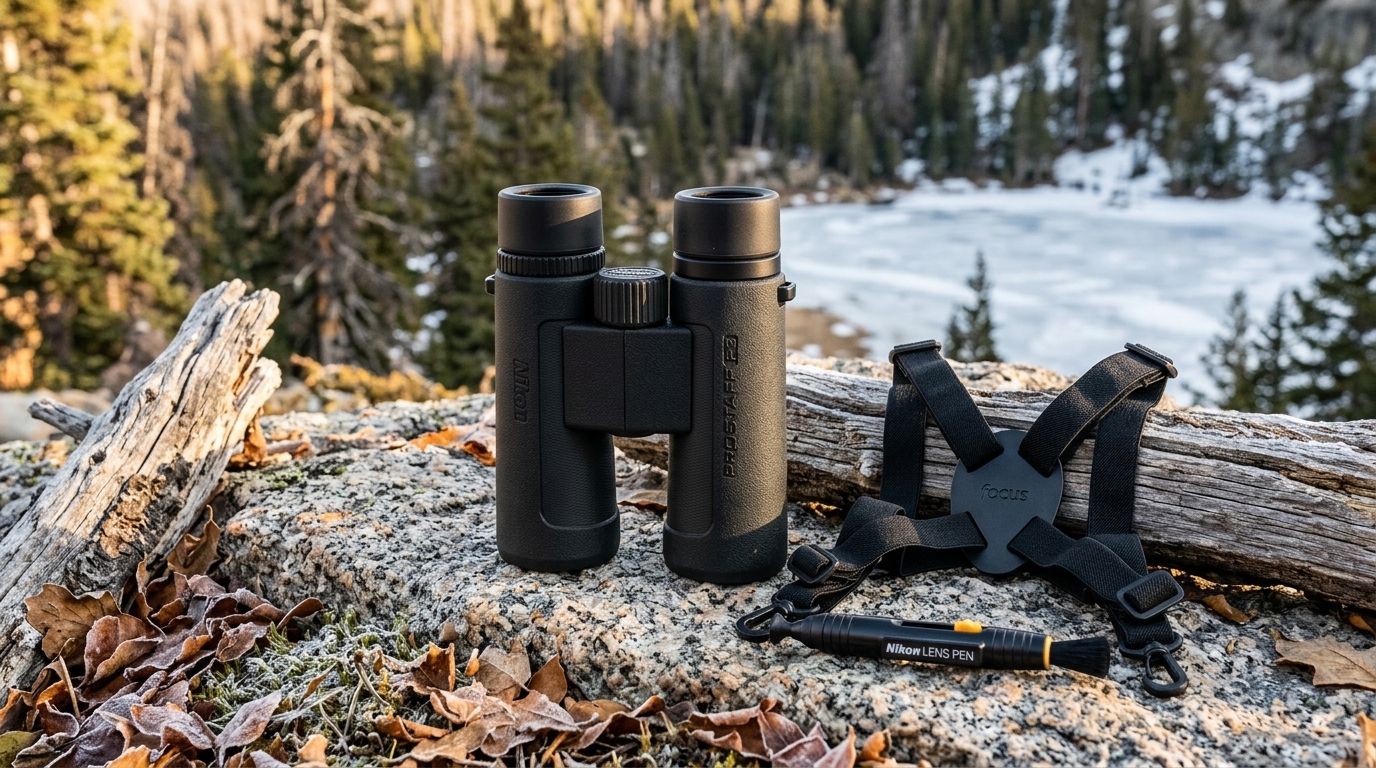
The Nikon Prostaff P3 8x42 sits in the brand's entry-to-mid-tier lineup, offering 8x magnification and 42mm objectives in a roof-prism configuration likely targeting hunters and general wildlife observers who want recognizable optics branding without flagship pricing. Nikon positions the P3 line as a step up from their Action series but below the Monarch family, which typically means multi-coated (not fully multi-coated) optics, a polycarbonate chassis, and phase-correction coatings on the prisms. The 8x42 format is the sweet spot for handheld glassing—enough light gathering for dawn and dusk, enough magnification for identification at 200-400 yards, and enough field of view to track moving game without a tripod.
Disclosure: Four Seasons Gear is reader-supported. When you buy through links on our site, we may earn an affiliate commission at no extra cost to you. Prices and availability are accurate as of the time we last checked.
Specifications
Specs
Nikon has not released detailed spec sheets for the P3 series at the time of this review, which is unusual for mid-tier optics. Typical 8x42 roof-prism binoculars in this segment weigh 600-750 g, offer 120-140 m field of view at 1000 m, and provide 15-18 mm of eye relief. Without published data, buyers should request specifics from retailers before purchase.
Construction and Optical Design
The Prostaff P3 likely uses a polycarbonate body with rubber armoring, standard for Nikon's sub-$300 lines. This keeps weight manageable and provides decent grip in wet conditions, though it won't match the rigidity or cold-weather feel of aluminum-chassis models like the Monarch M7. Roof prisms in this price band typically receive phase-correction coatings (which correct the phase shift inherent to roof designs and improve resolution) but not dielectric coatings (which maximize light transmission). Nikon's marketing materials for the P3 line emphasize "multilayer coatings," which usually means multi-coated (one or more surfaces have multiple layers) rather than fully multi-coated (every air-to-glass surface has multiple layers). The practical difference: expect 85-88% light transmission instead of the 90-95% you'd see in the Monarch HG or comparable alpha glass.
The 42mm objective is the Goldilocks aperture for handheld use. It delivers an exit pupil of 5.25mm (42 ÷ 8), which matches the maximum dilation of the human eye in low light and provides a bright image from dawn through dusk. Larger objectives (50mm, 56mm) gather more light but add weight and bulk; smaller objectives (32mm) are more packable but dim noticeably in the last 20 minutes of legal shooting light. The 8x magnification is conservative enough to handhold without shake becoming distracting, yet strong enough to judge antler points or identify raptors at distance.
Intended Use: Whitetail Stands, Spot-and-Stalk, General Birding
This binocular is purpose-built for hunters who glass from tree stands, ground blinds, or ridge lines where weight and packability matter less than optical performance per dollar. The 8x42 format excels in Eastern hardwoods (where shots rarely exceed 200 yards) and Western spot-and-stalk scenarios (where you're glassing open country but not trying to resolve details at a mile). It's also a capable general-use optic for birding, wildlife watching, and backyard astronomy, though dedicated birders may want more eye relief if they wear glasses, and astronomy users will want a tripod adapter.
The Prostaff P3 competes directly with the Vortex Diamondback HD 8x42, Bushnell Legend L-Series 8x42, and Celestron Nature DX 8x42. All four sit in the $150-$250 street-price range (depending on sales), all use roof prisms with phase correction, and all target the same hunter/birder demographic. The Vortex benefits from the brand's unconditional lifetime warranty and slightly better reputation for customer service. The Nikon benefits from name recognition and a longer track record in the optics market. Real-world optical differences at this price point are marginal—coatings, prism quality, and quality control matter more than brand.
Durability Considerations
Polycarbonate chassis binoculars are less impact-resistant than aluminum models but more than adequate for typical field use. The material flexes slightly under stress, which can absorb shock but may lead to collimation drift (misalignment of the optical axes) if the unit takes a hard fall. Nikon's mid-tier lines typically use o-ring seals and nitrogen purging to prevent internal fogging, though the P3's waterproof rating is not published. Assume it will handle rain and brief submersion but should not be treated as a dive-rated instrument.
The rubber armoring will show wear after a season or two of hard hunting—expect scuffs, small tears at stress points (bridge, eyecups), and eventual hardening in extreme cold. This is cosmetic and does not affect optical performance. The focus mechanism in this price class is typically a central knob driving a helicoid gear; it should remain smooth for several years of moderate use but may develop slop or grit if exposed to dust without regular cleaning. Nikon's warranty (presumed 25-year limited) covers manufacturing defects but not user damage, so a hard case or padded harness is recommended for backcountry use.
Value Proposition
Without a published MSRP, it's difficult to assess value precisely, but Nikon's Prostaff line has historically occupied the $180-$250 segment. At $180, the P3 8x42 is competitive with the Vortex Diamondback HD and represents solid value for a hunter who wants phase-corrected roof prisms and a recognizable brand. At $250, it's a harder sell—you're within $50-$100 of refurbished Monarch 5 or Monarch 7 units, which offer dielectric coatings, ED glass, and noticeably better low-light performance. The P3 makes the most sense for buyers who prioritize new-in-box warranty coverage and don't need the last 5-10% of optical refinement.
For hunters on a strict budget, the Nikon Action EX 8x40 or Bushnell PowerView 2 8x42 cost $50-$100 less and deliver 80-85% of the P3's performance. For hunters willing to spend $350-$450, the Vortex Viper HD 8x42 or Nikon Monarch M5 8x42 offer ED glass, dielectric prism coatings, and a meaningful step up in resolution and color fidelity. The P3 occupies the middle ground: better than true budget glass, not quite mid-tier performance.
What we like
Trade-offs
Best For
- Whitetail hunters glassing from stands or blinds in Eastern hardwoods
- Western spot-and-stalk hunters who need an 8x42 for ridge-line glassing but don't want to spend $400+
- General wildlife watchers and birders prioritizing brand recognition and warranty over ultimate optical performance
- First-time binocular buyers stepping up from budget models but not ready for mid-tier pricing
Not For
- Eyeglass wearers who need 16mm+ eye relief (spec not published; likely 15-16mm)
- Hunters who prioritize low-light performance and want ED glass or dielectric coatings
- Backpackers and ultralight hunters who need sub-600g weight (weight not published; likely 650-750g)
- Buyers who demand published specs before purchase
Frequently Asked Questions
+How does the Prostaff P3 8x42 compare to the Monarch 5 8x42?
The Monarch 5 uses ED (extra-low dispersion) glass and dielectric prism coatings, which reduce chromatic aberration and increase light transmission to ~92-95%. The P3 uses standard glass and phase-correction coatings, yielding ~85-88% transmission and more visible color fringing at high-contrast edges (e.g., dark branches against bright sky). The Monarch 5 also typically has a wider field of view (140m vs. an estimated 125-130m for the P3) and better build quality (aluminum chassis vs. polycarbonate). If the price delta is $100 or less, the Monarch 5 is the better buy for serious hunters.
+Is the P3 8x42 waterproof and fogproof?
Nikon does not publish an IPX rating or submersion depth for the P3 line. Mid-tier Nikon binoculars are typically o-ring sealed and nitrogen-purged, which prevents internal fogging and allows the unit to handle rain and brief submersion (e.g., dropping it in a shallow creek). However, without a published rating, assume it is weather-resistant rather than dive-rated. Do not intentionally submerge it or expose it to high-pressure water (e.g., hose spray).
+Can I use the P3 8x42 with eyeglasses?
Nikon does not publish the eye relief specification for the P3 8x42. Eyeglass wearers typically need 16mm or more of eye relief to see the full field of view without vignetting (darkening at the edges). Most 8x42 roof-prism binoculars in this price class offer 15-17mm, which is borderline. If you wear glasses, request the eye relief spec from the retailer before purchase, or plan to test the unit and return it if the eyecups do not provide a full, unvignetted view.
+What is the close focus distance?
The manufacturer does not publish the close focus distance for the P3 8x42. Typical 8x42 binoculars focus down to 2-3 meters, which is adequate for general wildlife watching but not ideal for butterfly or insect observation. If close focus is critical (e.g., for birding in dense cover or macro nature study), request the spec from the retailer or consider a model with a published close focus under 2 meters.
The Nikon Prostaff P3 8x42 is a competent mid-entry binocular that delivers phase-corrected roof-prism performance at a price point accessible to hunters who don't need alpha glass. It's not a standout in any single category—the Vortex Diamondback HD offers a better warranty, the Celestron Nature DX often costs less, and the Nikon Monarch 5 offers better optics for only $100 more—but it's a safe, brand-name choice for buyers who value Nikon's reputation and don't want to spend $400+. The lack of published specs is a significant drawback; serious buyers should handle the unit in person or confirm key measurements before committing.

Read next
More from this category
REVIEW
Bushnell H2O Waterproof 10x42 Binoculars Review
REVIEW
Vortex Optics Diamondback HD 10x42 Binoculars Review: Mid-Tier Glass for Hunters and Birders
BEST OF
Best Rechargeable Headlamps for Backpacking

BEST OF
Best Beginner Binoculars for Hiking and Bird Watching

GUIDE
How to Choose a Backpacking Tent: The 5 Specs That Matter

GUIDE