
Head-to-head
La Sportiva Tarantulace vs SCARPA Instinct VS: Which Climbing Shoe Fits Your Style?
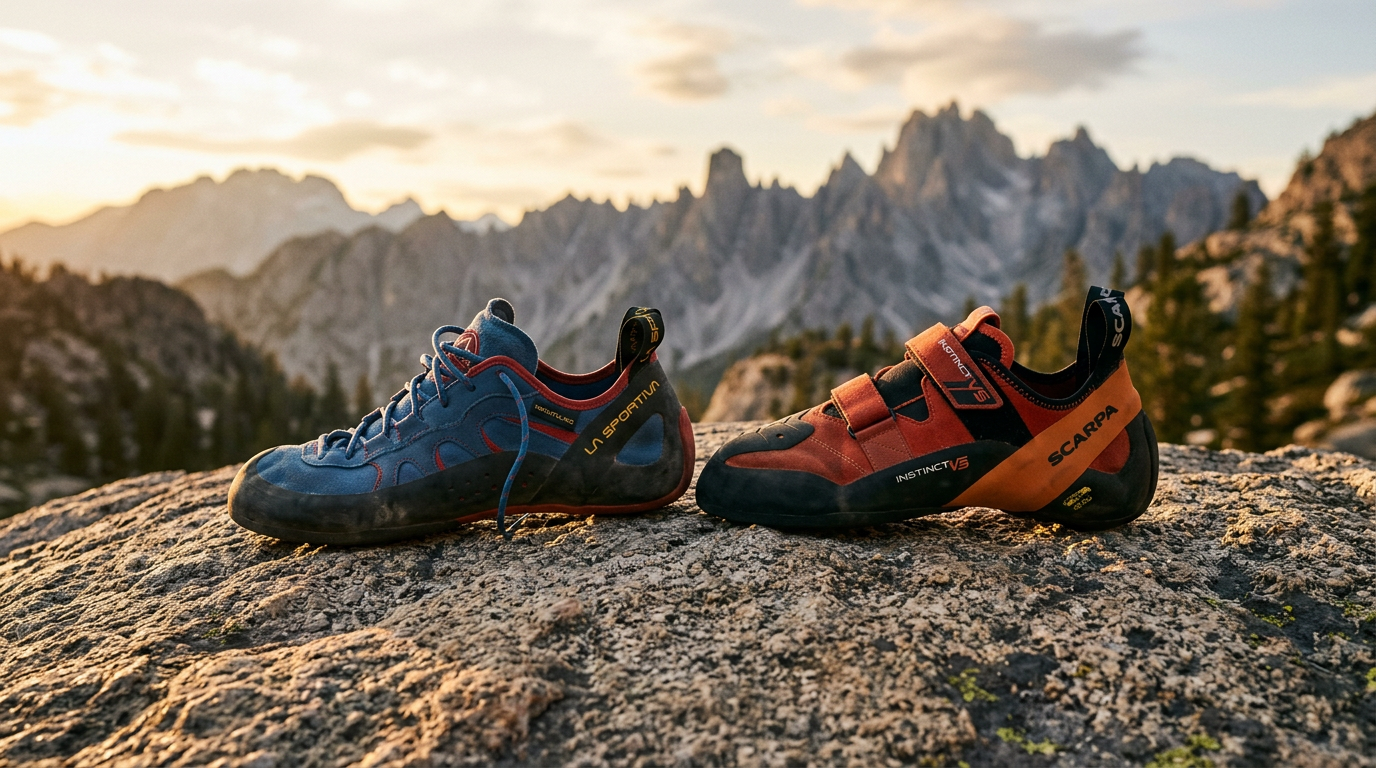
The SCARPA Instinct VS wins for intermediate to advanced climbers seeking precision on overhanging sport routes and technical bouldering, with its aggressive downturn and sticky Vibram XS Grip2 rubber justifying the $200 price point. However, the La Sportiva Tarantulace at $99 is the better pick for beginners, gym climbers, and anyone prioritizing all-day comfort over performance—its flat profile and lace system accommodate wider feet and longer sessions without the pain tax of a performance shoe.
Disclosure: Four Seasons Gear is reader-supported. When you buy through links on our site, we may earn an affiliate commission at no extra cost to you. Prices and availability are accurate as of the time we last checked.
Choosing between the La Sportiva Tarantulace and SCARPA Instinct VS means deciding what stage of climbing you're at and what terrain you'll tackle most. These shoes occupy opposite ends of the performance spectrum: one is a forgiving workhorse for learning fundamentals, the other a specialized tool for pushing grades on steep terrain.
Spec Comparison
Specs
Profile and Fit Philosophy: Comfort vs. Precision
The Tarantulace uses a flat, neutral last with zero downturn—your toes sit in a relaxed position as if standing barefoot. The lace system runs from toe to ankle across five eyelets, allowing micro-adjustments for volume and accommodating higher-volume feet or bunions. La Sportiva's unlined leather upper stretches approximately half a size over the first 10-15 sessions, so most climbers size down a half size from street shoe for a snug but not painful fit. This design prioritizes all-day wearability: you can keep these on for 2-3 hour gym sessions or multi-pitch trad routes without the toe-curling agony of performance shoes.
The Instinct VS employs an aggressively downturned last (approximately 15-degree angle from heel to toe) with a pronounced asymmetry that forces your big toe into the power position. SCARPA's bi-tension randing system and P3 platform maintain this shape permanently—the shoe won't flatten out even after 50 sessions. The dual hook-and-loop straps cinch quickly but offer less fine-tuning than laces. Most climbers size this shoe 1.5-2 full sizes below street shoe for maximum power transfer, resulting in significant toe curl. Expect to remove these between attempts; wearing them for more than 20 minutes continuously borders on masochistic.
Rubber Performance: Grip vs. Durability
La Sportiva's FriXion RS rubber measures approximately 4mm thick at the toe and uses a harder durometer (around 75-80 Shore A, though La Sportiva doesn't publish exact specs). This compound prioritizes durability and edging support over maximum friction—you'll feel solid standing on dime-sized edges, and a pair typically lasts 6-9 months of 3x/week gym use before needing a resole. The tradeoff: on polished gym volumes or greasy outdoor slopers, the Tarantulace offers noticeably less grip than stickier rubbers.
The Instinct VS uses Vibram's XS Grip2, a softer compound (approximately 65-70 Shore A) formulated for maximum friction. The 3.5mm sole thickness provides just enough structure for edging while allowing your foot to feel texture variations in the rock. On steep terrain with smears and heel hooks, this rubber outperforms the Tarantulace decisively—you'll stick moves that would skate off with harder rubber. The cost: XS Grip2 wears faster, typically requiring a resole after 4-6 months of regular bouldering. The extended toe rand also adds rubber coverage for toe hooks, a feature absent on the Tarantulace.
Midsole Stiffness and Power Transfer
The Tarantulace incorporates a full-length 1.1mm LaspoFlex midsole running from heel to toe. This relatively thick, continuous platform provides excellent support for beginners still developing foot strength—you can stand on small edges without your foot collapsing or cramping. The stiffness also aids in crack climbing, where you're torquing your foot into jams. However, this support comes at the expense of sensitivity; you won't feel subtle texture changes in footholds, which matters less when you're learning movement patterns but becomes limiting as you progress to reading micro-features.
SCARPA's Instinct VS uses a partial 1.4mm Flexan midsole that stops at the midfoot, leaving the forefoot area flexible. Combined with the P3 platform (a plastic insert that maintains downturn), this construction concentrates power at your big toe while allowing your forefoot to wrap around volumes and pockets. The result: superior sensitivity for feeling holds and explosive power for dynamic moves, but zero forgiveness—if your footwork is sloppy or your foot strength underdeveloped, you'll struggle on small edges where the Tarantulace would support you.
Value Proposition: Price Per Session
At $98.95, the Tarantulace costs less than half the Instinct VS's $200.10 price tag. For a beginner climbing 2x/week, this shoe will last 8-12 months before the rand wears through or the upper develops holes—approximately 80-100 sessions, or $0.98-$1.24 per session. Factor in a $45 resole (La Sportiva's standard service), and you can extend the life another 60-80 sessions. This makes the Tarantulace one of the most cost-effective entry points into climbing.
The Instinct VS's $200 entry cost and faster rubber wear (4-6 months for aggressive boulderers) translates to roughly $2.50-$3.00 per session before the first resole. However, this calculation ignores performance value: if the shoe's precision allows you to send a project you've been working for weeks, or prevents foot fatigue on a long sport route, the per-session cost becomes secondary to capability. For climbers operating at 5.11+ / V4+ and above, the Instinct VS isn't overpriced—it's appropriately priced for its performance tier.
Pros and Cons
What we like
Trade-offs
Decision Guide
Buy the La Sportiva Tarantulace if you're new to climbing (first 6-12 months), prioritize comfort for long gym sessions or multi-pitch routes, have wider feet that struggle with narrow performance lasts, climb primarily on vertical terrain or slabs, or want a single shoe that handles gym, sport, and trad equally well without specialization.
Buy the SCARPA Instinct VS if you're climbing 5.11+ / V4+ or harder, focus on overhanging sport routes or steep bouldering, need maximum rubber friction for competition-style volumes and smears, have developed enough foot strength to utilize an aggressive downturn, or want a dedicated performance shoe for projecting hard routes (and own a separate comfortable shoe for warm-ups).
Frequently Asked Questions
+Can I use the Tarantulace for bouldering, or do I need an aggressive shoe?
The Tarantulace handles gym bouldering up to approximately V3-V4, particularly on vertical problems with edges and pockets. Beyond that grade, routes increasingly feature overhangs, volumes, and heel hooks where the flat profile and harder rubber become limiting factors. You'll notice intermediate climbers at your gym wearing aggressive shoes on steeper problems for good reason—the downturn and sticky rubber provide measurable advantages. That said, many climbers successfully boulder in flat shoes by focusing on technique; you don't need an Instinct VS until the shoe itself becomes the limiting factor in your progression.
+How much should I size down each shoe?
For the Tarantulace, size down 0.5 sizes from your street shoe for a performance fit, or go true to size for maximum comfort (accepting some performance loss). The unlined leather will stretch about half a size, so factor that into your decision—if you buy true to size, expect them to feel sloppy after 15 sessions. For the Instinct VS, most climbers size down 1.5-2 full sizes from street shoe, resulting in significant toe curl and a tight, almost painful fit out of the box. The synthetic upper stretches minimally (maybe a quarter size), so what you feel in the store is what you'll climb in. If you're between sizes, go smaller on the Instinct VS—a loose aggressive shoe loses all performance benefits.
+Will the Instinct VS work for crack climbing or multi-pitch trad routes?
The Instinct VS is poorly suited for crack climbing—the aggressive downturn makes foot jams awkward and painful, and the thin, flexible forefoot lacks the torsional rigidity needed for secure jams. For multi-pitch trad, the comfort issue becomes prohibitive; even experienced climbers can't tolerate the Instinct VS for the 4-8 hours a big wall demands. The Tarantulace excels in both applications: its flat profile and lace system work perfectly for jams, and the comfort allows all-day wear. If you're building a quiver, buy the Tarantulace for trad and cracks, then add an aggressive shoe like the Instinct VS later for sport climbing and bouldering.

Read next
More comparisons + reviews
REVIEW
EDELRID Swift Protect 8.9mm Pro Dry Dynamic Climbing Rope Review
REVIEW
BlueWater Ropes 11.4mm AssaultLine NFPA Static Rope Review
REVIEW
Black Diamond Mojo Zip Chalk Bag Review: Classic Cylinder With Zippered Stash
REVIEW
PETZL Corax LT Women's Climbing Harness Review
REVIEW
Mammut Comfort Fast Adjust Climbing Harness - Men's Review
REVIEW