
Head-to-head
EVOLV Shaman Pro vs SCARPA Instinct VS: Which Aggressive Climbing Shoe Wins?
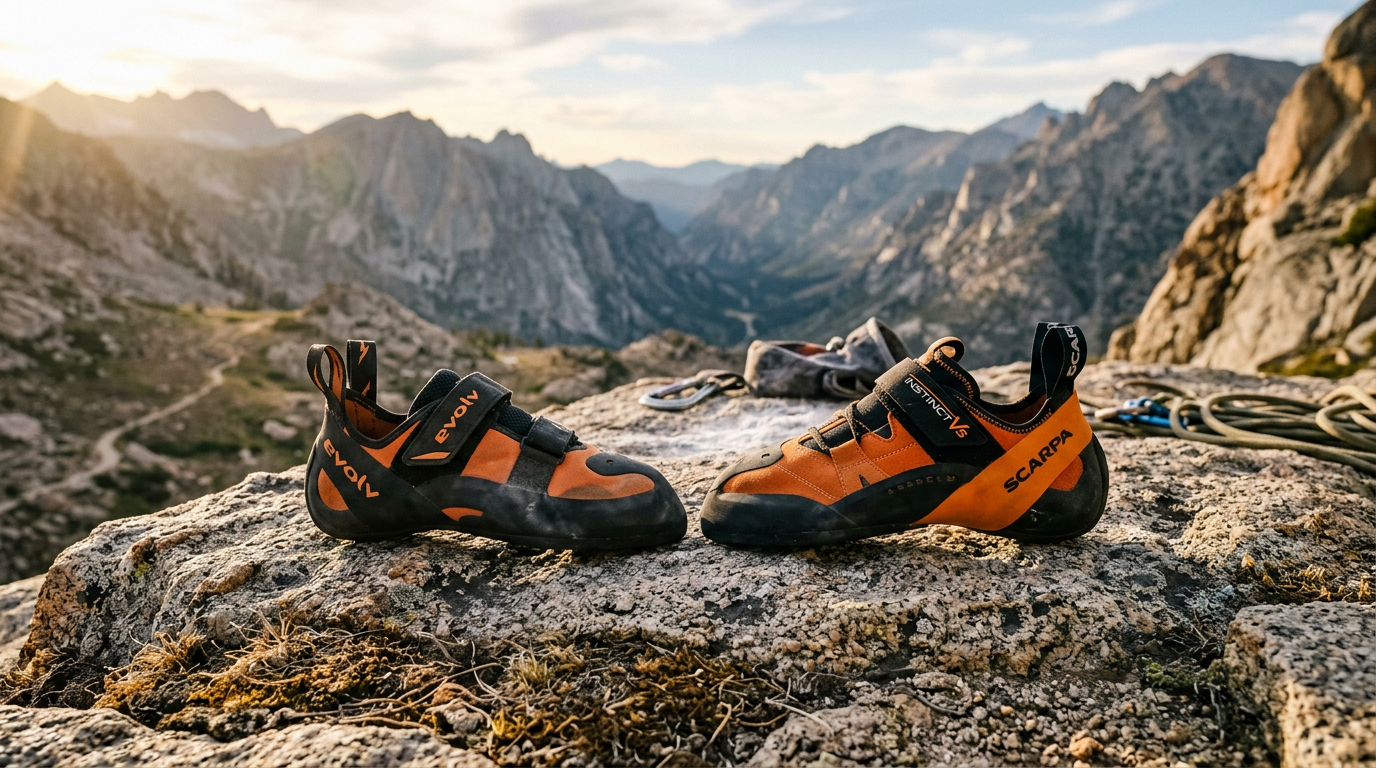
The SCARPA Instinct VS edges out the EVOLV Shaman Pro for most climbers thanks to its $39 lower price, proven bi-tension rand system, and exceptional edging precision on micro holds. However, the Shaman Pro is the better choice for climbers prioritizing toe hook power on steep terrain, those with wider forefeet who find the Instinct VS too narrow, and anyone seeking maximum sensitivity for reading subtle foot placements on volumes and slopers.
Disclosure: Four Seasons Gear is reader-supported. When you buy through links on our site, we may earn an affiliate commission at no extra cost to you. Prices and availability are accurate as of the time we last checked.
The EVOLV Shaman Pro and SCARPA Instinct VS represent two of the most aggressive climbing shoes on the market, both designed for steep sport routes and powerful boulder problems. At $239 versus $200.10, these shoes occupy the premium performance tier where small differences in fit and construction translate to meaningful advantages on specific terrain. Both feature aggressively downturned profiles, sticky rubber compounds, and slingshot heel systems—but they achieve power and precision through distinctly different design philosophies.
Specification Comparison
Specs
Price and Value: $39 Difference With Performance Trade-offs
The Instinct VS costs $200.10 compared to the Shaman Pro's $239.00—a $38.90 difference that represents 16% savings. For climbers buying multiple pairs per season due to aggressive use, this gap compounds quickly. The Instinct VS has been on the market since 2012 with consistent refinements, meaning replacement parts and resoling services are widely available. The Shaman Pro, introduced in 2022 as an evolution of the original Shaman, commands its premium through the proprietary Love Bump midsole technology and thicker 4.2mm toe rubber. Both shoes offer exceptional performance, but the Instinct VS delivers proven competition-level capability at a lower entry cost.
Rubber Thickness and Sensitivity: 4.2mm vs 3.5mm at the Toe
The Shaman Pro's 4.2mm TRAX SAS rubber at the toe patch provides 20% more material than the Instinct VS's 3.5mm Vibram XS Grip2. This translates to approximately 40-60 additional climbing sessions before the toe wears through to the rand, a meaningful durability advantage for climbers who spend significant time on steep terrain where toe dragging is unavoidable. However, the thinner Vibram layer on the Instinct VS delivers superior sensitivity for reading micro-texture on polished limestone and granite—you can feel individual crystal variations through the sole. The Shaman Pro's thicker rubber dampens this feedback slightly but provides more confidence when standing on dime-edge holds where you need structural support rather than pure feel. For gym climbers on textured volumes, the Shaman Pro's thickness is an asset; for outdoor sport climbers on technical face routes, the Instinct VS's sensitivity often proves more valuable.
Tension Systems: VTR vs Bi-Tension Randing
EVOLV's Variable Thickness Rand (VTR) on the Shaman Pro uses strategically placed thicker and thinner rubber sections to create tension—thicker at the toe for power, thinner at the arch for flexibility. SCARPA's Bi-Tension system on the Instinct VS employs two separate rubber rands layered at different angles, creating opposing forces that pull the shoe into its aggressive shape. In practice, the Bi-Tension system maintains its downturn more consistently over the shoe's lifespan; the dual-layer construction resists flattening even after 30+ sessions. The Shaman Pro's VTR system provides excellent initial power but shows more relaxation after 20 sessions, particularly if you climb in hot gyms where the rubber softens. The Instinct VS's construction also generates more spring-loaded power on toe hooks—when you weight the toe box, the bi-tension rands compress and rebound, helping lock the hook. The Shaman Pro counters with its Love Bump midsole, a raised arch support that pre-loads your foot into a powerful position, reducing fatigue on long boulder problems.
Fit and Toe Box Geometry: Width Makes the Decision
The Shaman Pro features EVOLV's knuckle-box toe design, which provides 8-10mm more width across the forefoot compared to the Instinct VS's narrower Italian last. Climbers with wider feet or those who prefer a less-compressed fit will find the Shaman Pro significantly more comfortable during multi-hour sessions. The Instinct VS's narrow toe box forces your toes into a more pointed configuration, which enhances precision on tiny edges but can cause numbness in the big toe after 45-60 minutes for climbers with medium to wide feet. The Shaman Pro's dual hook-and-loop straps allow more precise tension adjustment across the midfoot compared to the Instinct VS's single strap, which is critical for climbers with high-volume insteps. However, the Instinct VS's narrower profile excels on pockets and narrow cracks where a slimmer shoe body reduces drag. Sizing is critical for both: the Shaman Pro typically requires 1-1.5 sizes down from street shoe, while the Instinct VS demands 1.5-2 sizes down for performance fit.
Heel Cup Performance: Slingshot Systems Compared
Both shoes employ slingshot heel designs that wrap rubber high on the Achilles, but the execution differs. The Instinct VS's heel cup sits slightly lower and features a more pronounced heel tension rand that pulls the heel pocket tight against your foot. This creates exceptional security on heel hooks, with minimal slippage even when cutting feet dynamically. The Shaman Pro's heel sits 5mm higher on the ankle, providing more coverage for high heel hooks on steep terrain, but the slightly looser fit (necessary to accommodate the wider last) allows 1-2mm of movement during explosive moves. For pure heel-hooking power on overhangs, the Instinct VS's tighter fit edges ahead. For all-around versatility including toe-heel cams in roof cracks, the Shaman Pro's higher coverage proves more useful.
Edging Precision: Midsole Stiffness Determines Performance
The Instinct VS's full-length 1.4mm LaspoFlex midsole provides moderate stiffness that excels on micro-edges and technical face climbing. You can weight a 3mm crystal edge with confidence, as the midsole distributes pressure without collapsing. The Shaman Pro's Love Bump midsole is strategically placed only in the arch, leaving the toe area more flexible. This enhances sensitivity on volumes and slopers where you need to feel surface texture, but reduces edging support on tiny holds. On a 5.13a sport route with sequential micro-crimps, the Instinct VS's stiffer platform allows you to stand and rest more effectively. On a V8 boulder problem with large volumes requiring body tension and smearing, the Shaman Pro's flexibility lets you adapt to complex surface angles more intuitively.
Durability and Resoling Considerations
The Shaman Pro's 4.2mm toe rubber provides 40-60 sessions before requiring a resole for aggressive climbers who drag toes frequently. The Instinct VS's 3.5mm rubber typically lasts 30-45 sessions under similar use. However, the Instinct VS's longer market presence means more resolers have experience with its construction—expect to pay $65-75 for a quality resole versus $75-85 for the Shaman Pro, where fewer cobblers have developed efficient workflows. Both shoes use synthetic uppers that resist blowouts better than leather, but the Instinct VS's Lorica reinforcements at high-wear zones (toe rand, heel counter) show less delamination after 50+ sessions compared to the Shaman Pro's Synthratek VX, which can separate at the toe seam if you frequently jam the shoe into tight pockets.
Decision Framework: Which Shoe For Your Climbing
Buy the SCARPA Instinct VS if you prioritize edging precision on technical face routes, need a narrower fit for pockets and thin cracks, want proven competition-level performance at a lower price point, or climb primarily on outdoor rock where sensitivity to micro-texture provides critical feedback. The Instinct VS excels on vertical to slightly overhanging terrain where precise footwork on small holds determines success.
Buy the EVOLV Shaman Pro if you have wider feet and find narrow Italian lasts uncomfortable, climb primarily on steep terrain where toe hooks and flexibility on volumes matter more than micro-edging, want thicker rubber for extended durability between resoles, or need the Love Bump midsole's arch support to reduce foot fatigue during long bouldering sessions. The Shaman Pro shines in modern gym settings and on outdoor boulders with dynamic movement and varied hold types.
Frequently Asked Questions
+How much do these shoes stretch, and should I size differently than my street shoe?
Both shoes use synthetic uppers that stretch 3-5% over the first 10 sessions, primarily in the toebox width. The Shaman Pro typically requires 1 to 1.5 sizes down from your street shoe size, while the Instinct VS demands 1.5 to 2 sizes down due to its narrower last. What feels uncomfortably tight in the shop will feel correct on the wall—do not size up expecting significant break-in. If you cannot stand on your toes for 30 seconds in the shop without sharp pain, go up a half size, but expect reduced performance.
+Can I use these shoes for crack climbing, or are they only for sport and bouldering?
Both shoes work for wider hand and fist cracks where you're jamming the entire shoe, but neither excels in thin cracks. The Instinct VS's narrower profile reduces drag in tight splitter cracks, making it marginally better for this application. However, for sustained crack climbing, you'll want a flatter, stiffer shoe. These aggressive models are optimized for overhanging sport routes and boulder problems where precise footwork on small holds and powerful heel/toe hooks determine success.
+How long will these shoes last before needing a resole?
The Shaman Pro's 4.2mm toe rubber typically provides 40-60 climbing sessions before requiring a resole for climbers who drag toes on steep terrain. The Instinct VS's 3.5mm rubber lasts 30-45 sessions under similar use. Actual lifespan depends heavily on your technique—clean footwork extends life significantly. Both shoes can be resoled 2-3 times before the rand and upper materials degrade beyond repair. Factor $65-85 per resole into your total cost of ownership.

Read next
More comparisons + reviews
REVIEW
EDELRID Swift Protect 8.9mm Pro Dry Dynamic Climbing Rope Review
REVIEW
BlueWater Ropes 11.4mm AssaultLine NFPA Static Rope Review
REVIEW
Black Diamond Mojo Zip Chalk Bag Review: Classic Cylinder With Zippered Stash
REVIEW
PETZL Corax LT Women's Climbing Harness Review
REVIEW
Mammut Comfort Fast Adjust Climbing Harness - Men's Review
REVIEW