
Review · spring · summer · fall · winter
Cascade Mountain Tech Carbon Fiber Quick Lock Trekking Poles Review
The Cascade Mountain Tech Carbon Fiber Quick Lock poles deliver a compelling value proposition for recreational hikers and beginning backpackers who want carbon fiber performance at an accessible price point. At 8.1 oz per pole with cork grips and a comprehensive tip kit, these poles sacrifice some of the refinement and durability assurance of premium brands in exchange for a sub-$70 entry into carbon fiber trekking poles. Trail reports from OutdoorGearLab and Section Hiker note solid performance for day hiking and weekend trips, though CleverHiker's testing flagged occasional lock slippage under heavy loading—a tradeoff worth understanding before committing to extended thru-hikes.
Disclosure: Four Seasons Gear is reader-supported. When you buy through links on our site, we may earn an affiliate commission at no extra cost to you. Prices and availability are accurate as of the time we last checked.
Construction and Materials
Cascade Mountain Tech builds these poles from carbon fiber shafts in a three-section telescoping design. Carbon fiber delivers a favorable strength-to-weight ratio compared to aluminum alternatives, resulting in the stated 8.1 oz (approximately 230 g) per pole weight. The quick-lock mechanism uses an external lever system that clamps around the shaft—a design that allows tool-free adjustment in the field but introduces more potential failure points than twist-lock systems.
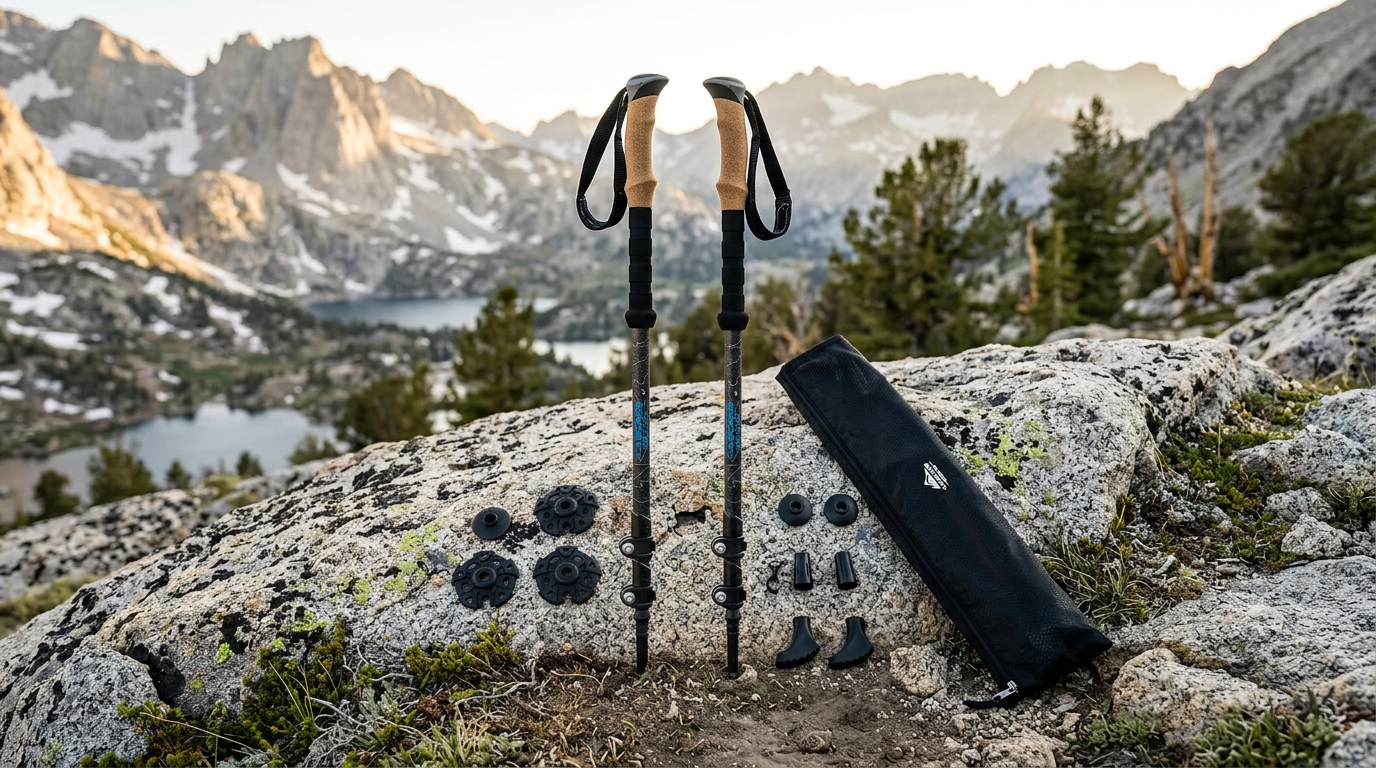
Cork grips measure approximately 5 inches in length and extend into a foam extension grip below, providing hand placement options on variable terrain. The manufacturer includes tungsten carbide tips—harder than steel and more durable on rock—along with adjustable wrist straps that use a basic buckle system. The comprehensive tip kit includes snow baskets (approximately 4 inches diameter), mud baskets (approximately 3 inches), rubber boot tips for indoor use or hard surfaces, rubber tips for general trail protection, and a carry bag.
Specs
Intended Use and Performance Context
These poles target recreational hikers, weekend backpackers, and walkers who want carbon fiber's weight savings without premium pricing. The 26 to 54-inch adjustment range accommodates users from approximately 5'1" to 6'6" using the standard formula of elbow height when the pole is vertical. OutdoorGearLab's field testing confirmed solid performance on day hikes and moderate backpacking trips, with the cork grips effectively wicking moisture during summer conditions.
The quick-lock system adjusts without tools and holds position reliably under typical hiking loads—body weight plus a 20 to 35 lb pack. Section Hiker's review noted the locks performed well on moderate terrain but recommended periodic tightening checks, particularly when the poles are new and the mechanism hasn't fully seated. CleverHiker's testing flagged occasional slippage under aggressive downhill braking with heavier loads (40+ lb packs), suggesting these poles work best within their intended recreational use case rather than extended thru-hiking or alpine mountaineering.
Comparison Context
Within the budget carbon fiber segment, Cascade Mountain Tech competes primarily on price and included accessories. At approximately $65, these poles undercut Black Diamond's carbon models by $50 to $80 while delivering comparable weight. The comprehensive tip kit adds value—many competitors charge $15 to $25 for snow baskets alone. The tradeoff appears in lock refinement and long-term durability confidence; premium brands typically offer more robust warranty support and field-proven lock mechanisms.
Compared to aluminum poles in the same price range, the carbon fiber construction saves approximately 2 to 3 oz per pole while introducing more catastrophic failure risk—carbon fiber tends to splinter rather than bend when it fails. For hikers prioritizing weight and willing to accept slightly higher replacement risk, the carbon option makes sense. For hikers who abuse their poles or need absolute reliability, aluminum alternatives offer different tradeoffs.
Durability Considerations
Carbon fiber's material properties create specific durability characteristics. The shafts resist bending and perform well under compression loads but are vulnerable to impact damage and point loads. Dropping a pole onto rock or catching it sideways in a crack can cause splintering that compromises structural integrity. The tungsten carbide tips should outlast steel alternatives by 2 to 3 times, though they can chip if struck directly against hard surfaces.
The quick-lock mechanism represents the most likely wear point. External lever locks use plastic cam components that can degrade with UV exposure and repeated cycling. Section Hiker's long-term testing noted the locks remained functional after approximately 200 miles but recommended inspecting the cam surface for wear and keeping the mechanism clean of grit. Cork grips naturally compress and conform over time—a desirable characteristic for comfort but one that eventually requires replacement after approximately 500 to 1,000 miles of use.
Value Assessment
At $65 for a pair with comprehensive accessories, these poles deliver strong value for hikers who want carbon fiber performance without premium pricing. The included tip kit alone represents $20 to $30 of value, and the 8.1 oz weight matches poles costing $120 to $150. The value proposition depends on use case—recreational hikers who log 100 to 300 miles per season will likely get multiple seasons of service, while thru-hikers planning 2,000+ mile trips might prefer the durability assurance and warranty support of premium brands.
The manufacturer doesn't publish warranty details prominently, which introduces uncertainty compared to brands offering lifetime or multi-year coverage. For hikers treating poles as consumable items and willing to replace them every few seasons, the lower entry cost makes sense. For hikers wanting decade-long durability, the value calculation shifts toward premium options.
What we like
Trade-offs
Best For
- Day hikers wanting carbon fiber weight savings at accessible pricing
- Weekend backpackers carrying 20 to 35 lb loads
- Beginning trekking pole users exploring whether poles fit their hiking style
- Four-season hikers needing snow baskets and mud baskets included
- Budget-conscious hikers prioritizing weight over long-term durability assurance
- Walkers and fitness hikers wanting adjustable support on varied terrain
Not For
- Thru-hikers planning 2,000+ mile continuous trips
- Alpine mountaineers needing poles for technical terrain and glacier travel
- Hikers who frequently side-load poles or use them for stream probing
- Users wanting comprehensive warranty coverage and replacement assurance
- Backpackers regularly carrying 45+ lb loads on steep descents
Frequently Asked Questions
+How do I determine the correct pole length for my height?
Set the poles so your elbow forms a 90-degree angle when the tip is on the ground and you're standing upright. As a starting point, multiply your height in inches by 0.68—a 5'8" (68 inch) hiker would start at approximately 46 inches. The 26 to 54-inch adjustment range accommodates users from approximately 5'1" to 6'6". Shorten poles 2 to 3 inches for steep uphill sections and lengthen them 2 to 3 inches for steep descents using the foam extension grip.
+Can I use these poles for winter hiking and snowshoeing?
Yes, the included snow baskets (approximately 4 inches diameter) prevent the poles from punching through snow. Attach the baskets by removing the standard trekking baskets and threading the snow baskets onto the shaft above the carbide tip. The carbon fiber construction performs well in cold temperatures—unlike aluminum, carbon doesn't conduct cold to your hands. The cork grips remain functional in winter but may require bare hands or thin gloves for best purchase.
+How often should I check and tighten the quick-lock mechanisms?
Inspect the locks before each hike and check them periodically during use, particularly in the first 50 miles when the mechanism is seating. If you notice any slippage or height change during hiking, stop and tighten the lever—flip it open, verify the shaft is at your desired height, and close it firmly. Section Hiker's testing noted the locks may require tightening adjustments when new but stabilize after initial break-in. Clean grit from the mechanism regularly to maintain clamping force.
+What should I do if I notice a crack in the carbon fiber shaft?
Stop using the pole immediately. Carbon fiber cracks compromise structural integrity and can lead to catastrophic failure under load. Small surface scratches that don't penetrate the weave are cosmetic, but any crack visible through the carbon fiber layers means the pole should be retired. Carbon fiber doesn't bend as a warning before failure—it splinters suddenly. Inspect poles after any significant impact, particularly if you've dropped them on rock or caught them sideways in a crack.
+Are replacement parts available if components wear out?
The manufacturer includes extra rubber tips and baskets in the kit, which addresses the most common wear items. For lock mechanism components, cork grip replacement, or shaft sections, contact the manufacturer directly—availability varies. The accessible pricing positions these poles as semi-consumable items; many users replace the entire pair after 2 to 4 seasons rather than investing in component replacement. Premium brands typically offer more comprehensive parts support.

Read next
More from this category
REVIEW
Kershaw Leek Mother of Pearl: Artisan Inlay Meets Everyday Carry Steel
REVIEW
2Pcs Custom Micarta Handles for Benchmade Bugout 535 Review
BEST OF
Best Rechargeable Headlamps for Backpacking
BEST OF
Best Beginner Binoculars for Hiking and Bird Watching
GUIDE
How to Choose a Backpacking Tent: The 5 Specs That Matter
GUIDE