Buying guide
How to Fit a Backpacking Backpack: Torso Length, Hip Belts, and Load Lifters
Disclosure: Four Seasons Gear is reader-supported. When you buy through links on our site, we may earn an affiliate commission at no extra cost to you. Prices and availability are accurate as of the time we last checked.
What You're Really Deciding
Backpack fit isn't about brand preference or aesthetic—it's biomechanics. You're optimizing three interdependent variables: torso length (the distance from C7 vertebra to iliac crest, which determines frame size), hip belt placement (which must sit on your iliac crest to transfer load to your skeletal system), and load lifter angle (which controls how the pack's center of gravity relates to your spine). Get torso length wrong and no amount of strap adjustment will fix it. Nail torso length but misposition the hip belt, and you'll carry weight on soft tissue instead of bone. Even with both correct, improper load lifter angle will pull the pack away from your back or dig straps into your neck.
Measuring Your Torso Length
Torso length is NOT your shirt size or overall height. A 6'2" person can have a shorter torso than someone 5'8" if their leg-to-torso ratio differs. To measure accurately: tilt your head forward and feel for the prominent bump at the base of your neck—that's your C7 vertebra. Place your hands on your hips with thumbs pointing backward; draw an imaginary line between your thumbs—that's your iliac crest. Measure the straight-line distance between these two points. Most adults fall between 15.5 and 21 inches.
Specs
Manufacturers' sizing charts vary by 0.5–1 inch between brands, so always check the specific chart for your pack model. Some packs like the TETON Sports Scout 3400 Backpack offer adjustable torso lengths within a single size, which provides more flexibility if you measure near a size boundary.
Hip Belt Fit: The Foundation of Load Transfer
The hip belt must sit directly on your iliac crest—the bony shelf at the top of your pelvis. Not above it (which puts weight on soft abdominal tissue), not below it (which loads your thighs and restricts stride). When positioned correctly and cinched, the hip belt should feel like firm pressure on bone, not squeezing on flesh.
- The padded section of the belt should wrap around your hips with 1–2 inches of overlap beyond the buckle on each side
- If the buckle sits at your side or behind your hip point, the belt is too small
- If you have more than 3 inches of webbing extending past the buckle, the belt is too large
- Hip belts typically come in S/M/L sizes; some packs offer interchangeable belts
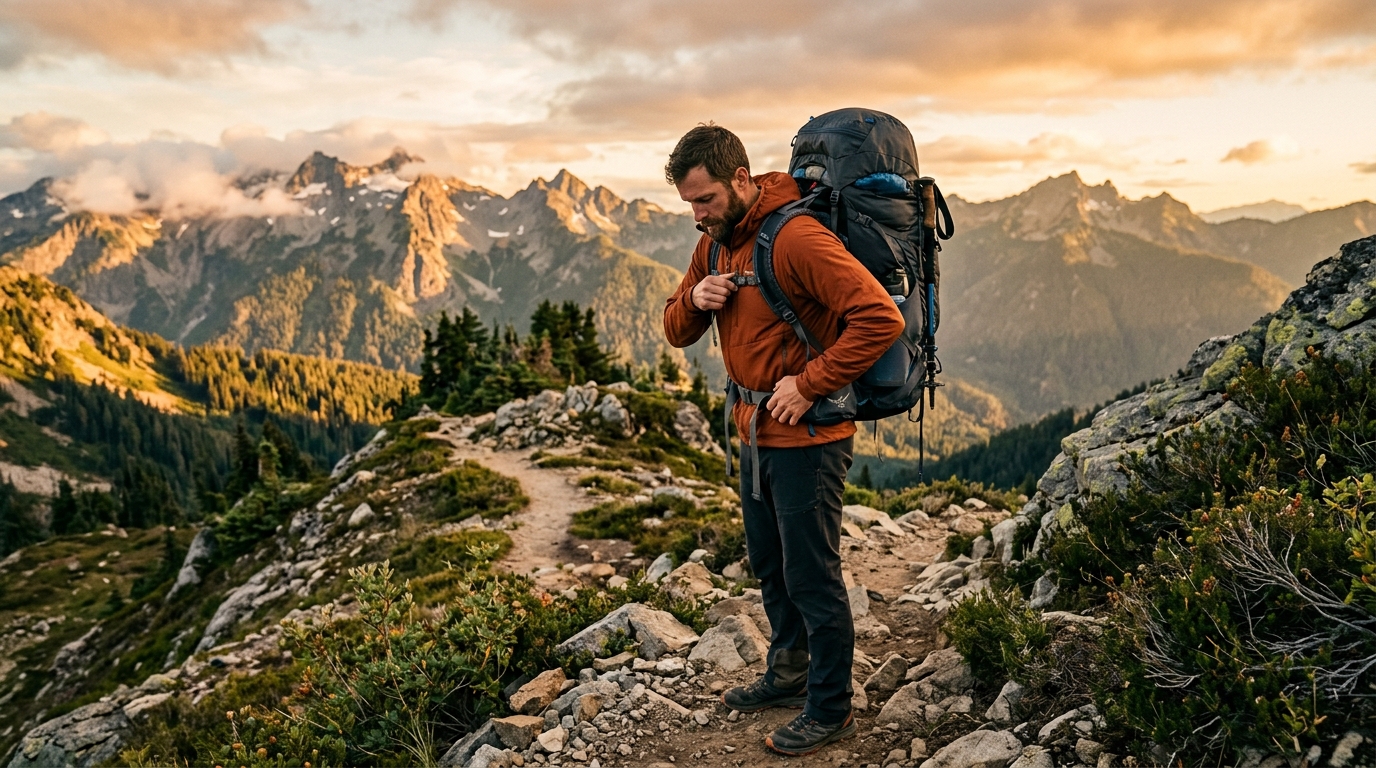
When trying on a pack, load it with 20–30 lbs of weight (sleeping bags, water bottles, whatever's available). An empty pack cannot be properly fitted. Loosen all straps, put the pack on, position the hip belt on your iliac crest, and cinch it firmly—this should be the first and tightest adjustment you make.
Shoulder Straps and the Sternum Strap
With the hip belt locked in, snug the shoulder straps until the pack feels stable but not tight. The anchor point where shoulder straps attach to the pack frame should sit 1–2 inches below the top of your shoulders. If it's at or above shoulder height, your torso is too long for the pack. If it's 3+ inches below, your torso is too short.
Shoulder straps should contact your shoulders and upper chest in a smooth curve without gaps. You should be able to slip your thumbs under the straps at the collarbone—if they're digging in, they're over-tightened. Remember: shoulders carry 20% of load at most. If you feel significant pressure here, your hip belt isn't doing its job.
The sternum strap connects the two shoulder straps across your chest. Position it 1–2 inches below your collarbones (roughly at armpit height) and snug it just enough to keep the shoulder straps from sliding outward. Over-tightening restricts breathing. The sternum strap is a stabilizer, not a load-bearer.
Load Lifters: Angle and Function
Load lifters are the small straps that run from the top of the shoulder straps up to the pack body at roughly 45 degrees. Their job is to pull the top of the pack toward your shoulders, keeping the pack's center of gravity close to your spine. Proper load lifter angle is 30–60 degrees from horizontal when the pack is loaded and you're standing upright.
- If load lifters are horizontal or angled downward, the pack is too long for your torso
- If they're vertical (greater than 70 degrees), the pack is too short
- When properly adjusted, you should feel the top of the pack settle closer to your shoulders without creating downward pressure
To adjust: after setting hip belt and shoulder straps, pull load lifters snug. You should see a small gap close between your shoulders and the pack body. If tightening them pulls the shoulder straps down into your shoulders, back off—that means you're using them to carry load, which is incorrect. Load lifters are fine-tuners, not primary support.
The Fitting Sequence
- Loosen all straps completely
- Put pack on and position hip belt on iliac crest
- Cinch hip belt firmly (this is your tightest adjustment)
- Snug shoulder straps until pack feels stable, not tight
- Adjust sternum strap to armpit height and lightly snug
- Pull load lifters to 45-degree angle
- Walk around for 5 minutes with weight, then re-check hip belt first
This sequence matters. Adjusting out of order—especially tightening shoulder straps before the hip belt—will give you a false sense of fit and lead to shoulder pain on the trail.
Common Fit Problems and Fixes
Gap between pack and lower back: Either your torso is too short for the frame size, or you need to tighten the load lifters more. If load lifters are already at maximum tightness and vertical, size down.
Shoulder straps digging into neck: Pack is too short for your torso, or load lifters are over-tightened. Check that shoulder strap anchor points are 1–2 inches below shoulder tops.
Hip belt sliding down during hiking: Belt is too loose, too large, or positioned too low initially. It should start on the iliac crest and be cinched tight enough that it cannot slide over the crest.
Pressure on shoulders after 30 minutes: Hip belt isn't carrying the load. Re-position it higher on the iliac crest and cinch tighter. Loosen shoulder straps slightly.
Adjustable vs. Fixed Torso Systems
Fixed torso packs come in distinct sizes (S/M/L) with no adjustability. They're lighter and simpler but require precise sizing. Adjustable torso packs use a sliding harness system that allows 2–4 inches of range within a single size. This adds 4–8 oz of weight but provides insurance if you're between sizes or sharing a pack with a partner.
To adjust a variable torso system: loosen the Velcro or buckle system inside the pack (usually accessed through the top or back panel), slide the shoulder harness up or down, and re-secure. Make adjustments in 0.5-inch increments and test with weight each time.
Gender-Specific Fit Considerations
Women's-specific packs typically feature shorter torso lengths in each size category, narrower shoulder strap spacing, more contoured hip belts with greater front-to-back curvature, and shoulder straps that angle inward more aggressively. These aren't marketing distinctions—average female torso length is 1.5 inches shorter than male at the same height, and hip-to-shoulder width ratios differ significantly.
That said, fit trumps label. A woman with a longer torso and broader shoulders may fit better in a unisex or men's pack, and vice versa. Try both categories if your measurements are near size boundaries.
When to Size Up vs. Size Down
If your torso measurement falls within 0.5 inches of a size boundary, default to the smaller size if you prioritize weight savings and plan to carry lighter loads (sub-30 lbs). Size up if you'll regularly carry 35+ lbs, plan to use the pack in winter with bulky layers, or want more adjustability range.
A slightly small pack can be made to work with careful strap adjustment. A too-large pack cannot—the frame will always sit wrong relative to your anatomy.
Match the Gear to Your Trip
Weekend trips (2–3 days, 25–35 lbs): Fit is critical but margin for error is higher. Prioritize hip belt comfort over perfect load lifter angle. A slightly imperfect fit won't ruin a weekend.
Week-long trips (40–50 lbs): Every fit element must be dialed. At this load, a pack that's one size off will cause pain by day three. Spend 30+ minutes testing with full weight before committing.
Thru-hiking (multi-week, variable loads): Consider adjustable torso systems. Your body composition will change over a 2,000-mile hike, and the ability to tweak fit is valuable. Prioritize hip belt durability—it's the highest-wear component.
Ultralight setups (sub-20 lbs): Fit matters less when total load is low. Many ultralight packs omit load lifters entirely and use minimal hip belts. Focus on shoulder strap comfort and sternum strap placement.
Testing Fit in the Store
Load the pack with 25–30 lbs (most retailers have sandbags or weight bags for this purpose). Wear the pack for at least 15 minutes—walk around the store, go up and down stairs if possible, simulate reaching for trekking poles or adjusting a hip belt pocket. Pay attention to any pressure points that develop after 10 minutes; these will become painful after 2 hours on trail.
Bring the layers you'll actually hike in. A pack that fits over a t-shirt may not fit over a puffy jacket and rain shell. If you'll carry gear like the Therm-a-Rest NeoAir XLite NXT Sleeping Pad Regular strapped externally, simulate that bulk during fitting.
Frame Styles and Fit Interaction
Internal frame packs have the frame sewn into the pack body. Fit is more forgiving because the frame conforms somewhat to your back, but proper torso length is still critical. External frame packs have a rigid frame outside the pack bag. They require more precise fitting but excel at load transfer for heavy loads (50+ lbs). Frameless packs (ultralight category) rely entirely on proper packing technique and work only with loads under 20 lbs—fit is minimal but hip belt and shoulder strap comfort become paramount.
Maintenance and Fit Longevity
Hip belt foam compresses over time, typically losing 10–15% of thickness after 500 miles of use. This effectively shortens the pack's torso length slightly. If a pack that fit perfectly new starts feeling "off" after a season of heavy use, check for foam compression in the hip belt and shoulder straps. Some manufacturers offer replacement hip belts; otherwise, this signals end of pack life.
Buckles and adjustment points accumulate dirt and salt from sweat, which causes sticky or difficult adjustments. Rinse these components in fresh water after trips and lubricate plastic buckles with silicone spray annually.
+Can I fit a backpack myself, or do I need to go to a store?
You can fit yourself if you accurately measure your torso length and follow the adjustment sequence methodically, but an experienced fitter will spot issues you might miss—like asymmetric shoulder height or scoliosis that affects how the pack rides. First-time backpack buyers benefit significantly from in-store fitting. If you're experienced and know your measurements, self-fitting with a careful try-on process works fine.
+How much should a properly fitted backpack move while hiking?
A well-fitted pack should move with your torso as a single unit, with minimal side-to-side sway. You should feel no bounce at the hip belt. Some flex at the top of the pack (1–2 inches of sway) is normal and actually desirable—a completely rigid connection can be uncomfortable. If the pack bounces on your hips with each step, the hip belt is too loose or too low. If the whole pack sways more than 3 inches side-to-side, it's improperly loaded (weight too high or too far back) or the sternum strap is too loose.
+Do I need to re-adjust my pack straps during a hike?
Yes. As you fatigue, your posture changes and your hip belt may loosen slightly from compression and sweat. Check and re-tighten your hip belt every 60–90 minutes. Some hikers loosen shoulder straps slightly on steep uphills to allow fuller breathing, then re-snug them on descents for better stability. Load lifters can be loosened on very steep descents to shift weight slightly back, improving balance. These are minor tweaks—if you're constantly fighting your fit, something is wrong with the initial setup.
+Can I share a backpack with a partner if we're close in height?
Only if you have very similar torso lengths (within 1 inch) and hip measurements. Height is a poor proxy for torso length. Two people who are both 5'10" can have torso lengths that differ by 2+ inches, which spans two pack sizes. If you must share, choose a pack with an adjustable torso system and interchangeable hip belts, and accept that it will never fit both of you optimally. For regular use, each person should have their own properly fitted pack.
+What if my torso length is between sizes and the store doesn't have the size I need to try on?
Order both sizes if buying online, or visit a store that carries more inventory. Fit cannot be guessed at. If forced to choose without trying on, default to the smaller size if you're within 0.5 inches of the boundary and will carry moderate loads. The consequences of a too-large pack are worse than a slightly small one. Some manufacturers offer fit consultation via video call—take advantage of this if available. Never buy a pack based solely on size chart numbers without trying it on with weight.
+How does pack volume relate to fit?
Pack volume (measured in liters) is independent of fit, but they interact practically. A 40L pack and a 65L pack from the same manufacturer in size Medium will have identical torso lengths and hip belt sizing, but the larger pack will extend higher above your head and lower below your hips. This shifts the center of gravity and can make load lifter angle more critical. Very large packs (75L+) in small sizes can create fit challenges because the pack body is so tall relative to the frame—the top may sway excessively even with perfect fit. If you're a small-torso person needing large volume, look for packs with removable top lids or extension collars that allow you to reduce height when carrying lighter loads.