Best of
Best Women's Sleeping Bags for Backpacking
best women's sleeping bags for backpacking
At a glance
| # | Product | |||||
|---|---|---|---|---|---|---|
| 1 |  ★ Best Overall★ Most Durable★ Most Comfortable | 7.8 | Check price ↗ | |||
| 2 | 7.8 | Check price ↗ | ||||
| 3 | 7.5 | Check price ↗ | ||||
| 4 |  ★ Best Value | 7.3 | Check price ↗ |

- 7.8★ Best Overall★ Most Durable★ Most Comfortable
Disclosure: Four Seasons Gear is reader-supported. When you buy through links on our site, we may earn an affiliate commission at no extra cost to you. Prices and availability are accurate as of the time we last checked.
Best Overall: Big Agnes Womens Torchlight Sleeping Bag w/600 DownTek
The Big Agnes Torchlight earns our top recommendation because it delivers 600-fill DownTek insulation—treated to resist moisture—in a women's-specific cut that adds insulation in the core and footbox where female backpackers typically need it most. The bag's mummy taper and integrated sleeve for a sleeping pad keep you centered on your mat through the night, preventing cold spots from forming underneath. At $216, it sits in the sweet spot between budget synthetic bags that pack bulky and premium ultralight models that demand $330+.
What we like
Trade-offs
Best Budget: W's Marmot Trestles 30° Sleeping Bag
The Marmot Trestles 30° delivers three-season warmth for $139, making it the obvious choice for new backpackers or anyone who prioritizes affordability over pack weight. This bag uses synthetic SpiraFil insulation that continues to insulate when damp—a critical feature if you're learning to manage condensation in a tent or hiking in humid climates. The 30°F rating suits spring through fall in most regions, though you'll want a warmer bag for shoulder-season trips above treeline. Marmot's Wave construction prevents insulation from shifting into cold spots, and the full-length zipper makes temperature regulation easy on warmer nights.
What we like
Trade-offs
Best for Cold Weather: Mountain Hardwear Bishop Pass 15°F Down - Women's
The Mountain Hardwear Bishop Pass 15°F earns its place as our cold-weather pick with a true 15°F comfort rating and women's-specific construction that adds insulation in the torso and footbox. This bag uses premium down fill with a water-resistant treatment, delivering warmth-to-weight performance that synthetic bags can't match when temperatures drop below freezing. The draft collar and insulated hood cinch down to seal out cold air, and the zipper baffle prevents heat loss along the full length of the bag. At $335, it's an investment, but if you're planning high-altitude trips or shoulder-season backpacking where nighttime temps regularly dip into the teens, the Bishop Pass delivers the warmth you need without the bulk of a winter expedition bag.
What we like
Trade-offs
Best Comfort-Focused: NEMO Equipment Disco Endless Promise Down Sleeping Bag
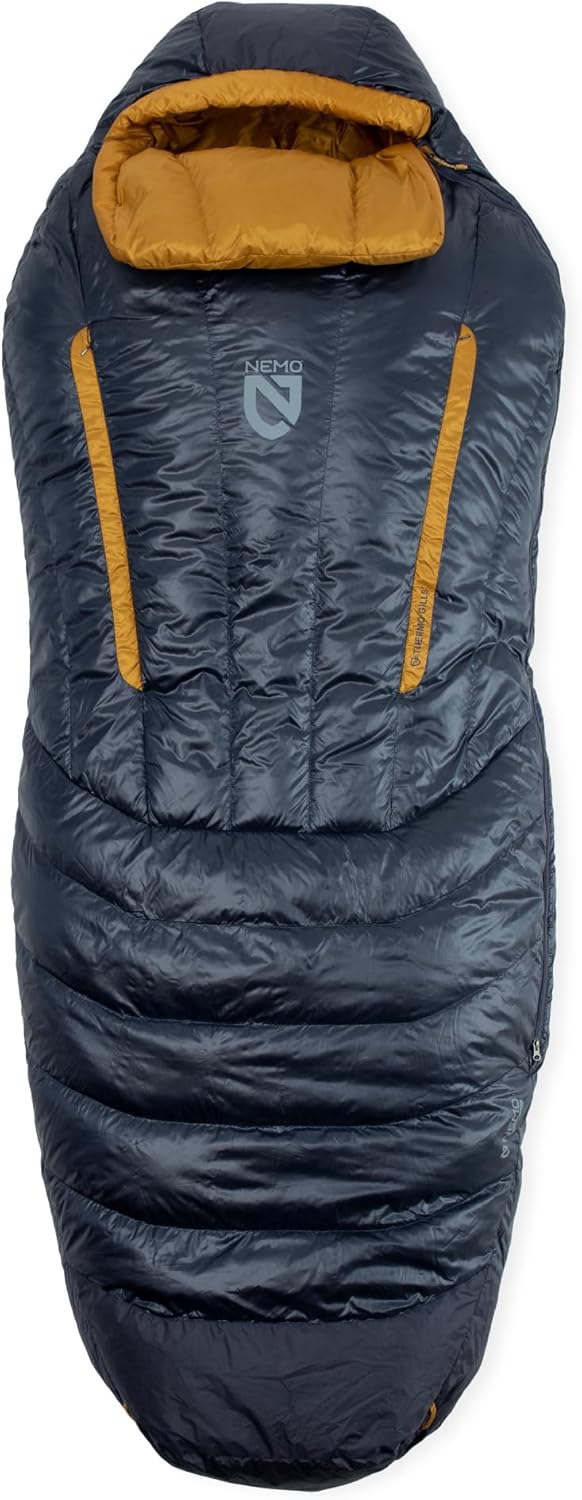
The NEMO Disco takes a different approach to backpacking bags, prioritizing comfort over ultralight performance with a spoon-shaped cut that gives you room to shift positions without feeling mummified. The Endless Promise down fill uses responsibly sourced insulation with a water-repellent finish, and the integrated blanket fold at the top lets you vent heat without unzipping the entire bag. NEMO's Thermo Gills—zippered vents along the sides—provide precise temperature control when conditions fluctuate. At $330, this bag targets backpackers who value a good night's sleep over shaving ounces, and the roomier cut makes it particularly appealing if you're a side sleeper or tend to feel claustrophobic in traditional mummy bags.
What we like
Trade-offs
Understanding Temperature Ratings
Sleeping bag temperature ratings indicate the lowest temperature at which a bag will keep you warm, but these numbers require context. The industry-standard EN/ISO testing measures comfort rating (the temperature at which a cold sleeper remains comfortable) and lower limit (the temperature at which a warm sleeper stays comfortable). Women's-specific bags typically use the comfort rating as their headline number because female physiology generally runs colder than male. A 30°F bag works for three-season backpacking in most regions, while 15-20°F bags handle shoulder-season trips and high-altitude camps. If you sleep cold or plan to push into late fall, size down 10-15 degrees from the ambient temperature you expect.
Down vs. Synthetic: The Core Tradeoff
Down insulation compresses smaller and weighs less than synthetic fill at the same temperature rating, making it the default choice for backpackers who count ounces. Modern hydrophobic down treatments improve moisture resistance, though down still loses loft when soaked. Synthetic bags cost less, continue insulating when wet, and dry faster—critical advantages if you're hiking in consistently damp conditions or learning to manage tent condensation. The W's Marmot Trestles 30° Sleeping Bag demonstrates synthetic's budget appeal, while the Big Agnes Torchlight shows how treated down bridges the gap with water-resistant performance at a reasonable price.
Women's-Specific Design Details
True women's-specific sleeping bags differ from unisex bags in three key ways: they add insulation in the core and footbox where female backpackers typically need extra warmth, they adjust the shoulder and hip dimensions to fit female body proportions without excess fabric that creates cold spots, and they often shorten overall length to reduce weight and improve thermal efficiency. Bags marketed as "women's" that simply scale down a men's pattern miss these critical design elements. The Mountain Hardwear Bishop Pass 15°F Down - Women's exemplifies proper women's-specific construction with targeted insulation placement that maximizes warmth without adding unnecessary weight.
Pack Size and Weight Considerations
Your sleeping bag typically occupies 20-30% of your pack's volume and weight, making it one of the Big Three items (alongside your tent and backpack) where smart choices compound into significant comfort gains. Down bags compress into smaller stuff sacks than synthetic alternatives—a 20°F down bag might compress to the size of a football, while a synthetic bag at the same rating fills a basketball-sized space. If you're using a smaller pack (40-50L) for ultralight trips, down's compressibility becomes essential. For weekend warriors with 60L+ packs, synthetic's bulk matters less than its lower cost and wet-weather performance.
Pairing Your Bag with a Sleeping Pad
Sleeping bags provide zero insulation underneath your body—the compressed fill creates a cold spot where you contact the ground. Your sleeping pad's R-value (thermal resistance) determines how much cold transfers from the ground into your back. For three-season backpacking, pair a 30°F bag with a pad rated R-3.5 or higher. If you're pushing into shoulder season with a 15°F bag like the Mountain Hardwear Bishop Pass, bump up to R-4.5+ to prevent ground cold from undermining your bag's warmth. The Big Agnes Torchlight's integrated pad sleeve keeps you centered on your mat, preventing the common problem of rolling off your insulation in the night and waking up cold.
+Do I really need a women's-specific sleeping bag?
Women's-specific bags deliver measurable warmth advantages if they're properly designed—not just scaled-down men's bags. True women's bags add insulation in the core and footbox where female physiology typically needs extra warmth, and they adjust shoulder and hip dimensions to eliminate excess fabric that creates cold spots. If you consistently sleep cold in unisex bags, a women's-specific model can add 5-10 degrees of effective warmth. However, if you run warm or prefer a roomier fit, a unisex bag in the correct size may work fine.
+How do I choose between a 20°F and 30°F bag?
Start with the coldest overnight temperature you expect to encounter, then subtract 10 degrees if you sleep cold or plan to wear minimal clothing in the bag. A 30°F bag handles three-season backpacking (late spring through early fall) in most regions below 8,000 feet. A 20°F bag extends your season into October and November at elevation or handles summer trips above treeline where nighttime temps drop into the 30s. If you're choosing one bag for year-round use, the 20°F rating offers more versatility—you can always vent excess heat with zipper adjustments, but you can't add warmth to an under-rated bag.
+How should I store my sleeping bag between trips?
Never store a sleeping bag compressed in its stuff sack—the constant compression permanently damages the insulation's loft, reducing warmth over time. Instead, store your bag loosely in a large mesh or cotton storage sack in a dry, climate-controlled space. If you don't have a storage sack, hang the bag in a closet or drape it over a shelf. Down bags require occasional fluffing to redistribute the fill, while synthetic bags benefit from being stored flat rather than hanging. Before your first trip each season, air out the bag for a day to release any moisture absorbed during storage.