Review · winter
Burton Step On Re:Flex Snowboard Bindings Review: Speed-Entry System for All-Mountain Riders
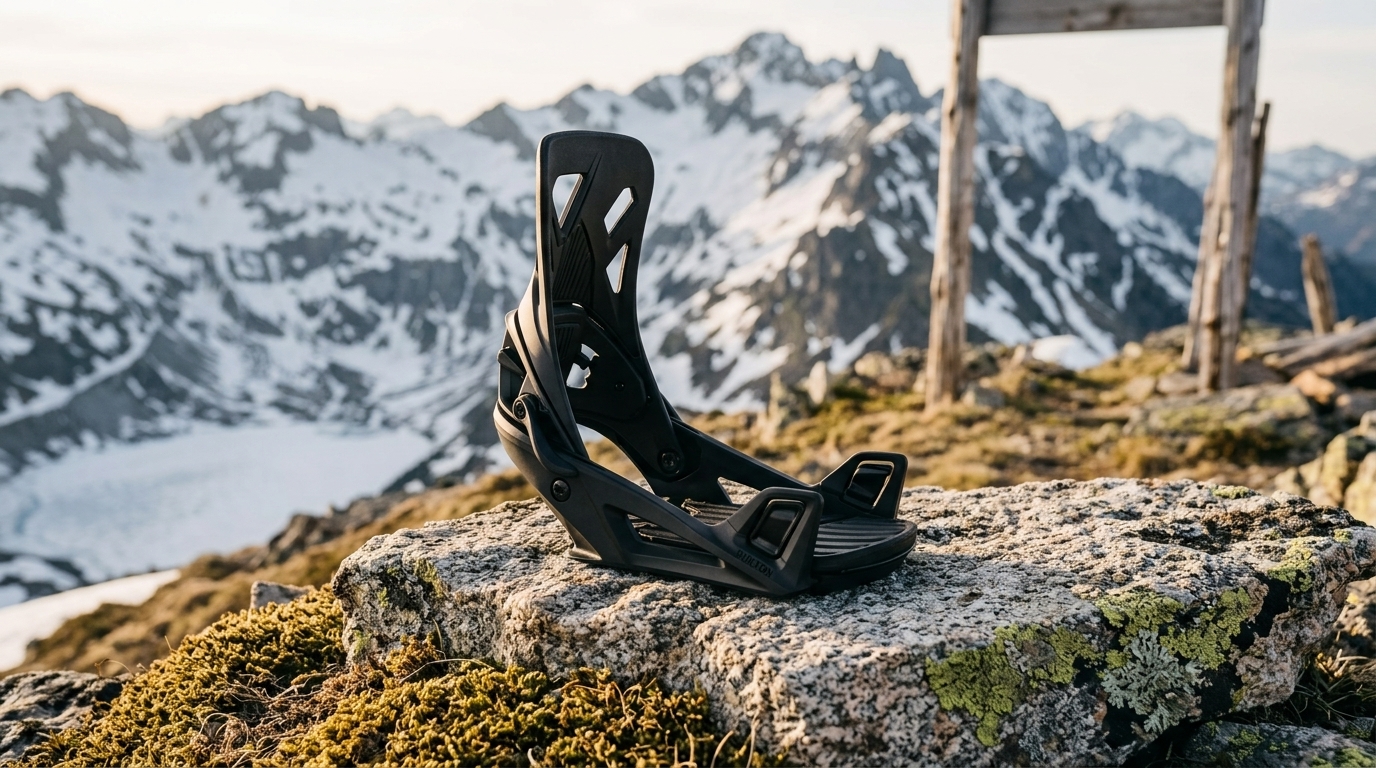
The Burton Step On Re:Flex bindings eliminate traditional strap buckles in favor of a boot-integrated step-in system that locks and releases in seconds. Designed for riders who prioritize lift-line efficiency and chairlift convenience over the micro-adjustability of strap bindings, these deliver reliable retention and all-mountain response but require purchasing compatible Step On boots—a meaningful ecosystem commitment that narrows your footwear options.
Disclosure: Four Seasons Gear is reader-supported. When you buy through links on our site, we may earn an affiliate commission at no extra cost to you. Prices and availability are accurate as of the time we last checked.
Construction and Step-In Mechanism
The Step On system replaces toe and ankle straps with three mechanical contact points: two toe hooks that engage cleat receivers on the boot sole and a heel lever that locks the boot heel into the highback. The Re:Flex baseplate uses Burton's channel-compatible mounting pattern with elongated slots, allowing 3 cm of stance-width adjustment and compatibility with boards featuring The Channel, 4x4, and 3D mounting systems. The highback is a single-piece molded composite with a forward lean adjuster offering approximately 0° to 18° of cant.
Entry requires aligning the boot toe with the binding, stepping down to engage the toe hooks, then pressing the heel down until the rear lever audibly clicks. Exit is a single motion: pulling the highback release lever while lifting your heel. The entire entry sequence takes 2 to 4 seconds with practice, compared to 15 to 30 seconds for traditional two-strap bindings.
Specs
Intended Use and Riding Character
Burton positions the Step On Re:Flex for all-mountain riding—groomed runs, moderate powder, and park laps where frequent binding engagement matters. The medium flex rating suits intermediate to advanced riders who carve, pop ollies, and ride switch but don't demand the stiffest possible energy transfer for charging steep chutes or landing large jumps. The system's lateral retention comes from the boot's molded cleat geometry rather than strap pressure distribution, which changes the feel: less ability to fine-tune ankle wrap, but consistent hold across varying snow conditions once properly engaged.
The Re:Flex baseplate's reduced footprint and flex windows are engineered to let the board's natural flex pattern come through, particularly beneficial on boards with pronounced camber or rocker profiles. This makes the binding well-suited to playful, buttery riding styles and boards designed for maneuverability rather than damp, race-oriented decks.
Comparison Context: Step-In Systems and Strap Alternatives
The Step On system is Burton's proprietary answer to the convenience problem that earlier step-in designs (Switch, Clicker, Flow) attempted to solve with mixed success in the 1990s and 2000s. Compared to Flow's rear-entry hinged highback, Step On offers faster exit and no moving highback parts that can ice up. Compared to traditional two-strap bindings like the Burton Cartel or Union Strata, Step On sacrifices independent toe and ankle strap tensioning—you cannot tighten the toe cap without affecting heel hold, because retention is binary: locked or unlocked.
Within Burton's own line, the Step On Re:Flex sits below the Step On X (stiffer, carbon-reinforced for aggressive riding) and above the entry-level Freestyle model. The Re:Flex mounting system adds approximately 50 to 80 grams compared to EST (Burton's Channel-only system) but gains compatibility with non-Burton boards.
Durability Considerations
The Step On mechanism introduces wear points not present in strap bindings: the toe hooks are spring-loaded steel components subject to fatigue cycling, and the boot cleats are molded plastic that can chip or crack on impact with rocks or ice. Burton does not publish cycle-life ratings, but the mechanical nature of the system means that hook springs and pivot pins will eventually require inspection or replacement—components not typically serviceable in the field.
The Re:Flex baseplate is injection-molded nylon composite, a material proven durable in Burton's traditional binding lines but less impact-resistant than aluminum or carbon-fiber baseplates found in premium freeride models. The highback's single-piece construction eliminates strap anchor rivets (a common failure point in strap bindings) but concentrates stress at the forward-lean adjustment hinge. Riders who frequently adjust forward lean mid-season should expect wear at this pivot over multiple seasons.
Value and Ecosystem Cost
The Burton Step On Re:Flex typically retails in the $300 to $350 range, positioning it $50 to $100 above mid-tier strap bindings like the Burton Cartel ($250) or Union Force ($280). The premium reflects the mechanical complexity of the step-in hardware. However, the total system cost includes Step On-compatible boots, which start around $300 for the Ruler Step On and reach $450+ for the Ion Step On, adding $50 to $100 to the cost of equivalent non-Step-On boot models.
For riders who value chairlift convenience—particularly those riding alone, teaching beginners, or making frequent sidecountry hikes—the time savings can justify the premium. A rider making 20 lift laps per day saves approximately 5 to 8 minutes of binding time compared to strap bindings, which compounds over a season. For riders who strap in once at the parking lot and ride all day, the value proposition weakens considerably.
Pros and Cons
What we like
Trade-offs
Best For and Not For
- Resort riders making 15+ lift laps per day who value speed over customization
- Snowboarders riding alone or with skiers who want to minimize group wait time
- Intermediate to advanced all-mountain riders on groomed and moderate powder
- Riders teaching beginners who need to strap in and out frequently
- Those willing to commit to Burton's boot ecosystem for multiple seasons
**Not for:**
- Riders who demand micro-adjustable strap tension for specific terrain
- Aggressive freeriders needing maximum stiffness and damping
- Backcountry tourers (splitboard bindings are a separate category)
- Budget-conscious buyers unwilling to invest in proprietary boots
- Riders who prefer boot options from manufacturers other than Burton
Frequently Asked Questions
+Can I use Step On bindings with my existing snowboard boots?
No. The Step On system requires Burton Step On-compatible boots with integrated toe and heel cleats. Standard snowboard boots lack the cleat receivers necessary to engage the binding's toe hooks and heel lever. You must purchase Step On boots to use these bindings.
+How do I know if the binding is fully locked in?
You'll hear and feel a distinct click when the heel lever engages. Visually, the heel lever should be flush against the highback with no gap. Before riding, lift your heel—if the boot releases, it wasn't fully engaged. With practice, the tactile and audible feedback becomes second nature within a few runs.
+Will the Re:Flex mounting system fit my board?
The Re:Flex baseplate is compatible with Burton's Channel system, standard 4x4 hole patterns, and 3D mounting systems. This covers the majority of modern snowboards. If your board uses a legacy 3-hole Burton ICS pattern or a rare proprietary system, verify compatibility with Burton's online mounting guide before purchasing.
+What happens if snow or ice builds up in the binding mechanism?
Ice accumulation on the toe hooks or in the boot cleat recesses can prevent full engagement. Knock snow off your boot sole before stepping in, and periodically clear the binding's toe hook area with a gloved hand. The system is less prone to icing than Flow's rear-entry design because the engagement points are more exposed, but vigilance in wet, heavy snow conditions is necessary.
+Can I adjust the forward lean while wearing the bindings?
The forward lean adjuster is accessible from the rear of the highback and can be adjusted with a screwdriver or the edge of a binding strap (if borrowed from another binding). Most riders set forward lean once at the start of the season and leave it. Adjusting mid-run is impractical and requires removing the binding from the board or contorting to reach the adjustment screw.
Final Verdict
The Burton Step On Re:Flex bindings solve a real problem for resort riders who spend cumulative minutes per day buckling straps. The mechanical simplicity of step-in entry, combined with Re:Flex's broad board compatibility, makes this a viable all-mountain binding for riders willing to accept the ecosystem lock-in. The medium flex and responsive baseplate suit playful, groomed-focused riding better than stiff, charge-hard applications. If you already own Burton boots or plan to invest in the Step On boot line, these bindings deliver measurable convenience. If you value boot choice, micro-adjustability, or ride primarily backcountry terrain, traditional strap bindings remain the better tool.