Buying guide
Winter Sleeping Bag Buying Guide: When Do You Really Need a 0°F Bag
Disclosure: Four Seasons Gear is reader-supported. When you buy through links on our site, we may earn an affiliate commission at no extra cost to you. Prices and availability are accurate as of the time we last checked.
What You're Really Deciding
Winter sleeping bag selection hinges on three trade-offs. First: temperature rating versus weight—every 5°F of additional warmth costs roughly 4-6 ounces in a down bag. Second: insulation type (down versus synthetic) which determines wet-weather performance, packed size, and lifespan. Third: your personal sleep system—the bag is only one component alongside your pad's R-value, tent choice, and clothing layers. A 10°F bag paired with an R-5.5 pad often outperforms a 0°F bag on an R-3 pad, because 80% of heat loss happens through ground contact.
Understanding Temperature Ratings
EN 13537 and the newer ISO 23537 standards define three temperatures: Comfort (where a cold sleeper remains comfortable), Lower Limit (where a warm sleeper stays comfortable), and Extreme (survival threshold, not sleep). For winter bags, the Lower Limit is your planning number. A bag rated 0°F Lower Limit will keep a warm sleeper comfortable to 0°F in base layers on an appropriate pad.
Specs
Fill Type: Down vs Synthetic
Down insulation (goose or duck) provides superior warmth-to-weight and compressibility but loses insulating value when wet. Synthetic insulation (polyester fibers) retains warmth when damp and costs less but weighs 30-50% more and packs 40% larger than equivalent-warmth down. For winter use, down dominates because cold air holds minimal moisture—your primary wet threat is condensation management, not precipitation.
Specs
Hydrophobic down treatments (DownTek, DriDown) add 5-15% to wet-resistance but don't make down waterproof. In sustained wet conditions, synthetic still outperforms treated down. For winter's dry cold, untreated high-fill-power down offers the best value.
Weight and Packed Size
Winter bags inherently carry more insulation. A 0°F down bag typically weighs 2.5-3.5 pounds and compresses to 8-12 liters. Compare this to a 20°F three-season bag at 1.5-2.5 pounds and 5-8 liters. The weight penalty is real but unavoidable—you're carrying roughly 8-12 ounces of additional down to gain that 20°F of warmth.
Specs
Bag Shape and Fit
Mummy bags taper from shoulders to feet, minimizing interior air volume and dead space. This maximizes warmth-to-weight but restricts movement. Semi-rectangular bags add 4-8 inches at the hips and knees, sacrificing 4-8 ounces of efficiency for comfort. For winter, mummy construction is standard—you're already carrying extra weight, and the tapered shape meaningfully improves thermal performance.
Fit matters: a bag too large creates excess air volume your body must heat; too small compresses insulation and creates cold spots. Most manufacturers offer Regular (fits to 6'0"), Long (to 6'6"), and Women's-Specific (shorter, wider at hips, extra insulation in footbox and torso) cuts. Women's-specific bags aren't marketing—the different insulation distribution reflects measurable differences in peripheral circulation and core temperature regulation.
Draft Protection Features
Winter bags add features that three-season bags omit. Draft tubes (insulated baffles behind zippers) prevent heat loss through the zipper track—worth 5-8°F in effective warmth. Draft collars (insulated neck baffles) cinch around your shoulders to trap warm air and block convective loss when you move. Insulated hoods with adjustable drawcords seal around your face, critical because 30-40% of body heat loss occurs through the head and neck.
- Draft tube: adds 2-4 oz, prevents 5-8°F heat loss through zipper
- Draft collar: adds 1-2 oz, blocks convective loss at neck opening
- Insulated hood: adds 3-5 oz, essential for sub-20°F comfort
- Zipper baffles: prevent cold spots along zipper line
- Footbox insulation: extra fill in feet area where circulation is poorest
The Sleeping Pad Factor
Your sleeping pad's R-value (thermal resistance) determines ground insulation. R-values are additive: stacking an R-3 pad on an R-2 pad yields R-5 total. For winter camping, you need minimum R-5, preferably R-6+. A 0°F bag on an R-3 pad will sleep colder than a 20°F bag on an R-6 pad because compressed insulation under your body provides near-zero warmth—the pad does all that work.
Specs
Match the Gear to Your Trip
Your intended use determines the right temperature rating and feature set. Here's how to map your trips to appropriate specifications:
**Winter car camping or basecamp (20°F to 35°F lows):** A 20°F synthetic or 650-fill down bag works. Weight doesn't matter; prioritize comfort features like roomier cuts and longer zippers. Pair with R-4+ pad. Budget: $150-250.
**Winter backpacking below treeline (10°F to 25°F lows):** A 15°F bag with 800-fill down hits the sweet spot. Expect 2.2-2.8 pounds. Pair with R-5 pad. This handles 90% of winter backpacking in the lower 48. Budget: $350-500.
**Alpine starts and exposed camping (0°F to 15°F lows):** A true 0°F bag with 850+ fill down and full draft protection. Weight: 2.5-3.2 pounds. Requires R-6+ pad. For high-altitude winter ascents, exposed ridgeline camps, or consistent sub-10°F nights. Budget: $500-700.
**Expedition and polar (-10°F to -30°F lows):** A -20°F to -40°F bag with 900-fill down, expedition-grade baffles, and oversized draft collars. Weight: 4-6 pounds. Pair with R-7+ pad or stacked pads. Only for extended extreme-cold exposure. Budget: $800-1200.
**Shoulder season and variable conditions (15°F to 40°F range):** A 20°F bag with full-length zipper for venting. Add a sleeping bag liner (adds 5-10°F warmth) for colder nights. More versatile than a dedicated winter bag if you camp across seasons.
Shell Fabric and Durability
Shell fabrics balance weight, durability, and breathability. Most winter bags use 10D to 20D ripstop nylon (denier measures thread thickness). 10D fabrics save 2-4 ounces but require careful handling; 20D adds durability for minimal weight penalty. DWR (Durable Water Repellent) coatings shed tent condensation and light moisture but wear off after 30-50 nights—reapply with aftermarket treatments.
Pertex Quantum and similar fabrics add breathability and down-migration resistance. The performance gain is marginal but measurable: better moisture transport means less condensation buildup inside the bag during high-output trips. Worth the $50-100 premium on bags you'll use 20+ nights per year.
Zippers and Ventilation
Full-length zippers add 3-5 ounces and cost $30-50 but provide essential temperature regulation. On warmer winter nights (25-35°F), you'll vent heat; on cold nights, you'll seal completely. Three-quarter-length zippers save weight but limit ventilation options. For winter-specific bags, half-length or no zippers are common—you're rarely too warm, and eliminating the zipper saves weight and improves draft protection.
Two-way zippers (open from bottom or top) add versatility for $10-20. Useful for temperature regulation without exposing your core. YKK #5 coils are standard; #3 coils save 1-2 ounces but snag more easily on draft tubes.
Storage and Maintenance
Never store down bags compressed. Prolonged compression crushes loft and permanently reduces insulation. Store loosely in a large cotton or mesh sack in a dry, cool location. Expect 5-10% loft loss in the first year (normal settling), then 1-2% annually with proper care. A well-maintained 850-fill bag retains 80%+ of original warmth after 10 years.
- Wash every 30-50 nights or when visibly soiled; use down-specific detergent (Nikwax, Granger's)
- Front-load washers only; top-loaders with agitators damage baffles
- Dry on low heat with tennis balls to break up clumps; takes 2-4 hours
- Air out after every trip to release moisture before storage
- Spot-clean shell fabric to extend time between full washes
Budget Considerations
Winter bags span $200 (synthetic, 20°F, 3.5 pounds) to $900+ (900-fill down, -20°F, 3 pounds). The performance gap between $400 and $700 bags is often just 8-12 ounces of weight—same warmth, lighter materials. If you winter camp fewer than 10 nights per year, a $350-450 bag delivers 90% of the performance at half the cost of ultralight options.
Cost per degree of warmth: A 0°F bag at $600 costs $30 per degree below freezing. A 15°F bag at $400 costs $27 per degree. The marginal cost of that extra 15°F of warmth is $200 for protection you may use 3-5 nights per season. Run the math on your actual exposure.
Layering and Sleep System Integration
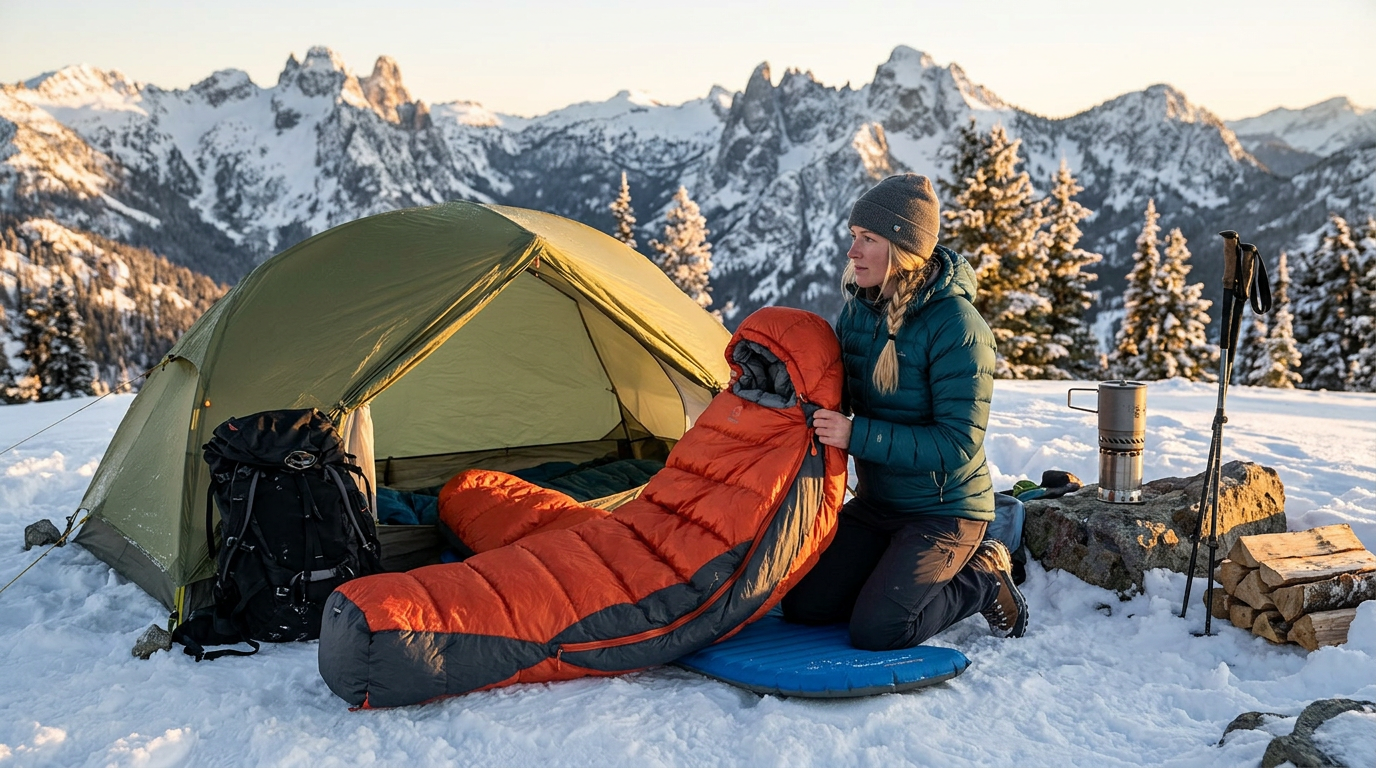
Your sleep system includes bag, pad, tent, and clothing layers. A 15°F bag plus puffy jacket and insulated pants equals a 0°F system. This modular approach adds versatility: wear the puffy around camp, sleep in it on cold nights, leave it behind on warmer trips. Total weight is similar to a dedicated 0°F bag, but you gain functional clothing.
Vapor barrier liners (VBL) trap body moisture, preventing it from condensing in your insulation. This preserves loft on multi-day trips in extreme cold but feels clammy. VBLs add 10-15°F effective warmth for 4-6 ounces. Worth considering for expeditions but unnecessary for weekend winter camping where you can dry gear between trips.
When to Size Up in Temperature Rating
Choose a colder-rated bag if you: sleep cold (poor peripheral circulation, low body mass), camp in exposed locations (ridgelines, above treeline), use a tent with poor heat retention (single-wall, highly ventilated), or want margin for unexpected weather. Each of these factors costs 5-10°F in effective warmth. Two factors together justify a 15°F colder rating.
Choose a warmer-rated bag if you: sleep hot, camp in sheltered locations (dense forest, snow caves), use a four-season tent, or layer aggressively. A 20°F bag in a four-season tent with R-6 pad and insulated clothing handles most 10-15°F nights comfortably.
The Real Answer: Most Winter Campers Need 15°F
After 15 years reviewing winter gear, the data is clear: 80% of winter campers in the continental US experience overnight lows between 15°F and 30°F. A properly rated 15°F bag with R-5+ pad handles this range comfortably. The remaining 20% who camp in consistent sub-10°F conditions or above treeline benefit from a true 0°F bag. The -20°F and colder category is expedition-only—unless you're planning multi-week arctic trips, you don't need it.
The 0°F bag question is really a risk tolerance question. Are you willing to carry an extra 8-12 ounces for warmth you'll use 5 nights per season, or will you layer strategically and accept that 2-3 nights per year might be slightly cold? There's no wrong answer, but most winter campers overestimate their cold exposure by 10-15°F and carry more bag than they need.
+Can I use a 20°F three-season bag for winter camping?
Yes, with the right system. A 20°F bag plus insulated clothing layers (puffy jacket, insulated pants) and an R-5+ pad handles 15-20°F nights comfortably. This works for occasional winter trips but becomes cumbersome for frequent winter use—you're essentially building a 10°F bag from separate components. If you winter camp more than 10 nights per season, a dedicated 15°F bag is more efficient.
+How much warmer is a 0°F bag than a 15°F bag in real use?
Exactly 15°F in laboratory conditions, but 10-12°F in field use due to variables like pad choice, tent type, and personal metabolism. The practical difference: a 15°F bag keeps you comfortable to 15-20°F; a 0°F bag extends that to 5-10°F. That 10°F margin costs 8-12 ounces and $150-250. Worth it if you regularly camp below 10°F; overkill if your typical winter lows are 20-25°F.
+Is 850-fill down worth the premium over 650-fill?
For backpacking, yes. An 850-fill 0°F bag weighs 2.5-2.8 pounds; the same warmth in 650-fill weighs 3.2-3.6 pounds. That's 8-12 ounces for $100-150 more. If you carry your bag more than 5 miles per trip, the weight savings justify the cost. For car camping or basecamp use where weight doesn't matter, 650-fill offers identical warmth at lower cost. The fill power affects only weight and packed size, not thermal performance.
+Should I buy a women's-specific winter bag?
If you're a woman, probably yes. Women's-specific bags aren't just shorter—they have wider hip dimensions, narrower shoulders, and 10-20% more insulation in the footbox and torso where women tend to sleep colder due to peripheral circulation differences. This isn't marketing; EN 13537 testing shows women sleep 5-10°F colder than men in identical bags. A women's-specific 15°F bag often performs like a unisex 10°F bag for female users. The exception: if you're tall (5'9"+) or have a straight torso, unisex Regular or Long may fit better.
+How do I know if I'm a cold sleeper or warm sleeper?
Track your three-season camping: if you're comfortable in a 40°F bag at 40°F ambient, you're a warm sleeper. If you need a 30°F bag at 40°F, you're a cold sleeper. Cold sleepers should add 10°F to temperature ratings (buy a 5°F bag for 15°F comfort). Factors that make you sleep cold: low body mass, poor circulation, female physiology, age over 50, or dehydration. Warm sleepers can often use bags rated 5-10°F warmer than ambient temperature.
+Can I make a 15°F bag work in 0°F weather?
Yes, but you're building a system, not relying on the bag alone. Add: insulated clothing layers inside the bag (puffy jacket, pants), a vapor barrier liner (+10-15°F), a sleeping bag liner (+5-10°F), and ensure your pad is R-6+. Boil water before bed and put the bottle in your bag (+5°F for 2-3 hours). Eat a high-fat snack before sleep to fuel internal heat generation. This works for occasional cold nights but is less comfortable than a properly rated bag. If you regularly camp at 0°F, buy a 0°F bag.
+How long does a winter sleeping bag last?
A quality down bag lasts 10-15 years with proper care (loose storage, washing every 40-50 nights, avoiding compression). Expect 5-10% loft loss in year one (normal settling), then 1-2% annually. After 10 years, an 850-fill bag retains 80-85% of original warmth—your 0°F bag is now a 5-8°F bag. Synthetic bags last 5-8 years before insulation breakdown accelerates. Signs to replace: persistent cold spots, visible thin areas, or more than 20% loft loss. Cost per night of a $600 bag over 12 years at 15 nights/year = $3.33/night.
+Do I need a different bag for wet winter conditions?
Possibly. In maritime climates (Pacific Northwest, coastal ranges) where winter brings rain and wet snow, synthetic insulation retains warmth when damp better than down. A synthetic 15°F bag weighs 3-3.5 pounds versus 2.2-2.5 pounds for down, but it won't lose all insulating value if your tent leaks or condensation soaks it. Hydrophobic down treatments help but don't make down waterproof. For dry continental cold (Rockies, Sierra, Northeast), down is superior. For wet coastal winter, synthetic or heavily treated down is safer.