Buying guide
Trail Running Shoe Drop, Stack Height, and Rock Plates: A 2026 Buying Guide
Disclosure: Four Seasons Gear is reader-supported. When you buy through links on our site, we may earn an affiliate commission at no extra cost to you. Prices and availability are accurate as of the time we last checked.
What You're Really Deciding
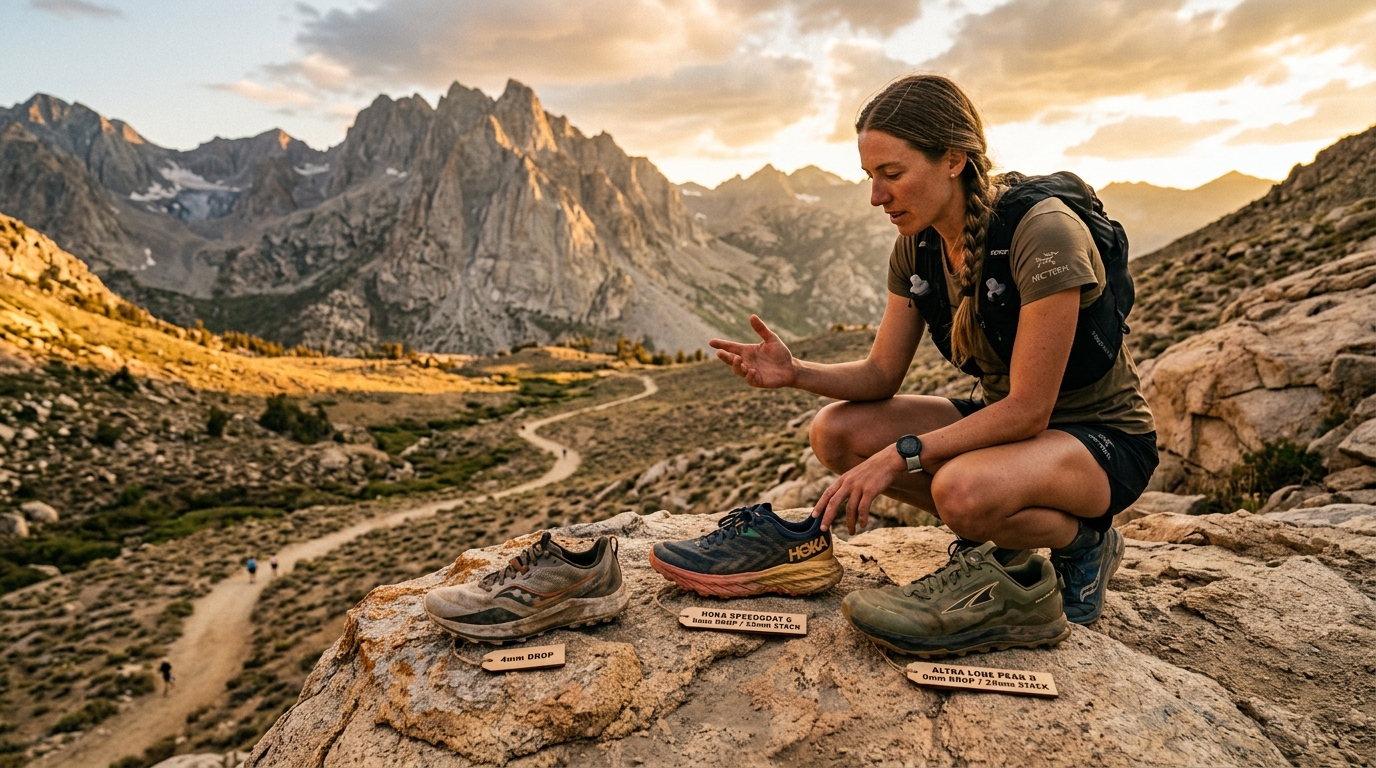
Trail running shoes differ fundamentally in how they position your foot relative to the ground and how much material sits between you and the trail. Drop measures the height difference between heel and forefoot, typically 0–12 mm. Stack height is the total midsole thickness under the heel, ranging from 15 mm in minimalist shoes to 40+ mm in maximal cushion models. Rock plates—thin, semi-rigid layers embedded in the midsole—add puncture protection at the cost of flexibility and weight. These three specs interact: a 35 mm stack with zero drop feels radically different from a 35 mm stack with 10 mm drop, and adding a rock plate changes how both stack and drop translate to trail feedback.
The core tradeoff is protection versus proprioception. High stack heights absorb impact on long descents and technical terrain, reducing fatigue in your feet and lower legs. Low stack heights deliver precise feedback about root placement and rock angle, improving agility on twisty singletrack. Drop influences your stride mechanics: higher drops (8–12 mm) accommodate heel striking and feel familiar to road runners, while zero-drop shoes encourage forefoot or midfoot landing but require gradual calf and Achilles adaptation. Rock plates matter most on sharp, rocky trails common in the Southwest or alpine zones, but they're overkill—and a weight penalty—on soft forest trails or groomed paths.
Drop: The Heel-to-Toe Offset
Drop is measured in millimeters and represents the difference between stack height at the heel and stack height at the forefoot. A shoe with 30 mm heel stack and 26 mm forefoot stack has a 4 mm drop. Drop directly affects your foot's angle in the shoe and, consequently, your running gait.
Specs
Drop does not determine cushioning—that's stack height's job. A zero-drop shoe can have 30 mm of stack (maximal cushion, flat geometry) or 12 mm of stack (minimalist). The confusion arises because many zero-drop shoes are also low-stack, but the two specs are independent. Drop affects biomechanics: lower drops shift load toward the calf and Achilles, while higher drops shift it toward the knee and quad. If you're new to low-drop shoes, add no more than 10–15% weekly mileage in them for the first month to allow connective tissue adaptation.
Stack Height: Total Cushioning Underfoot
Stack height is the thickness of all midsole material between your foot and the outsole, measured at the heel in millimeters. It determines impact absorption, ground feel, and stability. Current trail runners range from 15 mm (barefoot-adjacent) to 42 mm (maximal cushion platforms).
Specs
Stack height interacts with midsole foam type. A 30 mm stack of soft, compressible EVA foam feels plusher but less responsive than 30 mm of firm, resilient TPU-based foam. Modern trail runners often use dual-density midsoles—softer foam at the top for comfort, firmer foam at the bottom for stability—so stack height alone doesn't predict ride quality. Higher stacks provide more cushion but raise your center of gravity, which can reduce stability on uneven terrain. For technical trails with frequent direction changes, many runners prefer 24–28 mm stacks for a balance of protection and agility.
World Athletics regulations (formerly IAAF) cap road racing shoe stack at 40 mm, but trail shoes have no such limit because trail racing prioritizes durability and protection over speed. Some ultra-oriented models exceed 40 mm specifically to absorb the pounding of 50+ mile efforts on rocky trails.
Rock Plates: Puncture Protection and Tradeoffs
A rock plate is a semi-rigid layer embedded between the midsole and outsole, designed to prevent sharp rocks, roots, and debris from bruising your foot through the shoe. Rock plates are constructed from either thermoplastic polyurethane (TPU), which is stiffer and more protective, or woven fabrics like Kevlar or ESS (Energy Surge System) plates, which are lighter and more flexible.
- TPU rock plates: 1.5–2.5 mm thick rigid plastic; excellent puncture resistance; adds 20–40 g per shoe; reduces forefoot flexibility; best for sharp, angular rock fields
- Fabric rock plates: Woven aramid or polyamide; lighter (10–25 g per shoe); maintains some forefoot flex; adequate for moderate rocky terrain; less protective against sharp points
- No rock plate: Maximum ground feel and flexibility; lightest option; suitable for soft trails, groomed paths, or runners prioritizing agility over protection
Rock plates add a measurable weight penalty—typically 30–60 g per pair—and stiffen the forefoot, which reduces your ability to splay toes and adapt to uneven surfaces. On trails with frequent sharp rocks (think Sierra Nevada talus, desert sandstone, or alpine scree), that tradeoff is worthwhile; your feet stay comfortable and unbruised through 15+ mile days. On soft forest trails, Midwest singletrack, or coastal paths, a rock plate is unnecessary weight and stiffness. Some manufacturers now offer modular rock plates or half-length plates (covering only the forefoot) to balance protection and flexibility.
How Drop, Stack, and Rock Plates Interact
These three specs don't exist in isolation—they combine to define a shoe's ride quality and suitability for specific terrain. A zero-drop, 35 mm stack shoe with a fabric rock plate feels completely different from a 10 mm drop, 35 mm stack shoe with a TPU rock plate, even though both have the same total cushioning.
Zero-drop shoes with high stack heights (30+ mm) create a 'platform' feel—your foot sits flat but elevated, which maximizes cushion while maintaining neutral biomechanics. This combination is popular in ultra-distance models where impact absorption matters more than agility. Conversely, zero-drop shoes with low stack heights (18–22 mm) deliver a barefoot-adjacent experience, prioritizing ground feel and proprioception over protection. These suit short, technical runs where precise foot placement is critical.
High-drop shoes (8–12 mm) with moderate stack heights (26–30 mm) mimic traditional road running geometry, making them the easiest transition for runners moving from pavement to trails. Adding a rock plate to this combination creates a protective, stable platform ideal for long trail runs on rocky terrain. Low-drop shoes (0–4 mm) with low-to-moderate stack (20–28 mm) and no rock plate maximize agility and ground feel, suiting technical singletrack where you need to feel root edges and rock angles.
Rock plates interact with stack height in non-obvious ways. In a high-stack shoe (35+ mm), a rock plate sits deep in the midsole, so its stiffness is cushioned by foam layers above it—you get protection without much forefoot rigidity. In a low-stack shoe (20 mm), the rock plate sits closer to your foot, and you'll feel its stiffness more directly. This is why minimalist shoes rarely include rock plates: the thin midsole can't mask the plate's rigidity, defeating the purpose of a low-stack design.
Match the Gear to Your Trip
Use this decision tree to map your intended use to recommended spec combinations:
- Groomed trails, 5–10 miles, prioritizing speed: Low-to-moderate drop (4–8 mm), low-to-moderate stack (22–28 mm), no rock plate. Weight matters; ground feel aids quick turnover.
- Technical singletrack, roots and rocks, 8–15 miles: Low drop (0–6 mm), moderate stack (26–30 mm), fabric rock plate. Balance agility with enough protection for all-day comfort.
- Rocky alpine trails, 15+ miles, heavy packs: Moderate drop (6–8 mm), high stack (32–38 mm), TPU rock plate. Prioritize impact absorption and puncture resistance over ground feel.
- Ultra-distance (50+ km), mixed terrain: Low-to-moderate drop (4–6 mm), high-to-maximal stack (35–40 mm), fabric rock plate. Maximize cushion for fatigue resistance; moderate drop eases calf load over long hours.
- Transitioning from road running: Moderate-to-high drop (8–10 mm), moderate stack (28–32 mm), optional rock plate based on terrain. Familiar geometry eases adaptation; add rock plate only if trails are consistently rocky.
- Minimalist/natural running enthusiast: Zero drop, minimalist-to-low stack (15–24 mm), no rock plate. Maximum ground feel; requires strong feet and gradual volume buildup.
Terrain trumps distance when choosing specs. A 10-mile run on sharp talus demands more protection (high stack, rock plate) than a 20-mile run on soft forest trails. Similarly, your biomechanics matter: if you have a history of Achilles issues, favor moderate-to-high drop regardless of terrain to reduce calf strain.
Spec Ranges and When to Pay More
Understanding typical ranges for each spec helps you identify outliers and assess whether premium features are worth the cost for your use case.
Specs
Pay more for higher stack heights when you're running ultra distances (50+ km) or your trails are consistently rocky and rough—the fatigue reduction is measurable over 6+ hour efforts. Pay more for TPU rock plates over fabric plates only if your local terrain includes sharp, angular rocks (granite talus, desert sandstone) rather than rounded river rocks or hardpack. Fabric plates are adequate for 90% of trail runners and save 15–25 g per shoe.
Zero-drop shoes don't inherently cost more than high-drop shoes—drop is a geometry choice, not a premium feature. However, many zero-drop models are positioned as 'natural running' or 'minimalist' shoes with premium materials and construction, which inflates price. Judge the shoe by its overall build quality, not drop number.
Adapting to New Drop or Stack Heights
Changing drop or stack height is a biomechanical shift that requires gradual adaptation. Your tendons, ligaments, and muscles have adapted to your current footwear—abrupt changes invite injury.
When transitioning to lower drop (e.g., from 10 mm to 4 mm or zero), limit new-shoe mileage to 10–15% of weekly volume for the first three weeks. Your calves and Achilles will feel the difference immediately; soreness is normal, but sharp pain is a red flag. Increase mileage in the new shoes by 10–15% per week until they're your primary trainer. This process typically takes 6–8 weeks for a significant drop reduction (8+ mm change). Smaller changes (2–4 mm) require 3–4 weeks of gradual integration.
Increasing drop (e.g., from zero to 8 mm) is less demanding—you're reducing calf load, not increasing it—but still warrants a 2–3 week adaptation period to let your gait adjust. Your knee and quad will absorb more impact, which may cause temporary soreness if you're unaccustomed to heel striking.
Changing stack height is less biomechanically disruptive than changing drop, but it affects stability and proprioception. Moving from 24 mm to 36 mm stack raises your center of gravity, which can feel unstable on off-camber trails until you adapt. Give yourself 4–6 runs to recalibrate balance and foot placement. Moving from high stack to low stack improves ground feel but reduces impact absorption—your feet and lower legs will fatigue faster initially, so shorten run distances by 20–30% for the first two weeks.
Durability and Lifespan Considerations
Drop and stack height affect shoe lifespan in predictable ways. High-stack shoes compress over time—midsole foam loses 15–25% of its thickness after 300–500 miles, depending on foam type and runner weight. This compression reduces effective stack height and can subtly alter drop if heel and forefoot compress at different rates. Firmer foams (EVA with TPU additives, PEBA-based compounds) resist compression better than soft, single-density EVA.
Rock plates extend outsole life by preventing sharp rocks from puncturing through to the midsole, but they don't prevent midsole compression. A shoe with a rock plate and high stack will still lose cushioning over 400–600 miles; the plate protects against punctures, not foam fatigue. Low-stack shoes (20–26 mm) compress less in absolute terms simply because there's less foam to compress, but the percentage loss is similar—you'll notice cushioning degradation around 300–400 miles.
Zero-drop shoes don't wear differently than high-drop shoes, but gait mechanics matter. Heel strikers concentrate impact on the rear of the shoe, wearing the heel faster; midfoot strikers distribute wear more evenly. If you're a heel striker in a zero-drop shoe, expect faster heel wear than in a high-drop shoe, because there's less material in the heel to begin with.
Common Misconceptions About Drop and Stack
Several myths persist in trail running communities, often because drop and stack interact with individual biomechanics in complex ways. Here's what the data and field experience actually show.
Another persistent myth: 'Maximal cushion shoes cause instability and ankle rolls.' Controlled studies show no increased ankle injury rate in high-stack shoes versus low-stack shoes when both groups wear properly fitted footwear. Ankle stability depends more on shoe width, heel counter design, and individual ankle strength than stack height. High-stack shoes can feel less stable on off-camber trails because your center of gravity is higher, but this is a proprioceptive adjustment, not a structural flaw.
Sizing and Fit Interactions
Drop and stack height influence how a shoe fits, particularly in the heel and midfoot. High-stack shoes raise your foot higher in the upper, which can create more volume in the heel cup—some runners need to size down a half size or use a thicker insole to prevent heel slip. Zero-drop shoes position your heel and forefoot at the same height, which can make the heel cup feel shallower; if you have low-volume heels, you may experience more slippage in zero-drop models.
Rock plates affect forefoot fit by reducing the shoe's ability to flex and conform to your foot shape. If you have wide forefeet or prefer a roomy toe box, a stiff TPU rock plate can make the forefoot feel constricting. Fabric rock plates are more forgiving. Always test trail runners with rock plates on an incline or stairs—the plate's stiffness is most noticeable during toe-off on climbs.
Stack height also interacts with insole thickness. Most trail runners ship with 3–5 mm insoles. If you use custom orthotics or thicker aftermarket insoles (6–8 mm), you're effectively increasing stack height by 2–4 mm, which can alter the shoe's intended ride quality and reduce internal volume. If you plan to use custom insoles, test the shoe with them in place—don't assume the stock insole experience translates.
Frequently Asked Questions
+Can I use the same drop and stack height for road running and trail running?
Yes, but terrain differences may make you prefer different specs. Road running rewards consistency and efficiency, so many runners favor moderate-to-high drop (6–10 mm) and moderate stack (28–32 mm) for cushioned, predictable turnover. Trail running demands agility and ground feel on uneven surfaces, so many trail runners gravitate toward lower drop (0–6 mm) and varied stack depending on terrain. If you're comfortable in 8 mm drop road shoes, starting with 6–8 mm drop trail shoes eases the transition. You don't need to match specs exactly, but abrupt changes (e.g., 10 mm drop road shoes to zero-drop trail shoes) require adaptation time.
+How much does drop actually affect my running form?
Drop influences foot strike pattern and load distribution, but it doesn't dictate form—your biomechanics and running technique matter more. Studies show that lowering drop by 6+ mm encourages a shift from heel striking toward midfoot striking in about 60% of runners, but 40% maintain their original strike pattern regardless of drop. Higher drop (8–12 mm) accommodates heel striking by providing more material under the heel to absorb impact. Lower drop (0–4 mm) places your heel and forefoot closer to the same plane, which makes heel striking less comfortable and midfoot striking more natural. However, you can heel strike in zero-drop shoes and midfoot strike in 10 mm drop shoes—drop is a nudge, not a mandate. If you want to change your form, drop is one tool, but technique drills and gradual adaptation are more important.
+Do I need a rock plate if I'm only running on groomed trails?
No. Groomed trails—maintained paths with packed dirt, gravel, or crushed stone—rarely have sharp rocks or roots that would bruise your foot through the midsole. A rock plate adds 10–40 g per shoe and reduces forefoot flexibility without providing meaningful protection on smooth surfaces. Save the weight and stiffness penalty. Rock plates are worthwhile on trails with frequent sharp rocks (talus fields, exposed granite, desert sandstone), abundant roots (technical forest singletrack), or loose, angular scree (alpine zones). If your local trails are mostly smooth with occasional rocky sections, a fabric rock plate offers a reasonable compromise—light, flexible, and adequate for moderate protection.
+Will a higher stack height slow me down on technical trails?
Not necessarily, but it changes how you navigate terrain. Higher stack (33+ mm) raises your center of gravity, which can reduce stability on off-camber sections and make quick direction changes feel less precise. However, the extra cushioning reduces foot fatigue, which can maintain your pace over long distances even if you're slightly less agile. On highly technical trails with constant rock hopping and tight switchbacks, many runners prefer moderate stack (26–30 mm) for better ground feel and quicker reactions. On long, rough trails with sustained descents, high stack (35–40 mm) often yields faster overall times because your feet stay fresher. Speed depends on the interaction between terrain type, distance, and your fatigue resistance—test both moderate and high stack shoes on your typical trails to see which lets you maintain pace longer.
+Can I mix drop heights between training shoes and race shoes?
Yes, but keep the difference small (2–4 mm) to avoid biomechanical disruption during key efforts. Many runners train in moderate-drop shoes (6–8 mm) for comfort and injury prevention, then race in lower-drop shoes (2–4 mm) for better ground feel and efficiency. This works if you regularly include some training volume in your race shoes—don't debut a new drop on race day. Larger drop differences (6+ mm) between training and racing shoes can alter your gait enough to cause calf or Achilles strain during hard efforts when your form is already stressed. If you want to race in significantly lower drop than you train in, build up race-shoe mileage over 6–8 weeks before the event, including at least two tempo runs or long runs in the race shoes.
+How do I know when my shoe's stack height has compressed too much?
Monitor two indicators: cushioning feel and impact soreness. Midsole foam loses 15–25% of its thickness over 300–500 miles, depending on foam type, runner weight, and terrain. You'll notice reduced cushioning as a 'bottoming out' sensation—your foot strikes feel harsher, and you sense the trail more directly through the shoe. If you start experiencing foot, shin, or knee soreness on runs that previously felt comfortable, your midsole has likely compressed beyond effective cushioning. A simple test: press your thumb firmly into the midsole at the heel and forefoot. Fresh foam rebounds quickly and feels springy; worn foam compresses easily and recovers slowly. If the foam feels mushy or stays compressed, it's time to replace the shoes. Most trail runners should retire shoes at 350–500 miles, with lighter runners and softer trails pushing toward 500 miles, and heavier runners or rocky trails closer to 350 miles.
+Are fabric rock plates as protective as TPU rock plates?
Fabric rock plates (woven aramid or polyamide) provide adequate protection against moderate sharp rocks and roots, but TPU rock plates are more protective against very sharp, angular rocks and sustained pressure from pointed objects. Fabric plates are 10–20 g lighter per shoe and maintain better forefoot flexibility, making them the better choice for trails with occasional rocky sections or rounded rocks. TPU plates are stiffer and heavier but excel on consistently sharp terrain—think Sierra Nevada granite talus, desert sandstone with sharp edges, or alpine scree fields. For 80% of trail runners, fabric rock plates offer the best balance of protection, weight, and flexibility. Choose TPU only if your local trails are notoriously sharp and you've experienced foot bruising even in shoes with fabric plates.
+Does drop affect my risk of Achilles tendinitis?
Yes—lower drop increases Achilles load, while higher drop reduces it. Zero-drop and low-drop shoes (0–4 mm) position your heel and forefoot at similar heights, which lengthens the Achilles tendon and increases its eccentric load during the gait cycle. This can strengthen the Achilles over time with gradual adaptation, but abrupt transitions to low drop are a common cause of Achilles tendinitis in runners who don't allow adequate adaptation. If you have a history of Achilles issues, favor moderate-to-high drop (6–10 mm) to reduce strain, or transition to lower drop very gradually (2 mm drop reduction every 6–8 weeks) with careful attention to calf and Achilles soreness. Higher-drop shoes shift more load to the knee and quad, so they're not injury-proof—they simply redistribute strain. The safest approach is gradual adaptation to any new drop, combined with calf strengthening exercises (eccentric heel drops, calf raises) to prepare the Achilles for increased load.