Buying guide
How to Size Hiking Boots So They Don't Blister
Disclosure: Four Seasons Gear is reader-supported. When you buy through links on our site, we may earn an affiliate commission at no extra cost to you. Prices and availability are accurate as of the time we last checked.
What You're Really Deciding
Blister prevention comes down to three mechanical realities: eliminating heel slip (which causes friction at the Achilles and heel cup), managing toe-box clearance on descents (to prevent toenail trauma and forefoot blisters), and matching boot volume to your foot's three-dimensional shape (to avoid pressure points at the instep, lateral midfoot, and metatarsal heads). Most buyers focus only on length, but a boot that's the right length can still blister if volume is wrong or lacing isn't dialed. The goal is a fit where your foot moves with the boot as a single unit, with no internal sliding during the stride cycle.
The Four Fit Dimensions That Prevent Blisters
Hiking boot fit is defined by length, volume, heel pocket geometry, and last shape. Each dimension controls a specific failure mode that leads to blisters.
Length and Toe Clearance
Proper length means a thumb's width (roughly 12–15 mm) of space between your longest toe and the boot's interior front wall when standing with your weight forward. This clearance prevents your toes from jamming on descents, which causes subungual hematomas (black toenails) and forefoot blisters. Measure this with the boot unlaced, your heel seated back, and your knee bent forward to simulate downhill posture. Most hikers need to size up a half to full size from their street shoe—if you wear a US 10 sneaker, expect a 10.5 or 11 boot. Length alone doesn't prevent blisters; it just prevents one specific failure mode.
Volume (Width and Instep Height)
Volume is the three-dimensional space your foot occupies. Boots come in standard, wide, and narrow lasts (the foot-shaped form they're built on). A low-volume foot in a standard boot will slide laterally and vertically, causing blisters at the heel and ball of the foot. A high-volume foot in a standard boot will experience pressure points at the instep (top of the midfoot) and lateral malleolus (outer ankle bone), leading to hot spots that blister within 3–5 miles. Most manufacturers offer wide versions (typically 6–8 mm broader at the ball) and some offer narrow or low-volume models. If you can pinch more than 3–4 mm of material at the midfoot when the boot is laced, you need less volume. If lacing creates painful pressure before your heel locks, you need more volume.
Heel Pocket and Achilles Notch
The heel pocket is the cup-shaped interior that captures your calcaneus (heel bone). A proper fit allows zero vertical lift when you perform a locked-lace heel-lift test: lace the boot fully, stand on an incline or stair edge with the ball of your foot, and lift your heel. Movement over 5 mm indicates the pocket is too large or shaped wrong for your heel geometry. The Achilles notch (the dip at the boot's rear collar) should sit below your Achilles tendon, not press into it. Boots with aggressive notches work for high-arched feet; shallow notches suit flat or neutral arches. Heel slip causes the classic blister band across the Achilles and posterior heel—the most common hiking blister location.
Last Shape (Straight vs. Curved)
The last shape determines how the boot's footprint aligns with your foot's natural outline. A straight last has minimal curve from heel to toe; a curved last mirrors the medial (inner) curve of a neutral foot. If your foot is straight (big toe and pinky toe roughly equidistant from your heel's centerline) and you wear a curved-last boot, you'll get pressure blisters on the lateral (outer) forefoot. If your foot is curved and you wear a straight last, you'll get bunion-area (medial forefoot) pressure. Trace your foot on paper and compare it to the boot's removable insole outline to check last compatibility.
Sock System and Layering Strategy
Boots must be sized with the exact sock system you'll hike in. A midweight merino or synthetic hiking sock (typically 3–4 mm compressed thickness) changes boot volume significantly compared to a thin liner or thick mountaineering sock. Always try boots with your intended socks. Some hikers use a thin liner sock under a thicker outer sock to create a sliding interface that reduces friction at the skin—this double-sock method adds 1–2 mm of volume, so size accordingly. The sock should have minimal bunching at the toe box and no wrinkles at the heel cup, as fabric folds create pressure ridges that blister.
Lacing Techniques That Lock the Heel
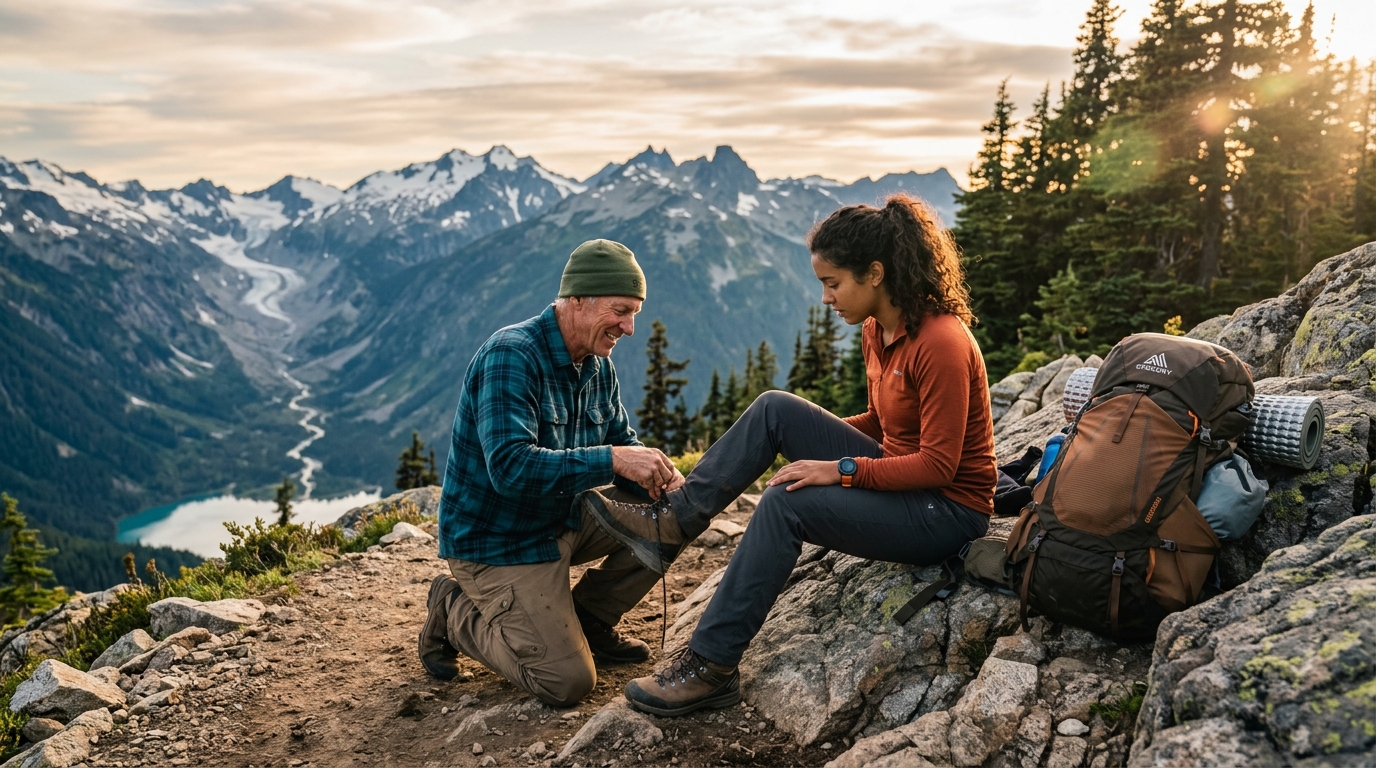
Standard criss-cross lacing doesn't prevent heel lift. Use a heel-lock (also called lace-lock or runner's loop) at the top eyelet: after lacing to the second-from-top eyelet, thread each lace through the top eyelet on the same side to create a loop, then cross the laces and thread each through the opposite loop before tying. This creates a pulley system that cinches the ankle collar down onto your heel without over-tightening the forefoot. Tighten laces in three zones: snug but not tight at the toe box, firm at the midfoot, and very tight at the ankle using the heel-lock. Re-tighten after the first 15 minutes of hiking, as boots and socks compress during initial wear.
The In-Store Fit Test Sequence
Perform these tests in order, with your hiking socks on, in the afternoon (feet swell 3–5% during the day). First, unlace the boot fully, slide your foot forward until your toes touch the front, and check rear clearance—you should fit one index finger (15–18 mm) behind your heel. Second, seat your heel back, lace using a heel-lock, and perform the incline heel-lift test on a ramp or box. Third, walk for 10 minutes on varied terrain if the store allows, or at minimum walk up and down stairs. Your heel should stay planted, your toes should not touch the front on descents, and you should feel no pressure points. Fourth, stand on one foot and flex your ankle through full range of motion—the boot should flex at the ball of the foot, not the midfoot, and the collar should not bite into your Achilles. If the store has a weighted pack, wear 20–30 lbs during the walk test, as load changes foot volume and gait.
Break-In Protocol for New Boots
Even a perfectly sized boot needs gradual adaptation. Wear new boots for 1–2 hours indoors on carpet (so you can return them if fit issues emerge), then progress to 2-mile neighborhood walks on pavement, then 4–6 mile trail walks with 10–15 lbs, then full-distance hikes with your typical load. Apply lubricant (petroleum jelly, anti-chafe balm, or specialized blister prevention tape) to known hot-spot areas (heel, Achilles, ball of foot, pinky toe) during break-in. If you develop a hot spot during a hike, stop immediately and apply tape or moleskin before it blisters—once the skin separates, you're managing an injury, not preventing one. Leather boots benefit from leather conditioner applied after the first 10 miles to accelerate softening.
When to Use Aftermarket Insoles
Stock insoles are minimal 3–4 mm EVA foam with basic arch support. If you have high arches, flat feet, or Morton's toe (second toe longer than big toe), an aftermarket insole with structured arch support and metatarsal padding can eliminate pressure points that cause blisters. Insoles add 2–4 mm of volume, so size boots with your intended insole installed. Heat-moldable insoles (like Superfeet or SOLE) conform to your arch shape and distribute pressure more evenly. If you use orthotics for street shoes, you likely need them in hiking boots—just verify the orthotic's volume doesn't create instep pressure when the boot is laced.
Match the Boot to Your Trip
Different hiking profiles require different fit priorities. Day hikes under 10 miles with under 15 lbs: prioritize comfort and light weight; a trail runner or low-cut hiking shoe with minimal break-in is often better than a boot. Multi-day backpacking with 30–50 lbs: prioritize ankle support and heel lock; a mid-cut or high-cut boot with a stiff midsole prevents the load from driving your foot forward on descents. Off-trail scrambling or talus: prioritize toe protection and a stiff shank; a mountaineering boot or approach shoe with a climbing-zone toe rand prevents stubbing injuries. Winter hiking or snowshoeing: size up an additional half size to accommodate thicker insulation socks and allow for foot swelling in cold (vasoconstriction reduces circulation, causing swelling).
Common Blister Locations and Fit Fixes
Specs
Sizing Differences Across Brands
Hiking boot sizing is not standardized. A US 10 in Salomon runs narrow and low-volume compared to a US 10 in Merrell, which runs wide and high-volume. Scarpa and La Sportiva use European sizing and tend toward narrow, curved lasts suited to Mediterranean foot shapes. Keen and Oboz run wide and straight, fitting North American foot shapes well. Lowa and Hanwag offer multiple width options within each size. Always try your measured size and a half-size up and down, across at least two brands, to find the best volumetric match. Bring a Brannock device measurement (length and width) to the store, but prioritize the fit tests over the number—sizes are labels, not standards.
Field Adjustments During a Hike
Even well-fitted boots can develop hot spots during long hikes as feet swell, socks compress, and gait changes with fatigue. Carry blister prevention supplies: medical tape (cloth or paper tape, not athletic tape, which doesn't breathe), moleskin, and lubricant. At the first sign of heat or rubbing, stop and address it—a hot spot becomes a blister in 15–30 minutes of continued friction. Apply tape directly to the skin over the hot spot, or use moleskin as a padded barrier. Re-tighten laces every 60–90 minutes, especially after breaks when feet swell from rest. On long descents, stop and tighten the heel-lock before starting down to prevent forward foot slide. On ascents, slightly loosen the toe box to allow toe splay and improve circulation.
When to Size Up vs. Add Volume
If your toes touch the front on descents but the heel and midfoot fit well, size up a half size. If your heel lifts but length is correct, don't size down—instead, add heel-grip pads, use thicker socks, or try a different boot model with a narrower heel pocket. If the instep feels tight but length and heel fit well, try a high-volume or wide model in the same length. Sizing up to solve a volume problem creates a length problem; adding volume without changing length solves the actual issue. Some brands offer half sizes only up to size 10 or 11, then jump to full sizes—in those cases, use insole thickness to fine-tune volume within a full-size increment.
The Role of Boot Stiffness in Blister Prevention
Boot stiffness (determined by midsole and shank material) affects how much your foot flexes inside the boot. A very stiff boot (mountaineering or heavy backpacking) limits foot motion, which can prevent blisters if the fit is perfect but causes pressure blisters if fit is slightly off, because your foot can't adapt. A flexible boot (trail runner or light hiker) allows more foot motion, which can cause friction blisters if the fit is loose but accommodates minor fit imperfections better. For blister-prone feet, a moderate stiffness (typical of mid-cut hiking boots with nylon shanks and dual-density EVA midsoles) offers the best balance—enough structure to limit slop, enough flex to accommodate natural foot motion. Test stiffness by flexing the boot with your hands: it should bend at the ball of the foot with firm resistance, not fold in half easily or resist all flexion.
Frequently Asked Questions
+Should hiking boots be tight or loose?
Hiking boots should be snug without being tight. Your heel should not lift more than 5 mm during walking, your toes should not touch the front on descents, and you should feel no pressure points at the instep, ankle bones, or ball of the foot. The boot should feel like a firm handshake around your midfoot—secure but not constricting. If you can slide your foot side-to-side more than 3–4 mm when laced, the boot is too loose. If lacing creates pain or numbness, it's too tight or the wrong volume for your foot shape.
+How much room should be in the toe of a hiking boot?
You need 12–15 mm (roughly a thumb's width) between your longest toe and the boot's interior front when standing with your weight forward and knee bent. This clearance prevents your toes from jamming into the front on descents, which causes black toenails and forefoot blisters. Test this with the boot unlaced, your heel seated back, and your body leaning forward to simulate downhill posture. If you can't fit your index finger behind your heel in this position, the boot is too short. If you can fit two fingers, it's too long.
+Why do my heels slip in hiking boots even when laced tight?
Heel slip indicates the boot's heel pocket is too large for your heel geometry, the boot is too long, or you're not using a heel-lock lacing technique. First, try a heel-lock: thread each lace through the top eyelet on the same side to create a loop, cross the laces, thread through the opposite loops, and pull tight before tying. This cinches the ankle collar onto your heel. If slip persists, add adhesive heel-grip pads to reduce pocket volume, or try a half-size smaller. If sizing down causes toe jamming, the boot's last shape doesn't match your foot—try a different brand with a narrower heel pocket.
+Can I prevent blisters by wearing two pairs of socks?
Double-sock systems (a thin liner under a thicker outer sock) can reduce blisters by creating a sliding interface between the two sock layers instead of at your skin. The liner wicks moisture away from skin, and friction occurs between the socks rather than between sock and skin. However, this adds 1–2 mm of volume, so boots must be sized with both socks worn. If your boots are already snug, adding a liner sock will create pressure points. Double-socking works best for blister-prone heels and Achilles areas; it's less effective for toe blisters, which are usually caused by length or toe-box fit issues.
+How long does it take to break in hiking boots?
Modern synthetic hiking boots require 10–20 miles of break-in. Leather boots need 30–50 miles. Full-grain leather mountaineering boots can require 50–100 miles. Break-in softens materials and allows 2–3% stretch in leather (less in synthetics), but it won't fix fundamental fit problems. If a boot causes hot spots in the first 2 miles of flat walking, it's a sizing or volume issue, not a break-in issue. Gradually increase mileage and load during break-in: start with 1–2 hour indoor wear, then 2-mile walks, then 4–6 mile trail hikes with light packs, then full-distance trips with your typical load.
+Should I size hiking boots differently for winter vs. summer?
Yes. Winter hiking requires thicker insulation socks (typically 5–7 mm compressed thickness vs. 3–4 mm for summer midweight socks), so size up an additional half size beyond your normal hiking boot size. Cold also causes vasoconstriction, which paradoxically makes feet swell slightly, requiring more volume. If you use the same boots year-round, size them for winter socks and use thinner socks or aftermarket insoles to reduce volume in summer. Alternatively, own separate boots: summer boots sized for midweight socks, winter boots sized for expedition-weight socks.
+Do I need wide hiking boots if I have wide feet?
If you wear wide-width street shoes (D width for women, EE width for men), you likely need wide hiking boots. However, boot 'width' actually refers to volume—wide boots are broader at the ball of the foot (typically 6–8 mm wider than standard) and often have higher insteps. Try both standard and wide in your measured length. Signs you need wide: the boot feels tight across the ball of the foot even when unlaced, lacing creates pressure at the instep before your heel locks, or you get blisters on the lateral (outer) midfoot or pinky toe area. Some brands (Keen, Oboz, Altra) run wide in their standard models, so you may not need a designated wide size.
+What's the difference between hiking boot fit and running shoe fit?
Hiking boots require more heel lock and less toe room than running shoes. Running shoes are sized with 15–20 mm of toe clearance to allow for foot expansion during repetitive impact; hiking boots need only 12–15 mm because the motion is less dynamic. Hiking boots must prevent any heel lift to avoid blisters on uneven terrain and descents, while running shoes allow minimal heel slip (2–3 mm) because the stride is consistent. Hiking boots are sized with thick socks; running shoes with thin socks. Expect to wear a half to full size larger in hiking boots compared to running shoes, but prioritize the fit tests over size number translation.