Buying guide
How to Pick a Camping Stove: Canister vs Liquid vs Alcohol
Disclosure: Four Seasons Gear is reader-supported. When you buy through links on our site, we may earn an affiliate commission at no extra cost to you. Prices and availability are accurate as of the time we last checked.
What You're Really Deciding
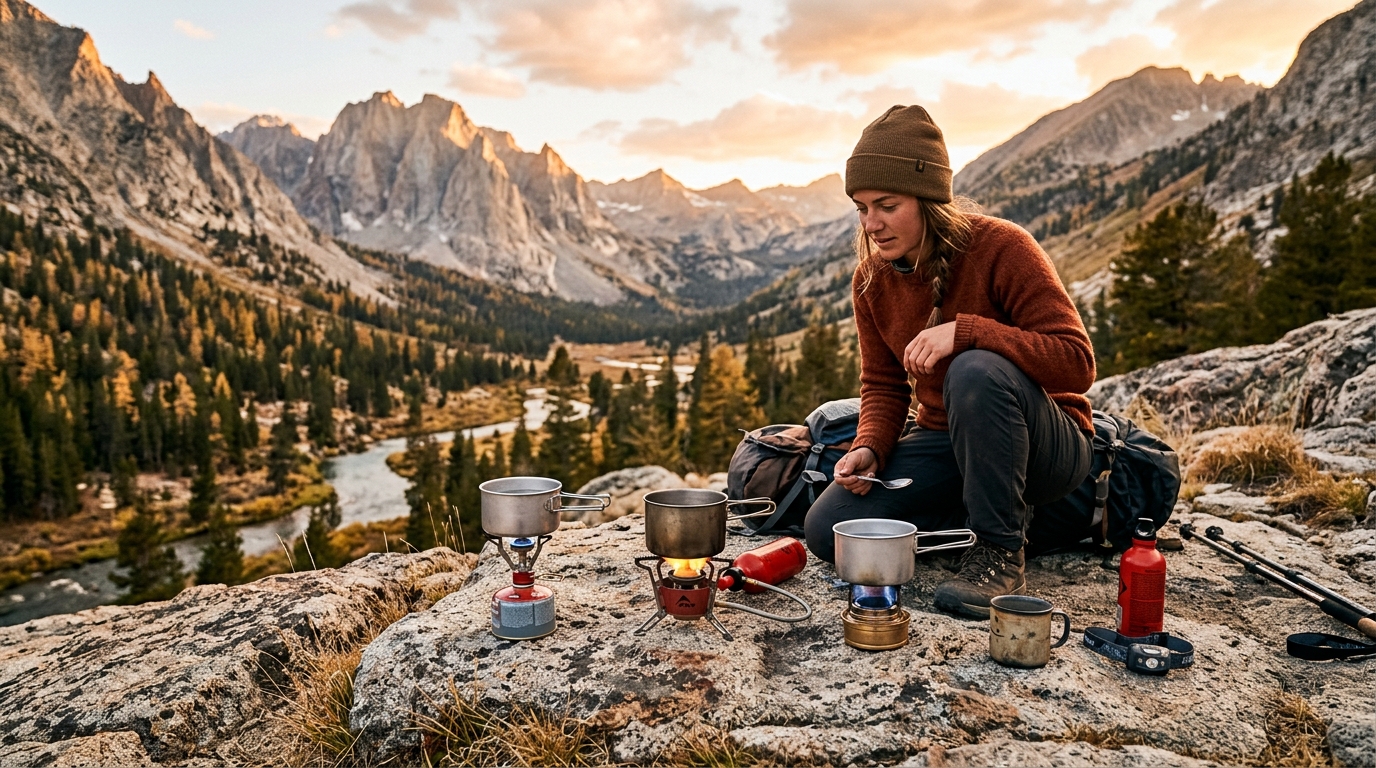
The camping stove market splits into three fuel systems, each optimized for different constraints. Canister stoves prioritize convenience and simmer control. Liquid-fuel stoves prioritize cold-weather reliability and international fuel availability. Alcohol stoves prioritize weight savings and simplicity. You cannot optimize for all three simultaneously—understanding which two matter most for your typical trips determines the right choice.
Fuel Type: The Foundation Decision
Fuel type dictates stove design, weight, cost per boil, and operational temperature range. This is not a preference—it's a technical constraint that cascades through every other specification.
Specs
Canister stoves dominate the backpacking market because they require zero priming, offer instant flame adjustment, and pack smaller than liquid-fuel systems. The fuel itself is the limitation: canisters cannot be refilled, performance drops below 30°F as internal pressure decreases, and they're unavailable in many international destinations. A 110g canister provides approximately 60 minutes of burn time at full output, translating to 10-12 boil cycles for a solo user.
Liquid-fuel stoves burn white gas (Coleman fuel), kerosene, or unleaded gasoline depending on the model. They require manual pressurization and priming—a 45-second procedure where you pump the fuel bottle to build pressure, then burn a small amount of fuel in a priming cup to vaporize the fuel line. This complexity buys you three advantages: refillable fuel bottles eliminate canister waste, performance remains consistent at any temperature, and fuel is available globally. White gas provides approximately 90 minutes of burn time per 16 oz, or 18-20 boil cycles.
Alcohol stoves are the minimalist's choice. They're passive devices—essentially a reservoir with vent holes—weighing 0.3 to 1.5 oz. Denatured alcohol is available at hardware stores, burns cleanly, and costs $8-12 per quart. The tradeoff is heat output: alcohol produces roughly half the BTUs of canister fuel, extending boil times from 3 minutes to 6-8 minutes per liter. There is no flame control; you light it, it burns until the fuel is consumed. This makes alcohol stoves suitable for boil-only cooking, not sautéing or simmering.
Stove Weight vs System Weight
Stove weight is a misleading metric. What matters is total system weight: stove body, fuel for your trip duration, fuel container, pot stand (if separate), and windscreen. A 2.6 oz canister stove paired with a 110g canister totals 8.5 oz. A 0.5 oz alcohol stove with 6 oz of fuel, a 0.8 oz titanium stand, and a 1.2 oz windscreen totals 8.5 oz. The systems converge.
Specs
Liquid-fuel systems start heavier but become competitive on expeditions exceeding 10 days. A 30 oz fuel bottle provides 40+ boil cycles, eliminating the need to carry multiple canisters. For a 14-day trip, a canister user carries three 230g canisters (total fuel weight: 24 oz) while a liquid-fuel user carries 20 oz of white gas. The liquid-fuel stove's 10 oz weight penalty is offset by 4 oz of fuel savings, and the gap widens with trip length.
Boil Time and Heat Output
Heat output is measured in BTUs per hour, but the useful metric is time-to-boil for one liter of water. This accounts for burner efficiency, pot coupling, and real-world wind conditions. Manufacturer claims assume no wind and a perfectly matched pot—subtract 30-40% for field performance.
Specs
Higher BTU output matters most in cold weather and at altitude, where water's boiling point drops but heat loss to the environment increases. A 10,000 BTU canister stove maintains 4-minute boil times at 10,000 feet and 40°F. An 8,000 BTU alcohol stove extends to 12-14 minutes under the same conditions. For alpine or winter use, BTU output below 9,000 becomes a practical limitation.
Integrated canister systems (where the pot locks directly onto the burner with a heat exchanger) improve efficiency by 30-40%, reducing boil times to 2-2.5 minutes per liter and cutting fuel consumption proportionally. This design sacrifices versatility—you cannot use your own cookware—but for boil-only users, the fuel savings compound over a season.
Cold-Weather Performance
Temperature performance is not linear. Canister stoves experience a performance cliff below 20°F as the fuel blend's vapor pressure drops. Liquid-fuel and alcohol stoves maintain output until the fuel itself freezes—white gas to -40°F, alcohol to approximately 5°F (though burn efficiency degrades below 32°F).
- Canister stoves: Use inverted-canister models or remote-canister designs with a preheat loop for winter use. Standard upright canisters become unreliable below 30°F.
- Liquid-fuel stoves: Require no modifications for cold weather. Priming may take an extra 10-15 seconds in subzero temperatures.
- Alcohol stoves: Require preheating the fuel reservoir in cold conditions. Performance degrades measurably below 32°F; not recommended for winter camping.
Inverted-canister stoves draw liquid fuel rather than vapor, maintaining pressure in cold conditions. This requires a stove designed for inverted use—standard canister stoves will flare dangerously if inverted. Remote-canister designs place the fuel canister away from the burner, connected by a fuel line, allowing you to insulate or warm the canister independently.
Simmer Control and Cooking Versatility
Simmer control is the ability to reduce flame output to 20-30% of maximum without the flame extinguishing. This matters if you cook meals beyond boiling water—rice, sauces, or dehydrated meals that require low heat to avoid scorching.
Specs
If your cooking involves only boiling water for freeze-dried meals or coffee, simmer control is irrelevant. If you cook fresh food or need to keep water at a sub-boil temperature, canister stoves are the clear choice. Liquid-fuel stoves offer workable simmer on newer models with refined valve designs, but they cannot match the precision of a canister stove's needle valve.
Maintenance and Field Reliability
Canister stoves have no user-serviceable parts. They either work or they don't. Failures are rare—typically a clogged jet from debris in the fuel, which occurs in fewer than 1% of units over their lifetime. You cannot repair a canister stove in the field.
Liquid-fuel stoves require maintenance every 20-30 hours of burn time: cleaning the fuel jet, replacing the pump leather or O-rings, and clearing the fuel line. This is a 10-minute procedure with the included maintenance kit. The tradeoff for this complexity is field repairability. If a jet clogs on day 4 of a 10-day trip, you can disassemble and clear it. Liquid-fuel stoves are the only system where user maintenance extends lifespan and restores performance.
Alcohol stoves are inert devices with no moving parts. They cannot fail mechanically. The only maintenance is rinsing out residue every 30-40 burns. Reliability is absolute, but performance is fixed—an alcohol stove will not boil water faster on day 100 than on day 1.
Fuel Cost and Availability
Specs
Fuel cost matters most for frequent users. A backpacker cooking 100 meals per season spends $50-65 on canister fuel, $30-40 on white gas, or $25-35 on alcohol. Over a decade, the difference funds a new stove. For international travel, liquid fuel and alcohol are the pragmatic choices—canister fuel is unavailable or prohibitively expensive in much of the developing world.
Match the Stove to Your Trip Type
The right stove depends on trip duration, season, destination, and cooking style. Use this decision tree to narrow your options:
- Weekend backpacking, 3-season, boil-only cooking → Canister stove (upright design, 7,000-10,000 BTU)
- Weekend backpacking, ultralight priority, boil-only → Alcohol stove (0.5-1 oz burner, titanium pot stand)
- Week-long trips, 3-season, varied cooking → Canister stove with good simmer control (adjustable valve, 8,000+ BTU)
- Winter camping or alpine mountaineering → Liquid-fuel stove or inverted-canister stove (10,000+ BTU, cold-rated)
- International travel, developing regions → Liquid-fuel stove (multi-fuel capability preferred) or alcohol stove
- Expeditions over 10 days → Liquid-fuel stove (refillable bottles, field-repairable)
- Car camping or base camp cooking → Liquid-fuel stove or dual-burner canister stove (heat output and simmer control prioritized over weight)
If your trips span multiple categories, own two stoves. A 3 oz canister stove for summer weekend trips and a 15 oz liquid-fuel stove for winter or international travel costs less than $200 combined and covers 95% of use cases. Trying to find one stove that does everything means compromising on every trip.
Integrated Systems vs Modular Stoves
Integrated systems lock the pot to the burner, using a heat exchanger to capture waste heat. This design improves fuel efficiency by 30-40% and reduces boil times by 20-30%. The cost is versatility: you cannot use your own cookware, and the pot capacity is fixed (typically 0.8 to 1.8 liters). For solo users or pairs who only boil water, integrated systems save 20-30% on fuel weight over a week-long trip.
Modular stoves separate the burner from the cookware, allowing you to use any pot. This matters if you cook for groups (requiring larger pots), if you simmer or sauté (requiring wider pots for even heating), or if you already own cookware and don't want to replace it. Modular designs sacrifice 5-10% fuel efficiency but gain flexibility.
Wind Resistance and Stability
Wind is the primary cause of slow boil times and excessive fuel consumption. A 10 mph wind can double boil time by carrying heat away from the pot. Windscreens are essential for alcohol stoves and helpful for canister stoves. Liquid-fuel stoves often include integrated wind protection in the burner design.
- Canister stoves: Use a separate windscreen positioned 2-3 inches from the burner. Do not fully enclose the canister—trapped heat can cause dangerous pressure buildup.
- Liquid-fuel stoves: Many models include a built-in windscreen or pot supports that block wind. Additional windscreens provide marginal benefit.
- Alcohol stoves: Require a windscreen for any wind above 5 mph. A 360-degree aluminum or titanium windscreen weighing 1-2 oz is standard.
Stability is determined by the pot support design and the stove's footprint. Canister stoves with low, wide pot supports are more stable than tall, narrow designs. Liquid-fuel stoves with a separate fuel bottle and three-leg pot supports offer the most stability, especially on uneven ground. Alcohol stoves require a separate pot stand, typically a titanium tripod or cross-brace design—test stability with a full pot before committing to a design.
Safety Considerations
All stove types are safe when used correctly. Accidents occur from user error, not equipment failure. The most common mistakes are operating stoves inside tents (carbon monoxide poisoning and fire risk), refueling hot stoves (flare-ups), and using damaged fuel canisters (leaks and pressure failures).
- Never operate any stove inside a tent or enclosed shelter. Carbon monoxide is odorless and lethal. Cook in a vestibule with full ventilation or outside.
- Allow stoves to cool for 5 minutes before refueling or disconnecting fuel sources.
- Inspect canister threads and seals before each use. Discard canisters with dents, rust, or damaged threads.
- Liquid-fuel stoves: Ensure the fuel cap is tight and the pump is fully seated before pressurizing. Leaking fuel during priming causes flare-ups.
- Alcohol stoves: Never add fuel to a burning or hot stove. Alcohol vapor is invisible in daylight and can ignite unexpectedly.
Environmental Impact
Canister waste is the primary environmental concern. A 110g canister is single-use and made of steel or aluminum. Recycling requires full depressurization, which most users skip, sending canisters to landfills. Some manufacturers offer canister recycling programs, but participation is low. A backpacker using 15 canisters per year generates 1.5 pounds of metal waste annually.
Liquid-fuel systems eliminate disposable containers—one fuel bottle lasts decades. White gas burns cleaner than kerosene or gasoline, producing minimal soot. Alcohol also burns cleanly, leaving no residue, and is biodegradable if spilled. For users prioritizing waste reduction, liquid-fuel or alcohol systems are the clear choice.
+Can I use a canister stove in winter?
Standard upright canister stoves become unreliable below 30°F as the fuel's vapor pressure drops. For winter use, choose an inverted-canister stove (which draws liquid fuel) or a remote-canister design (which allows you to insulate the canister separately from the burner). Alternatively, keep the canister warm in your sleeping bag before use and insulate it during cooking. Liquid-fuel stoves are the more reliable winter choice.
+How long does a fuel canister last?
A 110g canister provides approximately 60 minutes of burn time at full output, translating to 10-12 boil cycles for one liter of water. Actual duration depends on altitude, temperature, wind, and whether you're simmering or boiling. For a solo user boiling water twice daily (morning coffee, evening meal), a 110g canister lasts 5-6 days. A 230g canister lasts 10-12 days under the same conditions.
+Are alcohol stoves legal in fire-restricted areas?
Regulations vary by jurisdiction. In the United States, most national forests and parks allow alcohol stoves if they have an on/off valve or can be extinguished immediately. Open-flame alcohol stoves without a shutoff mechanism are often prohibited during fire restrictions. Always check local regulations before your trip. Canister and liquid-fuel stoves with adjustable valves are universally permitted in areas allowing stoves.
+Do I need a different stove for high altitude?
No, but altitude affects performance. Water boils at lower temperatures as elevation increases (203°F at 10,000 feet vs 212°F at sea level), which slightly reduces boil times. However, thinner air provides less oxygen, reducing burner efficiency by 10-15% above 10,000 feet. High-BTU stoves (9,000+) compensate for this loss. Canister stoves lose additional performance at altitude if temperatures are cold, as the double stress of low pressure and low temperature reduces fuel vaporization. Liquid-fuel stoves maintain consistent output at any altitude.
+Can I use automotive gasoline in a liquid-fuel stove?
Some liquid-fuel stoves are rated for unleaded gasoline, but it's a compromise fuel. Gasoline contains additives that leave residue in the fuel line and jet, requiring more frequent cleaning (every 10-15 hours vs 30 hours for white gas). Gasoline also produces more soot and odor. Use gasoline only when white gas or kerosene is unavailable, and plan to clean the stove thoroughly after the trip. Never use gasoline in a stove not explicitly rated for it—fuel system components may not be compatible.
+What's the best stove for a beginner?
A basic upright canister stove is the best starting point. It requires no priming, no maintenance, and no technique beyond turning a valve. Boil times are fast, simmer control is intuitive, and the total system weight is competitive with more complex options for trips under a week. Once you understand your typical trip profiles—duration, season, destination—you can add a second stove optimized for specific conditions. Starting with a canister stove gives you immediate capability while you learn what you actually need.